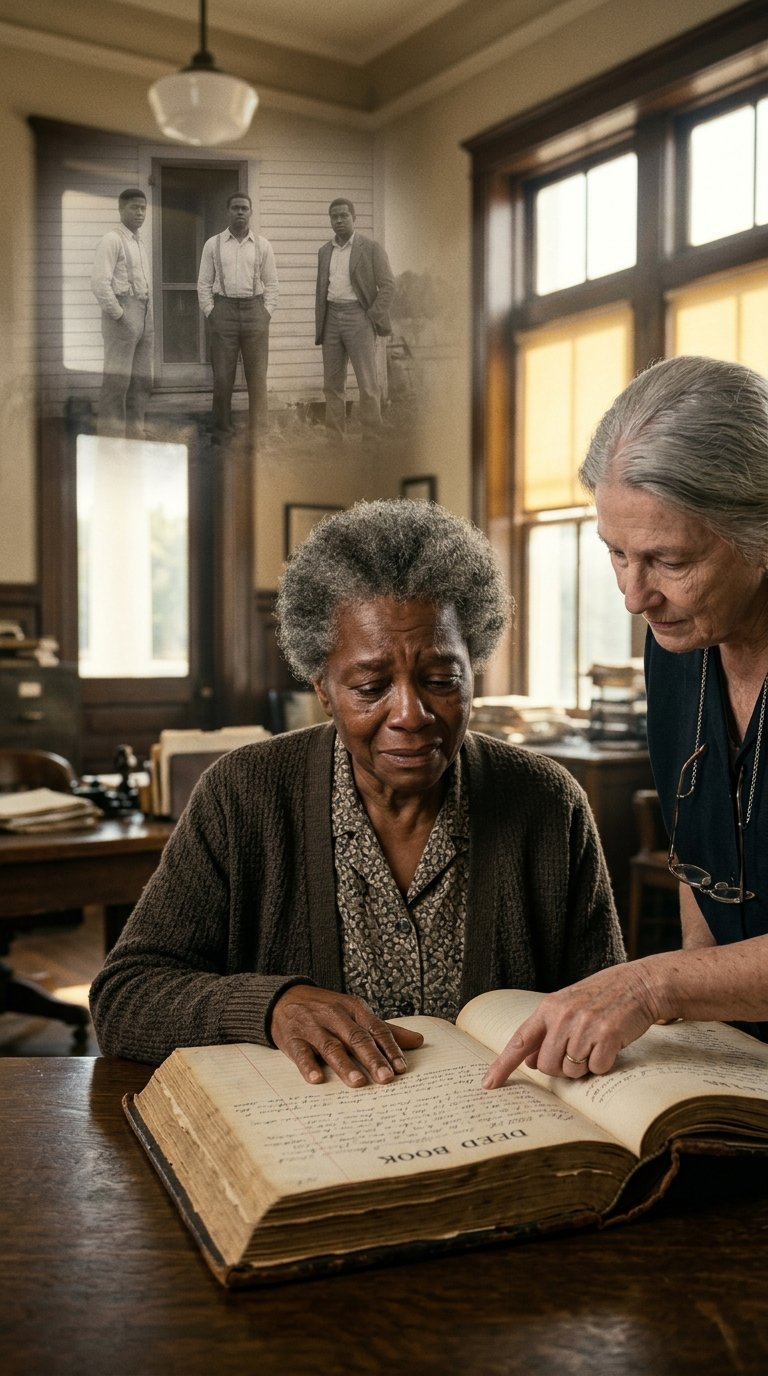
I put on my reading glasses with fingers that wouldn’t hold still. The handwriting in the book was old-fashioned and slanted, but the first name on the line I knew as well as my own.
Henrietta Mae Lockridge, grantor, conveys to Elnora Ruthanne Whitsett, grantee, in fee simple, the tenant house and forty acres lying along the pike, including the pecan grove, the pond, and the lane.
I read it twice. Then I read the date.
“Rosella,” I said, “this was recorded eleven years ago.”
“Eleven years in March,” she said gently. “Henrietta came in herself, in her good blue hat. She had her attorney with her, and she paid the recording fee in cash. She said, ‘Rosella, I don’t want a soul to know until I’m gone. Not the boys, not even Elnora. If Elnora knew, she’d refuse it.'”
I laughed, and it came out a sob. “She was right.”
“There’s more,” Rosella said, and turned the page.
On the facing page was a second recorded instrument, a life estate and trust agreement. Mrs. Lockridge had set aside a sum of money in a trust at the Farmers & Merchants Bank, and the trustee was ordered to pay the property taxes and insurance on my forty acres for as long as I lived. After that, any money left would go to my daughter.
At the bottom was a notation in the margin, typed by the clerk: Grantor’s note: “For twenty-six years of Fridays.”
I had to sit down. Rosella pulled a chair under me before my knees gave out.
“The tenant house,” I whispered. “My mama’s porch.”
“It’s yours, honey. It’s been yours since before Carlton ever slid that check through the door.”
“But they don’t know.”
“They know now, or they will by Monday,” Rosella said, and her mouth twitched like she was holding back something mischievous. “Henrietta’s attorney is Mr. Abernathy Pruitt, over on Church Street. She left him instructions. He was to call the boys in after the funeral and read them her will. I think they’ve been sitting on their hands for a week waiting for the appointment, because Carlton’s been telling folks the farm is all settled.”
I drove straight to Mr. Pruitt’s office, still in my good dress, and he was waiting with the door open. He was a thin man with white hair and a bow tie, and he looked at me like he’d been expecting a ghost.
“Mrs. Whitsett. Please. Sit.”
He showed me everything. Mrs. Lockridge’s will was in a folder, and it was plain as day. The big house and the remaining four hundred acres went to her three sons in equal shares, with one condition. Each son would receive his inheritance only if he signed an acknowledgment that the forty acres and the tenant house belonged to me and would not be contested. If any son refused, his share would pass instead to the county’s agricultural extension fund and a scholarship in her late husband’s name.
“She knew them,” Mr. Pruitt said, almost to himself. “She said Carlton would be the hardest, because he’d convinced himself he was the good one.”
I felt my face crumple. I had been so ashamed that week. I’d called myself a fool a hundred times for crying over three hundred dollars.
“The reading is Monday at ten,” he said. “She wanted you there. I tried calling the week of the funeral, but your phone was going to a machine, and then Rosella said she’d handle it.”
“I was ashamed to answer,” I said. “I thought it was bill collectors.”
He smiled kindly. “Mrs. Whitsett, I think it’s the opposite.”
On Monday morning, I wore my good dress again and drove my old Buick to Church Street. Carlton, Thurston, and Bertram were already in the conference room, sitting up straight with their hands folded like boys in the principal’s office. When I walked in, Carlton’s face went through three colors.
“What’s she doing here?” Thurston demanded. “This is a family matter.”
“Sit down, gentlemen,” Mr. Pruitt said.
He read the will aloud, every word. When he reached the part about the forty acres, the room got so quiet I could hear the clock.
“That’s the tenant place,” Bertram said slowly. “That’s ours. The whole farm is ours.”
“It was deeded to Mrs. Whitsett eleven years ago,” Mr. Pruitt said. “It’s recorded. It was never part of the estate.”
“She was senile!” Thurston shouted.
“She was ninety-four and sharper than any of us in this room,” Mr. Pruitt said, “and she was eighty-three when she signed, with two physicians’ letters attesting to her competence. I have them here. You’re welcome to challenge it, of course. But if you do, the will says your shares go to the scholarship fund instead.”
Thurston’s mouth worked, but no words came.
Carlton hadn’t moved. He was looking at me across the table, and for the first time in twenty-six years he really looked, and I watched his face change.
“Elnora,” he said, in a small voice. “The check. The back door. I…”
“You told me you wouldn’t be needing me,” I said. I wasn’t angry, not anymore. I was only tired, and a little sad for him. “I cleaned your mother’s house with love, Carlton. I’d have done anything for her. You didn’t have to be cruel to me to get what was yours.”
“I was grieving,” he said. “I was stupid. I was…”
“You were all three. I know.” I folded my hands in my lap. “I’m not going to fight you. Sign what your mama asked you to sign. Take what she left you. And go home and call your own children on Sundays, the way you used to call her.”
He was crying by then. He signed first.
Thurston and Bertram signed after, grumbling, and neither of them could look at me.
I moved back into the little white house that winter. My granddaughter Marigold helped me paint the porch, and Alfreda came with groceries and cried and apologized for what she’d said. I forgave her, because she was frightened too. Mama’s porch swing still hung where it always had, and in the evenings I’d sit out there with a biscuit and a cup of coffee, looking at the pecan grove.
The trust paid the taxes. My Social Security covered the rest. And on the second Friday of every month, Carlton Lockridge’s truck came rolling up the lane. He’d sit down on the steps with his hat in his hands and say, “Elnora, I’d sure like some coffee, if you’ve got it.”
I always did.
Some Fridays we talked about his mother, and some Fridays we didn’t talk at all.
The dirt could wait, just as she’d always said.