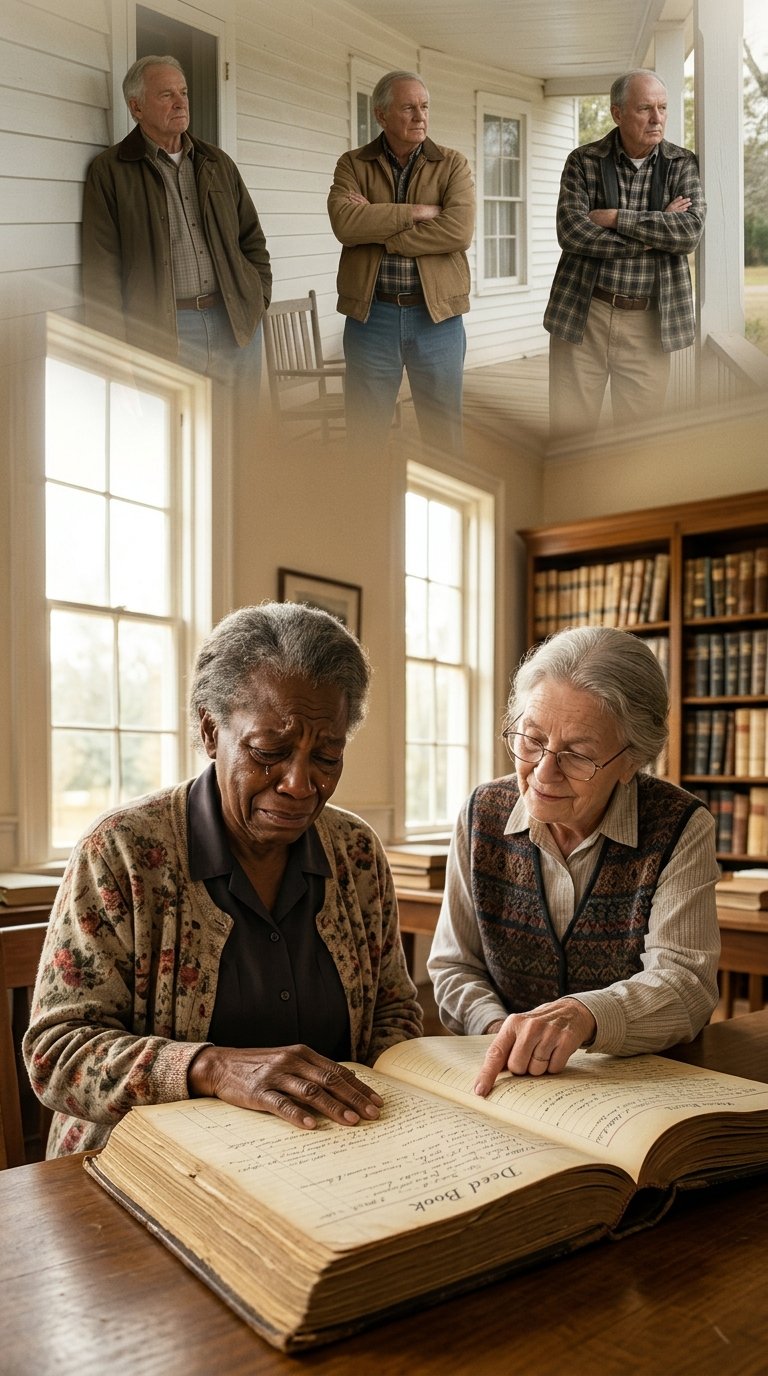
I put on my reading glasses with fingers that wouldn’t stay still. The ink was faded, but the handwriting was a lawyer’s careful hand, and the name on that line was mine.
Henrietta Mae Lockridge, grantor, to Elnora Ruthanne Whitsett, grantee: the tenant house at the end of the lane, together with sixty acres, the pecan grove, the pond, and all water rights, to have and to hold in fee simple, forever.
“Fee simple,” I said. “Rosella, what does that mean?”
“It means it’s yours, honey. Not a loan, not a lease. Yours, and nobody can take it back.” She tapped the margin. “Look at the date.”
I looked. It had been recorded fourteen years ago.
“Fourteen years?” My voice cracked. “I’ve been paying her no rent for fourteen years. I thought she was just being kind.”
“She was being kind. She was also being smart.” Rosella smiled. “She told me she didn’t want you to know while she lived, because you’d have refused it, or worse, you’d have felt you had to stop working for her. She said, ‘Elnora would scrub my floors out of love, but she’d never take a gift she hadn’t earned.'”
I sat down hard in the chair she pulled over. My mama had died in that little white house. I had learned to walk on that porch. And all along it had been mine.
“There’s more,” Rosella said, and she slid a sealed envelope across the table. “She left this with me, to give you after the funeral. It’s addressed in her hand.”
I opened it slowly. The paper smelled faintly of lavender, the way her kitchen always did on Fridays.
Dear Elnora,
If you’re reading this, I’ve gone on, and my boys have probably behaved the way I feared. Don’t be too hard on them. Grief makes some people small, and money makes them smaller.
Twenty-six years ago you walked into my kitchen with a mop and a bucket, and you stayed for coffee when you didn’t have to. You sat with me when Walter died. You sat with me when the boys didn’t call. You never once asked me for a thing, and that is exactly why I’m giving you everything I’m able to.
The house and land are yours already. I’ve also set aside a trust at the Farmers & Merchants Bank, enough to pay the taxes and the upkeep and a monthly sum for as long as you live. Mr. Pruitt will explain. Don’t argue with him. I’ve already won this argument.
You told me once the dirt will wait. I told you I wouldn’t. I was right, and I’m sorry I didn’t wait longer for you.
With all my love, and with no mop,
Henrietta
I laughed and cried at the same time, and Rosella handed me three tissues without a word.
Mr. Abernathy Pruitt’s office was on Church Street, above the hardware store. He was a thin, white-haired man in a bow tie who rose when I walked in, as if I were somebody important.
“Mrs. Whitsett. Please. Sit.”
He laid it all out in plain English. The trust held $186,000, with a monthly payment of $1,400 that would continue for life. After I was gone, the remainder would pass to my daughter, Alfreda. Henrietta had also named me in her will, though that was a separate matter.
“What separate matter?” I asked.
“The reading is Monday at ten. She asked that you attend.” He cleared his throat. “She left the main house and the remaining four hundred acres to her three sons in equal shares, on one condition. Each must sign an acknowledgment that your property is yours, free of any claim, and that you’ve been treated with respect. Any son who refuses forfeits his share to the county scholarship fund.”
I stared at him. “She wrote that?”
“She dictated it twice, to be sure.” His mouth twitched. “She said, ‘Abernathy, put it in language even Thurston can understand.'”
On Monday morning, I wore my good dress again and drove my twelve-year-old Buick to Church Street. I parked between two shiny trucks that I knew belonged to Henrietta’s sons.
They were already in the conference room, sitting stiffly around the long table. Carlton saw me first. His face went white, then red.
“What is she doing here?” Thurston demanded. “This is a family matter.”
“Sit down, gentlemen,” Mr. Pruitt said, “and listen.”
He read the will aloud. When he reached the part about the tenant house, you could have heard a pin drop on that carpet.
“That’s our land,” Bertram sputtered. “That’s part of the farm.”
“It was deeded to Mrs. Whitsett fourteen years ago,” said Mr. Pruitt. “It was never part of the estate.”
“She was old! She was confused!”
“She was eighty years old and signed with two physicians’ letters attesting to her sound mind. I have them in this folder. You are welcome to contest it, but I’d advise you to read the next page first.”
He read the condition. Thurston swore. Bertram went pale. Carlton didn’t say a word. He was looking at me across the table.
Finally he spoke, and his voice was small. “Elnora, the check. The back door. I…”
“You told me you wouldn’t be needing me,” I said. I wasn’t angry anymore. I had cried that out in my Buick. “I cleaned your mother’s house for twenty-six years, Carlton. I held her hand when she was frightened. I would have done it for nothing.”
“I know.” His eyes were wet. “I was grieving, and I was ashamed. I thought you’d always be there, so I never thanked you.”
“Thanks would’ve been nice,” I said. “A kind word at the door would’ve been nicer.”
He lowered his head.
I looked at all three of them, these boys I’d watched grow gray, and I felt something I hadn’t expected. I felt sorry for them. Their mother had given them a test, and one by one they were failing it, except that she had left them one last chance to pass.
“Sign it,” I told them. “Take what your mama left you. I won’t fight over a single board.”
Carlton signed first. Bertram signed, grumbling. Thurston held out the longest, but in the end he signed too.
That winter, I moved back into the tenant house. My granddaughter Marigold painted the porch swing, and Alfreda came with groceries and apologies, and I forgave her over a cup of coffee. The pecan grove dropped its nuts in October, and I gathered a bushel by hand, the way Mama used to.
On the second Friday of December, a pickup truck rolled up my lane. Carlton climbed out, took off his hat, and stood at the bottom of the steps.
“Elnora,” he said, “I’d be honored if I could sit with you a while. For coffee. If you have any.”
I had a pot already going.
We sat on the porch, with biscuits between us and the pond glittering in the cold light. He talked about his mother, and I talked about mine, and somewhere in the middle of it he laughed, really laughed, for the first time since the funeral.
Every second Friday after that, he came back.
The dirt could wait, just as Henrietta always said.