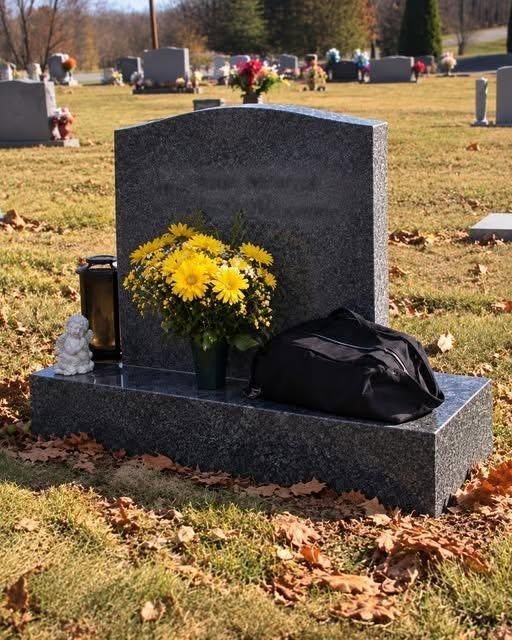
I knelt in the damp grass, staring at what was inside.
On top lay a man’s brown leather jacket, folded carefully. I knew it before I touched it. It was Paul’s. He had been wearing it the night of the accident, and the hospital had told me it was lost with the rest of his belongings.
Beneath it sat a wallet, his watch, a cracked phone, and a thick envelope with my name on it in handwriting I didn’t recognize.
My hands shook so badly that I nearly tore the paper.
Dear Megan,
You don’t know me. My name is Thomas Reyes. Five years ago, I was the driver of the truck that struck your husband’s car on Highway 41.
I stopped reading. The cemetery tilted around me. I pressed my palm flat against Paul’s headstone, cold and solid under my hand, and made myself keep going.
I have carried this for five years, and I can’t carry it anymore. I’m dying. The doctors give me a few months. Before I go, I need you to know the truth, because I believe you were told something that wasn’t complete.
It was raining. Paul’s car had stalled in the right lane after a tire blew out. He had his hazards on. I was exhausted, coming off a double shift, and I looked down at my phone for two seconds. That was all it took. I never braked in time.
I stopped. I got out. Paul was still conscious for a few minutes. I held his hand until the ambulance came. He asked me to call you. He gave me your name and said, “Tell Megan I’m sorry I’ll be late for dinner.”
I made a sound I didn’t recognize. Dinner. We had planned lasagna. He had texted me an hour earlier: Running a little behind, save me a plate.
I was too much of a coward to call. The police report listed the accident as weather-related, and my employer’s insurance handled everything. I let it stay that way. Every day since, I have regretted it.
His things were in my truck. In the chaos, a paramedic handed me his jacket to keep him warm, and afterward I wasn’t allowed to return it without admitting who I was. I kept it. I’ve kept everything. I’m sorry.
I sat back on my heels and wept, in the quiet cemetery with the sun coming up over the hills, holding the jacket against my chest. It still smelled faintly of cedar and coffee. Or maybe I imagined it. I didn’t care.
When I could breathe again, I read the last page.
I don’t ask forgiveness. I only ask that you let me say it to your face, if you can bear to. I am at St. Brendan’s Hospice on Alder Street, room 14. If you never come, I’ll understand. Whatever you decide, the envelope in the bottom of the bag is yours.
At the bottom of the bag was a second, smaller envelope. Inside was a cashier’s check for $60,000 and a note: Everything I have. It will never be enough.
I didn’t move for a long time. A cemetery worker eventually came down the path, saw me, and quietly offered to sit with me. I told him I was all right, and he nodded and stayed anyway, a respectful distance away, until I stood.
I called my sister from the car. I couldn’t get the words out, so I just said, “Can you come?”
She arrived in twenty minutes. I handed her the letter, and she read it with her hand over her mouth.
“You don’t have to go,” she said finally. “You don’t owe him anything.”
“I know.”
“Do you want to?”
I looked out the windshield at the gate, where the workers were pressure-washing the old iron bars. For five years, I had wondered about those last minutes, whether Paul was afraid, whether he was alone. I had imagined the worst, over and over.
“I think I need to,” I said. “Not for him. For me. For Paul.”
The next afternoon, I walked into room 14 at St. Brendan’s, with my sister waiting in the hall.
Thomas Reyes was a small, gray man, hollowed out by illness, propped on pillows by the window. He looked sixty but was only forty-eight. When he saw me, he tried to sit up and couldn’t.
“Mrs. Hale,” he whispered. “You came.”
“Don’t get up.”
I pulled a chair beside the bed. For a long moment, neither of us spoke. I had rehearsed a hundred angry speeches, and not one of them survived the sight of him.
“Tell me about his last minutes,” I said. “All of it.”
He did. He told me how Paul stayed calm, how he asked whether the other driver was hurt before he asked about himself. He told me Paul talked about me, about the yellow flowers on the kitchen table and the lasagna and the vacation we hadn’t taken yet to Portugal. He told me Paul’s last clear words were, Make sure she knows I wasn’t scared.
“Was he?” I asked. “Scared?”
“No, ma’am,” Thomas said, tears sliding into his collar. “Not for a second. He was thinking about you.”
I let myself cry then, without hiding it. He cried too. Two strangers, bound by the worst night of my life, grieving the same man in a sterile room that smelled of antiseptic and lilies.
“I’m not going to tell you it’s all right,” I said at last. “It isn’t. You looked at your phone, and my husband died, and I lost five years of what we should have had.”
“I know.”
“But I’m not going to let that be the end of you, either.” I took a breath, and the words surprised me with how true they felt. “You stayed with him. You held his hand. He wasn’t alone. That’s the thing I’ve been afraid of for five years, and you gave it back to me. Thank you.”
He covered his face with his thin hands and sobbed.
“I forgive you, Thomas,” I said. “Not because it erases anything. Because I’m tired of carrying it, and so are you.”
I visited every Sunday for the next seven weeks. Sometimes we talked about Paul, and sometimes we just sat in silence while the afternoon light moved across the blanket. He told me about his estranged daughter, whom he hadn’t spoken to in years. I helped him find her number, and she came, finally, three days before the end.
He passed on a Wednesday in March, with her beside him.
I did not keep the $60,000. I donated it, in Paul’s name, to a highway safety foundation that funds distracted-driving education in high schools. The first program launched that fall, and a banner in the gym reads Two Seconds Can Last Forever. I attended the assembly. A boy in the front row put his phone away, and I watched him do it.
Paul’s jacket hangs in my closet now. Some mornings I put it on and drink my coffee in it.
The next year, my sister drove me to the cemetery. I brought yellow flowers, and a second bouquet beside them, white, for a man I had once hated and finally understood.
I set both down and sat in the grass.
“He’s with you now,” I said aloud. “Be kind to each other.”
A breeze moved through the trees, soft and warm, and for the first time in six years, it felt like an answer.