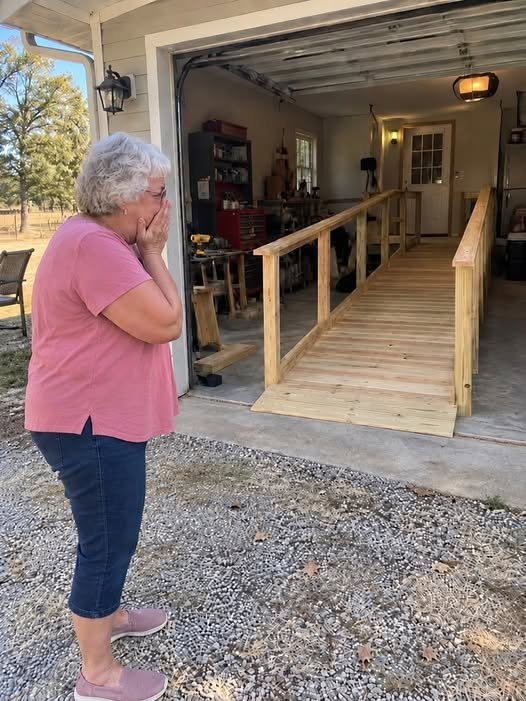
I stood at the foot of that ramp for a long time, one hand on the rail, the pine smell sharp in my nose.
Wheelchair. I had joked about it once, over supper, and Wendell hadn’t laughed.
“Winnie?”
He stood in the garage doorway with a paintbrush in one hand and sawdust in his gray hair. His face went from startled to something close to heartbreak.
“I told you Christmas,” he said quietly.
“You did.” My voice wobbled. “Wendell, what is all this?”
He set the brush on a paint can and wiped his hands on his jeans. “Come inside. Please. I’d planned to do this right, with flowers and a clean shirt. But I suppose you found me out.”
He opened the door, and I stepped into the kitchen.
It was buttercup yellow.
Every wall, fresh and warm, the exact shade I had described to him months earlier, my childhood kitchen in Waxahachie, with Mama’s curtains and the smell of cornbread. Someone had hung a gingham valance. The countertops had been lowered, I realized slowly, to a height a person could reach from a seated position. There was a roll-in shower down the hall, with a bench and grab bars. The doorways had been widened. A reading chair sat beside a window that looked out on the pecan tree, with a small brown recliner cushion tied to it.
“The recliner’s Dwight’s,” Wendell said gently. “I couldn’t take it, of course. But I measured it that Sunday while you were in the kitchen, and I built one just like it. I thought you might want something familiar.”
I put my hand over my mouth.
“I’m not in a wheelchair, Wendell,” I whispered.
“No, ma’am. Not yet, and maybe never.” He took a breath. “But you told me about your knees, and about your mother. I buried my wife, Carol Ann, after four years of watching a house that wasn’t built for her illness. We had stairs, narrow halls, a bathtub she couldn’t climb out of. I carried her everywhere, and I wasn’t always strong enough. I promised myself that if I ever loved someone again, I’d build a place where age couldn’t take her home away from her.”
I sat down hard at the table.
“I wasn’t hiding another woman,” he said, a little ashamed. “I was hiding a surprise, and a foolish one at that. Every night after our suppers, I came back here and worked until two. I’m sixty-six. I can’t do it as fast as I used to.” He laughed softly. “That’s why I fell asleep in Dwight’s chair.”
Tears ran down my face before I could stop them. In thirty-four years of nursing, I had watched families scramble to modify homes after disaster struck. I had never once seen a man do it out of love, ahead of time, for a woman who hadn’t asked.
“Why didn’t you simply tell me?”
“Because I wanted to hand you the keys, Winnie, not a plan. And because I was afraid.” He looked at his hands. “You’ve buried a good man. I didn’t want you to think I was trying to replace him. I only wanted to build something of our own.”
I reached across the table and took those big, gentle, paint-stained hands in mine.
“Wendell,” I said, “I was suspicious of you. I drove out here to catch you with another woman.”
He blinked, and then he started to laugh, a real belly laugh that shook the table. I laughed too, until we were both wiping our eyes.
“Zach put you up to it,” he guessed.
“Zach put it in my head. I did the rest.”
We spent the afternoon walking through every room. He showed me the guest bedroom he’d made up for my grandchildren, with bunk beds and a shelf of picture books. He showed me the garden bed under the window where he planned to plant my hydrangeas. In the shed, I found a half-finished rocking chair with my initials carved into the back.
Before I left, he took a small box from his shirt pocket.
“I was going to wait until Christmas.”
“Wendell Hayes, if you’re proposing in a garage…”
“It’s a kitchen,” he said, grinning. “And no, not a proposal. Not yet. It’s a key.”
Inside lay a single brass house key on a ribbon.
“I’d like you to have the choice,” he said. “Live here, live there, live in both. I just want you to know there’s always a door that opens for you.”
I closed my fingers around it.
The harder conversation came that Sunday.
I told Zach everything at my kitchen table, the same table where he’d accused Wendell of scheming to steal Dwight’s insurance money. I laid out the story plainly, and I watched my son’s face change, from anger to doubt to a shame he couldn’t hide.
“Mama,” he began.
“I’m not finished.” I kept my voice level. “You went into my bank account without my permission. You treated me like a child in front of my grandchildren. You were afraid for me, and I understand that. But fear doesn’t give you the right to take away my dignity.”
“I was trying to protect you.”
“I know. And I love you for it. But being protected isn’t the same as being respected.” I slid the brass key across the table. “That belongs to a house a good man built for me with his own hands. You can come see it, or you can stay home. But your father’s insurance stays in my name, and you’ll sign out of that app tonight.”
He didn’t argue. He took out his phone and, right in front of me, logged out.
Megan arrived that evening, and the three of us talked until midnight. Both of them apologized, and both of them cried. It wasn’t tidy, but it was honest.
Zach visited Wendell’s house that Saturday, alone. He stood in the yellow kitchen for a long moment, looking at the lowered counters and the ramp outside, and then he asked, a bit hoarsely, if he could help finish painting the rails.
They worked side by side the whole afternoon. By sundown, Zach was holding a ladder for the man he’d accused, and Wendell was telling him how Dwight had once fixed his truck’s brakes for free. I watched from the porch with a glass of sweet tea, my heart so full it ached.
Wendell proposed on Christmas Eve, under the pecan tree, strung with lights the grandchildren had hung. This time, it was a proper proposal, with a ring and a clean shirt and a very nervous speech.
I said yes before he finished.
We married in the spring, in that buttercup kitchen, with Zach standing beside Wendell as his best man. Dwight’s recliner went into the corner of our living room, beside the window, and Wendell never once asked me to move it.
My knees did worsen over the years. In my seventieth year, I began using a walker, and later, on bad days, a wheelchair. But I never once struggled at the door, never once missed my own kitchen, never once felt like a guest in my life.
On the day I first rolled up that ramp, Wendell walked behind me with his hand on my shoulder.
“Welcome home, Winnie,” he whispered.
I had spent two years believing that love was something that had ended with Dwight. Instead, I learned it can arrive late, wearing sawdust and carrying a paintbrush, and build you a house you didn’t know you needed.