Travis gripped the railing so hard his knuckles went white. For a moment I thought he might leave. Then he let go, stepped out of our row, and walked down the bleacher steps toward the edge of the court.
He didn’t rush. He didn’t wave or call out. He simply stood at the sideline, hands at his sides, the way a man stands when he knows he has no right to be there and can’t stay away.
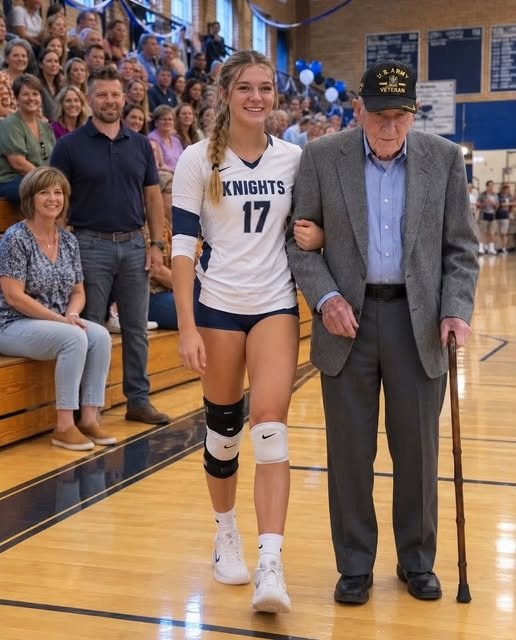
Dad and Kaylee reached center court. The announcer read her stats: three seasons varsity, two-time all-conference libero, team captain. Kaylee held the red rose against her jersey. Out of the corner of her eye she must have seen Travis, because her chin lifted a fraction, and she turned her face toward Dad instead.
Then she did something I hadn’t expected. She handed the rose to my father.
“This is for you, Grandpa,” she said. The microphone was close enough to catch it. “You’ve been showing up my whole life.”
Dad’s eyes were wet. He took the rose with a hand that shook, and the gym got louder.
That should have been the end of it. But Travis was already moving. He crossed the sideline, and for one awful second I thought he’d cause a scene. Instead he stopped a few feet from them, took off his work cap, and held it in both hands.
“Kay,” he said. It wasn’t a shout, but the gym had gone quiet enough to carry it. “Can I say something?”
Kaylee’s arm tightened around Dad’s. She looked at me across the court. I gave her the smallest nod, which meant it’s your choice, and I’ll back you either way.
“You can talk,” she said. “Not here, though.”
“Here,” Travis said. His voice cracked. “I need to say it where I said it wrong.”
Dad leaned on his cane, looked at Travis for a long moment, and then, to my astonishment, patted Kaylee’s hand. “Go on, Kitten. Let the man try.”
So Travis told her, in front of six hundred people.
“I told you the walk was for your real dad. I was wrong, and the way I said it was worse.” He swallowed. “I told myself I was respecting your father’s place. The truth is I was scared. Scared I’d be reaching for something that wasn’t mine, scared you’d say no, scared that after nine years I still wasn’t enough. So I protected myself. And I hurt you to do it.”
Kaylee’s eyes were bright and hard. “You didn’t even argue.”
“I know.” He looked down at the cap. “Your biological father hasn’t called in six years. I’ve never once been confused about who showed up. I drove you to every six a.m. practice. I sat through every bad loss. I learned the rotation chart because you asked me to explain it. Real isn’t about blood. You taught me that, and I was too much of a coward to say it out loud.”
Someone in the stands sniffled. A man near the back muttered, “Well, I’ll be.”
Travis took a breath. “I’m not asking you to walk with me tonight. Your grandfather earned this one, and I’d never take it from him. I only want you to know that if you ever decide I’m worth it, I’ll be standing wherever you want me.”
Nobody moved.
Kaylee looked at him for what felt like a full minute. Then she let go of Dad’s arm, crossed the few feet between them, and, very quietly, said something only Travis could hear.
I learned later what it was. She said, “You don’t get to disappear after dinner anymore.”
“No,” Travis said. “Never again.”
She hugged him. It was brief and stiff, and then it wasn’t. His shoulders folded around her, and the gym erupted all over again. Even the visiting team stood and cheered.
When they stepped apart, Kaylee wiped her face and turned toward Dad. “Grandpa, can Travis walk the last part with us? Back to the bleachers?”
Dad grinned and shifted his cane to his left hand. “I’ve got a good side and a bad side. Travis can take the good side.”
So they walked off the court together, my father on one arm, my husband on the other, Kaylee in the middle with the red rose back in her hand. Dad’s cane squeaked against the hardwood. This time the crowd was already standing.
We drove home in two cars. Dad rode with me, and Kaylee rode with Travis. I was afraid to ask what they’d talked about, so I didn’t.
Dad was quiet for half the drive. Then he said, “That boy’s a good man who made a dumb mistake.”
“He hurt her, Dad.”
“Yes. And he knows it. That’s why it counted.” He tapped his cane against the floorboard. “Forgiveness isn’t pretending it never happened. It’s deciding what the hurt gets to cost.”
I had no answer for that.
At home Travis insisted on making dinner, which was a disaster. He burned the tater tots. Mason ate three anyway and announced that Dad’s cane was the coolest thing he’d ever seen. Kaylee laughed so hard she had to put her fork down.
Later that night I found Travis in the garage, sitting on an overturned bucket, staring at nothing.
“I should have apologized the same night,” he said. “You waited for me to figure it out, didn’t you?”
“I did,” I admitted. “I’m not sure that was fair to either of you.”
“It was a test I should’ve passed.” He rubbed his face. “I won’t need to be told again.”
The following week, a small box arrived at the house, addressed to Kaylee in Travis’s handwriting. Inside was a framed photograph from the gym that night: Kaylee in the middle, Dad on her right with his cane, Travis on her left with his cap in his hand. Someone from the school paper had snapped it. Across the bottom Travis had written, in neat block letters: Walked together.
Kaylee hung it above her desk. She told me she didn’t need a speech or a ceremony. She just needed him to stay.
He did. At her last home game in the spring, he sat in the front row with Mason on his shoulders and a sign he’d painted himself. It read: #17’s DAD.
She saw it from the court. She didn’t wave. She just pointed at him, once, and smiled.
And at graduation in June, when the principal read the names and the families rose, my father stood on the left, leaning on his hickory cane, and Travis stood on the right with his cap tucked under his arm.
Kaylee crossed the stage between the two of them. She had room for both.