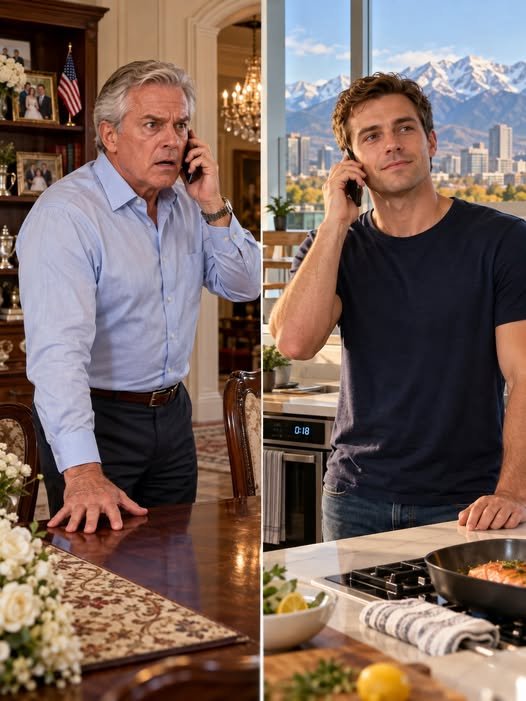
“Dad,” I said, “I make more money than all of you combined.”
The line went dead quiet. I could hear the oven fan humming behind me and the faint sound of my father breathing, the way he did when something didn’t fit the version of the world he’d built.
“Don’t be ridiculous,” he finally said.
“I’m not.” I turned off the oven and set the salmon on the counter. “Last quarter I led a project at Cascade Compute that saved us nearly five million dollars. I’m a senior engineer. My compensation, with bonuses and equity, is more than your pension, Cole’s salary, and Mom’s retirement account put together. I paid off my student loan eighteen months ago. The one you told me I’d figure out.”
“You’re lying to hurt me.”
“I’ve never lied to you, Dad. You just never asked me anything.”
He tried another angle, because he always did. “Then your brother needs you there. His wedding is about family.”
“His wedding is about the image. You said it yourself. ‘Look unified.'” I leaned against the counter. “I’m not a prop, and I’m not an employee you can summon.”
“Ethan, I will cut you out of everything.”
“Go ahead,” I said, and I meant it completely. “I don’t need the will. I never did. That’s what you taught me.”
Then I hung up. My hands shook for about thirty seconds. Then they stopped.
I assumed that was the end of it. I was wrong.
Two days later, Cole called. We hadn’t spoken in almost a year. His voice was tight and careful, the way it gets when he’s reading from a script.
“Dad told me what you said.”
“I’m sure he did.”
“Is it true? About the money?”
I thought about lying. It would have been easy. But I’d spent my whole life softening the truth so other people could stay comfortable, and I was finished with that.
“Yes. Every word.”
He was quiet. Then he said something I never expected. “I didn’t know you went without the college fund. Dad told me you didn’t want it.”
I closed my eyes. “He said that?”
“He said you’d turned it down. That you wanted to prove something.” Cole’s voice cracked. “Ethan, I swear I didn’t know. I thought I was getting what you didn’t need.”
So that was the shape of it. My father hadn’t just chosen Cole. He’d rewritten the story so Cole would never question it, and so I would never be able to prove otherwise.
“I believe you,” I said, and was surprised to find that I did.
“I’m getting married Saturday,” Cole said. “And honestly, I don’t want you there because Dad ordered you. I want you there if you want to be there. If you don’t, I’ll understand.”
“Why are you telling me this?”
“Because I was in the room when he made that call,” he said. “I heard how he talked to you. I’ve heard him talk to you like that my whole life, and I never once said anything. I’m saying something now.”
I didn’t promise him anything. But I told him I’d think about it.
I did think about it. For two days I walked the trails behind my apartment and watched the light change on the Wasatch peaks. I talked to Olivia and Marco on a video call, and Marco, as usual, got straight to the point.
“Do you want to go for them or for you?”
It was a good question. I realized I wanted to go for one specific reason: I wanted to stand in that room as exactly who I was, not hidden, not diminished, and not asking permission.
So I booked a flight. Not because my father demanded it. Because I decided.
The wedding was at a country club outside Houston, all white flowers and crystal, the sort of place my father had always wanted to belong. I arrived in a charcoal suit I’d bought myself, and I walked in without a plus-one, without an apology, and without anyone’s permission.
Dad saw me from across the lobby. His face moved through three expressions: relief, calculation, and something that looked almost like fear.
“You came,” he said, extending a hand like we were colleagues.
“I did. For Cole.”
“Good. Now, the in-laws are over there. Let’s just keep things pleasant. Maybe you could say you’ve been traveling for work.”
“I live in Utah, Dad. I’m not going to say otherwise.”
His jaw tightened. “Not tonight, Ethan.”
“Tonight is exactly when,” I said, quietly enough that nobody else could hear. “I’m not going to cause a scene. I’m also not going to lie.”
Cole found me before the ceremony. He hugged me hard, the kind of hug that has years in it. His fiancée, Hannah, shook my hand and said, “I’ve heard so little about you, and I’ve been wondering why.” She said it with a kind smile, but she meant it. I answered honestly: “That’s a question for my father.”
Hannah’s parents, the “in-laws” who had set this whole thing in motion, turned out to be warm, sharp, and curious. Her father, Richard, sat next to me at dinner and asked what I did for a living. I told him. Not to brag. Just because he asked, and nobody in my family had asked in years. He listened to the whole thing, nodded, and said, “That’s impressive work. Your father must be proud.”
At the end of the table, my father stopped chewing.
“You’d have to ask him,” I said, and left it there.
Richard looked at Dad. Then at me. Then at Cole, who was looking at his plate. He was a perceptive man, and he understood the room perfectly. He didn’t say a word. He just refilled my water glass and changed the subject.
My father cornered me near the bar after the toasts.
“You embarrassed me,” he hissed.
“I answered a question honestly.”
“You made it look like I didn’t care.”
I took a long breath. “Dad, I’m not trying to humiliate you. I came because my brother asked me to, because he told me the truth about the college fund. You told him I turned it down.”
His face went gray. “Cole said that?”
“Why did you tell him that?”
For a long moment, my father looked every one of his sixty-eight years. The anger drained out and left something smaller behind.
“Because Cole needed it more than you,” he said at last. “You were always fine. You were always the one who could handle anything. And I thought…” He stopped. “I thought if I didn’t say it, he’d feel guilty.”
“I wasn’t fine. I just never told you I wasn’t.”
“I know that now.”
It wasn’t an apology. It wasn’t even close. But it was the first honest sentence he had ever given me, and I decided to treat it as a beginning.
“I’m not taking back what I said,” I told him. “Not the money, and not Utah. But I’m willing to talk, if you can do something you’ve never done.”
“What’s that?”
“Ask me how I’m doing. And wait for the answer.”
He looked at me. Then, haltingly, like a man reading a language he’d never spoken, he said, “How are you doing, Ethan?”
“Better than I’ve ever been,” I said. “Thank you for asking.”
I flew home Sunday morning. At the gate, my phone buzzed with a message from Cole: Thank you for coming. I’m sorry it took this long.
Another buzz, from an unknown Texas number. Four words from my father: What’s your address, son?
This time I sent it.
Back in Utah, I unpacked the old volcano model, the one I’d kept through three moves, and set it on my bookshelf by the window. The paint was still chipped. The label was still faded.
But the mountains behind it were glowing, and for the first time, I wasn’t disappearing anywhere.