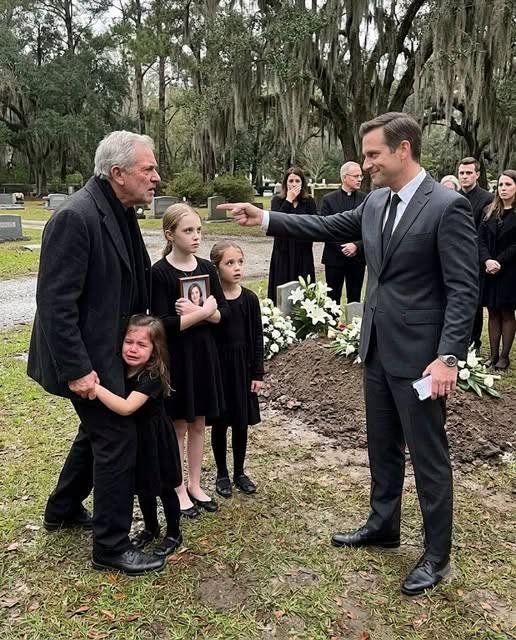
“Where are they?” I asked.
Lucy looked at her sisters, and Rachel gave a tiny nod. “In the cedar chest at the foot of Mom’s bed. Under the quilt Grandma made. Mom told us the week before she went into the hospital. She said, ‘If Daddy ever says something that makes you feel like you don’t matter, you go get the chest, and you give it to Grandpa.'”
My daughter had known she was dying, and she had used her last strength to protect her children from the man she married.
That night, in my kitchen on the east side of Savannah, I sat at the table with three girls in borrowed pajamas and a cedar chest Rachel had dragged from the car with both arms. April fell asleep against my shoulder before I’d opened the lid.
Inside was a green notebook, a small digital recorder, a USB drive, and a cream-colored envelope with my name on it in Rose’s slanted handwriting.
I read the envelope first.
Dad,
If you’re reading this, I’m gone, and Arthur has shown you who he is. I’m sorry I didn’t tell you sooner. I was ashamed, and I was running out of time to be brave.
The notebook is everything. Please take it to Margaret Hale at Hale & Pruitt. I’ve already paid her retainer. She knows you’ll come.
Don’t let the girls feel guilty. They did exactly what I asked.
I love you. Take care of my babies.
I read it three times before I could see the page.
Margaret Hale was a sharp, silver-haired attorney who had practiced family and estate law in Chatham County for thirty years. She met us Monday morning, listened to me explain, and then opened the notebook without a word.
Rose had kept it for fourteen months. Every page was dated. She had documented the moment Arthur lost his job at the real estate firm, the credit cards he’d opened in her name, and the second mortgage he’d taken out on their home by forging her signature. She’d written down the nights he came home late smelling of another woman’s perfume, and the day she found out about Vanessa, the young woman in the white van.
Then, three months before her death, she’d written something else.
Arthur found out about the life insurance. He asked me twice this week how much it pays. He asked it like he was asking about the weather.
Rose had carried a two-million-dollar policy through her employer, a hospital system where she’d worked as a nurse administrator. She’d named her daughters as sole beneficiaries, in a trust, with me as trustee. Arthur had known nothing about the trust structure. He’d assumed, as he assumed everything, that as her husband the money would be his.
Margaret closed the notebook. “Your daughter was extraordinarily careful,” she said. “Let’s hear the recordings.”
There were eleven. Rose had hidden the recorder in her nightstand and switched it on when Arthur’s temper rose. Most were arguments. Arthur calling her useless. Arthur telling her the girls were “your problem, not mine.” One was different.
It was recorded two weeks before she died. Arthur’s voice, low and clear: “When you’re gone, I’ll get the insurance, and the house, and I’ll be done with all of it. Vanessa and I are going to Tuscany. You think I’m going to sit around raising three kids? Please.”
Then Rose’s voice, weak but steady: “You’ll never get a dime.”
Then Arthur laughed. “We’ll see.”
Lucy, sitting in Margaret’s office with her hands folded, looked at the floor. “Mom said to keep it safe. She said when Daddy heard it, he’d know it was real.”
The USB drive held scanned bank statements, the forged mortgage documents, copies of Arthur’s messages to Vanessa that Rose had found on the family iPad, and a letter from a forensic accountant Rose had hired in secret. The total Arthur had taken or fraudulently borrowed came to just over three hundred and ninety thousand dollars.
Margaret filed three things that week: a petition for my guardianship of the girls, a notice of fraud and forgery with the district attorney, and an emergency order freezing the proceeds of the second mortgage.
Arthur, meanwhile, was busy. He’d announced his engagement to Vanessa on social media two days after the funeral. The wedding was scheduled for six weeks out, at a waterfront venue on Tybee Island, with a guest list of a hundred and fifty. He’d already put down a deposit using one of the credit cards in Rose’s name.
I didn’t tell the girls. They didn’t ask. April started sleeping through the night in my spare room. Rachel began talking again, a little at a time. Lucy, who had been the strongest, finally broke down in the garden one evening, and I held her until the crickets started.
Arthur learned what Rose had done on a Friday afternoon, three days before the wedding.
Two deputies served him at the venue, during the rehearsal dinner. Margaret and the district attorney’s investigator had coordinated it carefully. The deputies handed him the guardianship order, the notice of the insurance trust, and a copy of the arrest warrant for forgery, identity theft, and fraud.
I wasn’t there. But a groomsman who later became a witness told the investigator what he saw. Arthur read the first page and laughed. He read the second and stopped laughing. When the deputy took out handcuffs, Vanessa asked, loudly, whether the venue deposit would be refunded.
Arthur said nothing. He looked at his phone, which was ringing with a call from his own mother, and it kept ringing as they led him out.
Vanessa left the same night. She filed a statement saying she’d had no idea about the forgery, and the investigator, after reviewing the messages, found that mostly true and mostly irrelevant. She had no legal exposure. She also had no fiancé.
The criminal case moved faster than I’d expected. Arthur’s own voice on the recording was the strongest evidence, and his lawyer advised a plea. He pleaded guilty to forgery and identity theft. The sentence was seven years, with restitution, and a court order terminating his parental rights, which he signed without reading.
The insurance trust paid out untouched. Margaret structured it carefully: education funds, a home, and a monthly stipend for me as trustee, with oversight until each girl turned twenty-five. Rose had even requested that a portion go to a scholarship for nursing students at her old hospital. We named it the Rose Whitfield Fund.
I adopted the girls legally the following spring. There was a small ceremony in the judge’s chambers, and April wore her best dress and refused to let go of my hand for the photographs.
On the one-year anniversary of Rose’s funeral, we went back to the cemetery. It was damp again, and the air smelled of lilies. Lucy carried her mother’s framed photograph. Rachel carried a handful of wildflowers from the garden. April carried a drawing of all four of us standing outside the house.
We stood at the grave for a long time. Nobody said anything. It was the kind of silence that doesn’t need filling.
Then Lucy knelt and touched the stone.
“We did what you asked, Mom,” she said. “We kept it safe. We gave it to Grandpa.”
April leaned her head against my arm. “And he took us home.”
I put one arm around each of them, and I looked at my daughter’s name carved in granite, and I told her what I hadn’t had the chance to say at the funeral.
“You were braver than any of us, Rose. And they’re going to be all right.”
A breeze moved through the oak trees, warm for the first time that spring.
I like to think she heard.