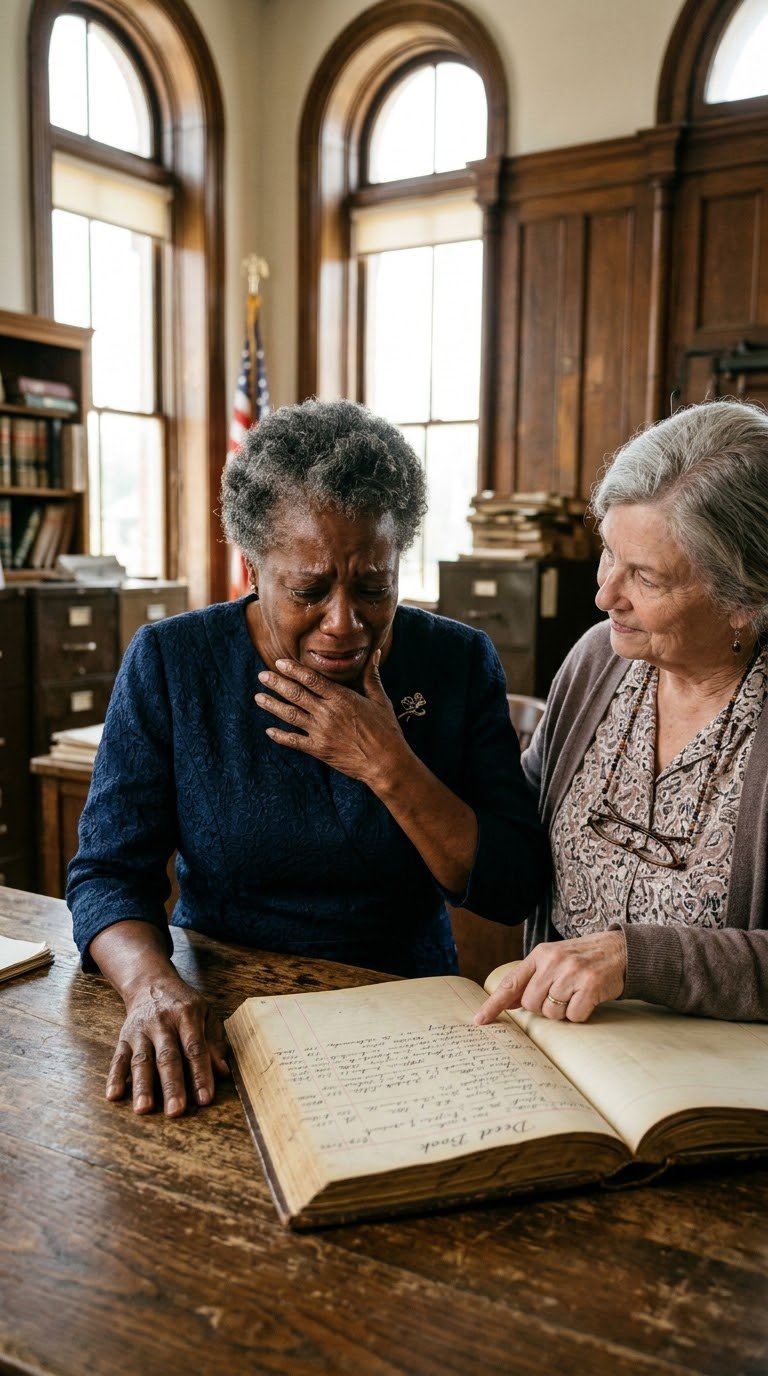
I put on my reading glasses with hands that wouldn’t hold still.
The page was written in blue-black ink, the careful script of a county clerk. Near the top I saw the Lockridge name, and the words Warranty Deed, and a date from eleven years back. My eyes went down the page slowly, the way they do when they’re afraid of what’s waiting.
…conveys to Elnora Ruthanne Whitsett, in fee simple, the following described real property, being the tenant house, the pecan grove, and twelve acres, more or less, lying along the south side of Lockridge Lane…
I read it. Then I read it again, because it didn’t make sense.
“That’s my house,” I said. “That’s Mama’s house.”
“It’s your house,” Rosella said. “It’s been yours for eleven years, honey. Henrietta recorded it herself and paid the transfer fee in cash. She never wanted her boys to know.”
I had to sit down. Rosella pulled out a chair and held it steady.
“I don’t understand,” I said. “I never paid a cent. I’ve lived there all my life, and I always thought…”
“You thought you were a tenant,” she said gently. “She let you think so. Henrietta told me she wanted you to have it quietly, with no ceremony and no fuss, because she knew if she handed you a deed you’d hand it right back out of pride.” Rosella’s mouth trembled. “She was right, wasn’t she?”
I laughed, and then I was crying, right there at the long table with the big book in front of me.
That wasn’t all.
Rosella took a folder from beneath the counter. Inside was a second document, recorded the same week, and a letter in Mrs. Lockridge’s shaky hand.
The second document was a deed of gift transferring the tenant house and acreage free of any lien, and a note that all property taxes had been prepaid through a trust account for twenty years. The trust was held at the First National Bank in town, and it was in my name.
Then I read the letter.
Dear Elnora,
If Rosella has called you, I am gone, and I expect my sons have behaved as I feared. Do not blame yourself, and do not be angry with me for keeping this secret. If I had told you, you would have refused, and then you would have kept cleaning my floors out of loyalty I never earned.
Your mother raised my boys when I was too sick to. You raised me when I was too old. Neither of you ever sent a bill. I am sending it now.
The tenant house was never theirs to take. It was your mother’s by every right except paper. Now it is yours by paper too.
Drink your coffee sitting down. The dirt will wait.
Henrietta
I held that letter against my chest, and Rosella didn’t say a word.
The trust had one more surprise. Rosella walked me down the street to the bank, where a young man named Mr. Pruitt, polite and careful, led me into an office. He opened a file and told me, in that gentle voice people use when delivering large numbers, that Mrs. Lockridge had set aside a trust for me.
“It was funded eleven years ago,” he said, “and invested conservatively. Today it stands at just under four hundred and ten thousand dollars. It pays you a monthly income for life, and you may draw principal for medical needs or repairs.”
I said, “Four hundred and ten thousand what?“
“Dollars, ma’am.”
I asked him to say it again. He did. I asked him to write it down. He did that too, on a bank notepad, and I folded the page and put it in my purse next to my ID like it might fly away.
I would like to say the Lockridge boys took it graciously.
Three weeks later, when the estate was opened, their lawyer found the recorded deed. Thurston came driving up my lane in a silver truck with Bertram in the passenger seat and Carlton following in his sedan. They stood on my mama’s porch, which was now mine, and Thurston did the talking.
“There’s been a mistake,” he said. “Mother wasn’t in her right mind at the end. That property is part of the estate.”
“She recorded it eleven years ago,” I said. “She was eighty-three and sharp as a tack.”
“We’ll contest it.”
“You’re welcome to,” I said. “My lawyer’s name is Miss Delacroix, and she’s already got the notarized statements from Rosella and the two witnesses who signed the deed.”
I hadn’t known I had a lawyer until Rosella gave me a card. Miss Delacroix turned out to be a brisk young woman who laughed out loud when she read the file. “Mrs. Whitsett,” she said, “your friend Henrietta did everything right. The witnesses are alive. The notary is alive. This deed is bulletproof.”
Carlton hadn’t spoken. He stood by his car with his hands in his pockets, looking at the ground. When his brothers ran out of arguments, he finally lifted his head.
“Miss Elnora,” he said. His voice was rough. “I’m sorry about the check.”
“The three hundred dollars.”
“The way I did it. At the door.” He swallowed. “I was angry she didn’t leave me more. It wasn’t about you. I took it out on the wrong person.”
I looked at him for a good while. I had known that boy since he was in short pants.
“Carlton,” I said, “your mama left you plenty. She left you a letter too, didn’t she? I expect you haven’t read it yet.”
He flinched. I knew from his face that he hadn’t.
“Go read it,” I said. “And then you come back and have coffee, if you can sit down for it.”
His brothers left in a huff. Carlton stayed another minute, and then he nodded and walked away. A month later, he did come back. We sat on the porch swing, and neither of us said much. Some debts you can’t pay in a day, but you can start.
The suit went nowhere. A judge threw it out in under an hour.
I used a little of the money to fix the roof on the tenant house and put in a new furnace. I used some of it to help Alfreda, who had been struggling more than she’d let on. When I told her about the deed and the trust, she cried so hard on the phone I had to hold it away from my ear.
“Mama, I’m sorry,” she said. “I should have taken you in.”
“You’ve got a husband and three kids in a two-bedroom, baby,” I said. “I never blamed you. Come see the house. There’s room.”
She and the grandchildren came every Sunday after that.
Spring came, and the pecan trees leafed out behind the little white house. I put a pot of coffee on the stove one Friday morning and set out two cups, out of habit, and a biscuit on a plate.
Then I carried everything out to the porch and sat on the swing, the same swing where I’d learned to walk.
“Henrietta,” I said, to nobody and everybody, “the dirt’s waiting.”
A breeze moved through the grove, and the swing creaked, and I could almost hear her laugh.
I picked up my cup. I drank it sitting down.