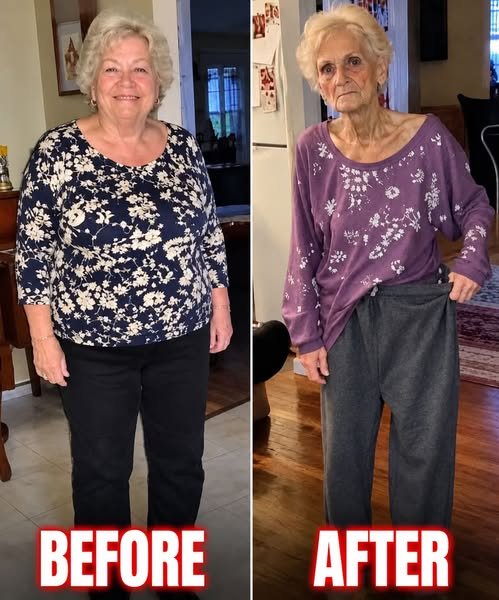
The third photograph showed two women sitting side by side on a faded floral sofa, their hands clasped together in the space between them.
One was my mother.
The other looked exactly like her.
Not similar. Exactly. The same narrow chin, the same small crooked left eyebrow, the same way of tilting her head when she smiled. The only difference was that the second woman was thinner and paler, with an oxygen tube looped over her ears. Both of them were laughing at whoever held the camera.
I stared at that screen until it dimmed.
The fourth photograph was a plain wooden box on a windowsill, a sprig of lavender laid across the lid.
“Laura.”
I turned. Mom stood in the doorway in her cardigan, one hand gripping the frame. She looked at the camera in my hands, then at the open suitcase, and she didn’t scold me. She just let out a long breath, as though she’d been holding it for fifty years.
“I wondered how long it would take you,” she said.
We sat at the kitchen table. I made tea because I didn’t know what else to do, and she wrapped both hands around the cup without drinking.
“Her name was Ellen,” Mom said. “She was my sister. My twin.”
“You don’t have a sister.”
“I do,” she said softly. “I did.”
She told me the story slowly, in pieces.
In 1946, when she and Ellen were born, her family was close to destitute. Her father had come home from the war unable to hold a job. Her mother, Ruth, was already raising three children in a two-room house. A wealthy aunt and uncle in another state had been unable to have children, and they offered to take one of the babies. Ruth wept for a week. Then she chose.
“She kept me because I was the louder one,” Mom said, almost smiling. “She told me that, much later. She said she thought I’d be the one who needed her more.”
Nobody ever spoke of it again. Mom grew up believing she was an only twin, no, an only child of that pair, and never knew why her mother sometimes stood at the window for hours on her birthday.
She found out at thirty-one, when Ruth died. Tucked inside her mother’s Bible was a letter, a birth certificate with two names on it, and an address in Ohio.
“I drove there the next week,” Mom said. “I didn’t call. I just knocked.”
“Mom…”
“She opened the door, and it was like looking into a mirror that had decided to live its own life.” Her eyes filled. “She’d known about me. Her adoptive parents told her when she turned eighteen. She’d been too afraid to look.”
I asked the question I had been dreading. “Why didn’t you ever tell us?”
Mom lowered her cup. “Ellen asked me not to, at first. Her parents were still alive, and they were good people who had loved her completely. She didn’t want to hurt them. After they passed, we both thought about telling everyone. But by then it had been years, and I was ashamed of how long I’d waited, and every year that passed made it harder to start.”
“Did Dad know?”
“Your father knew from the beginning.” She almost laughed. “He drove me to Ohio that first time and waited in the car for three hours. He said it wasn’t his story to tell, and he never did.”
So that was it. For nearly fifty years, my mother had written letters, made quiet phone calls from the garden, and taken “trips to see a friend.” Margaret had been a real person, a neighbor from childhood who’d died long ago. Mom had borrowed her name because it was easier than inventing a stranger. The phone number she’d given me belonged to a house Margaret’s family had once rented, a number she’d memorized in 1958.
“I was a coward,” Mom whispered. “I’m sorry.”
“Why now?” I asked. “Why this week?”
“Ellen called me three weeks ago,” she said. “She’d been told she had less than a month. Heart failure. She had no husband, no children. Just a care aide who came on Tuesdays and Fridays.” Mom’s voice shook. “I couldn’t let her go alone. So I went.”
She had sat beside her sister for six days. She’d slept in a chair, barely eaten, and cooked soft food Ellen could swallow while giving most of her own away. She had been supposed to leave on Wednesday, hence the early train ticket, but Ellen had asked her to stay.
“The last night, she was lucid,” Mom said. “We talked until sunrise. Fifty years of conversation, all at once. She asked me to bring her home.” She touched the suitcase. “Her ashes are in there. The clothes are hers. She wanted me to have them. I couldn’t wear a single one, they’re far too big, but I couldn’t leave them either.”
“And the envelope?”
Mom pushed it across the table with a trembling finger.
It was addressed to me, in handwriting nearly identical to my mother’s.
Dear Laura,
You don’t know me, but I have known you your entire life. Your mother sent me every school photograph, every recital program, and every Christmas card you ever drew. I have a wall in my bedroom with your face on it at every age.
I never asked to be part of your life. I only asked to be allowed to love you from a distance. Your mother gave me that, and it was more than I deserved.
Please don’t be angry with her. She kept our secret out of love for me and for you. Mostly she kept it because it was the only way she knew to keep both of us.
If you are willing, I would like to rest in your family’s plot, next to the sister I lost for thirty years and found again for fifty.
With love, your aunt,
Ellen
I read it twice. Then I put it down and found that I was crying, and so was Mom, and neither of us said anything for a long while.
We held a small service three weeks later, on a gray Saturday morning, at the cemetery where my father is buried. Mom stood at the grave in a new dark cardigan, held up by my arm on one side and her cane on the other. A few cousins came, confused and kind. I read Ellen’s letter aloud.
When it was over, Mom knelt, slowly, painfully, and placed a sprig of lavender on the fresh earth.
“I’m home, Ellie,” she whispered. “We’re both home.”
That Sunday, I set the table for Sunday dinner as I always do. Then, without really deciding to, I put out one extra place and set a small framed photograph against the water glass: two old women on a floral sofa, laughing.
Mom looked at it, and at me.
“Pass the potatoes, sweetheart,” she said, her voice thick, and she was smiling.
I passed them. For the first time in my life, my mother’s table felt completely full.