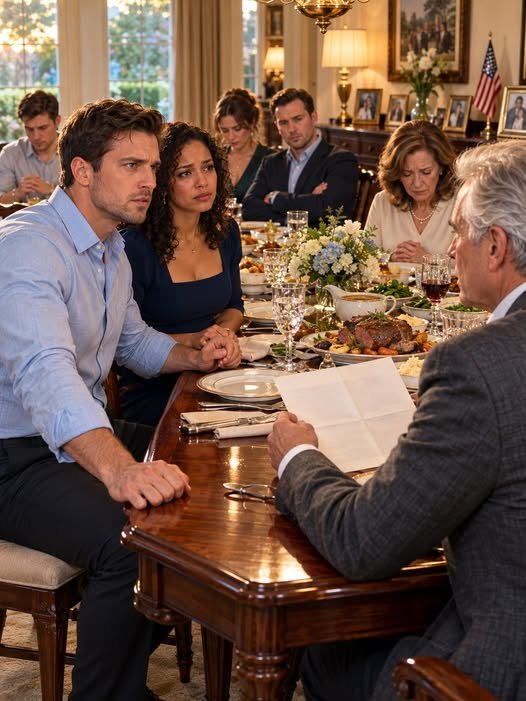
We left without a word. Naomi picked up her coat, I took her hand, and we walked out past the good china and the flower arrangement. Nobody followed. Behind us, I heard my father say, “Let him go. He’ll come around.”
He was wrong about that for eight months.
The drive home was quiet until we crossed the river. Then Naomi said, “I’m not going to cry about your father.”
“You’re allowed to.”
“I know.” She looked out at the dark water. “I’m crying because of you. You kept hoping.”
She was right. I had hoped through the garage conversation, the cold holidays, and the empty chair at our wedding. I had spent thirty-four years believing that if I was patient enough, I would eventually be chosen.
That night, I decided to stop waiting.
The next months were a kind of recovery. I didn’t call. I didn’t check my phone for my mother’s name. I coached baseball, ran trivia club, and came home every evening to a wife who laughed at my terrible jokes and kept a list on the refrigerator titled Things We Own That Nobody Gave Us. It started with a couch we’d bought on credit and ended with a plant that, against all odds, survived the winter.
Colton called once, in February. He was twenty-nine and had always been the easy one, the child who avoided conflict by agreeing with everyone.
“I should have said something at that dinner,” he said.
“Yes.”
“I didn’t want to lose what I had.”
“I know,” I said. “That’s what Dad counted on.”
He was silent for a long time. Then he said, “I’m sorry,” and I believed it, and we left it there.
On a Saturday in October, eight months after the dinner, the doorbell rang while I was grading essays at the kitchen table.
Naomi was at the grocery store. I opened the door and found my mother on the porch.
She looked smaller. Her coat hung loosely, and her hair, always set, was flat from the wind. Her eyes were red and swollen.
“James,” she said. “Please. May I come in?”
I stood aside. She sat on our secondhand couch, hands clasped on her purse, and for a minute nothing came out.
“Your father had a stroke,” she said at last. “Three weeks ago.”
I sat down slowly. “Is he alive?”
“He’s alive. He can’t speak well yet. He’s in rehab.” Her voice cracked. “I didn’t call because I didn’t know how. I was ashamed.”
She told me the rest in pieces, looking at her hands.
After the stroke, my father’s lawyer had read the will aloud to the family in the hospital waiting room, per Dad’s old instructions. Paige and Trent had immediately begun discussing the house, who would take which room, and whether Mom could be moved somewhere smaller. Colton had stood at the window, saying nothing.
“I sat there,” Mom said, “listening to them divide my home while your father was lying in a bed down the hall. And I thought, This is what we built.”
She looked up, and her face was stripped of every polite thing.
“I let him do it, James. I sat at that table, and I watched him read that paper, and I stared at the flowers because I couldn’t look at you. I told myself it was his decision. It wasn’t. I could have stopped him with one sentence. I’ve been a coward for thirty-six years.”
“Why are you here, Mom?”
“Because I wanted to say it before it was too late.” She took a breath. “And because there’s something else.”
From her purse she took a thick envelope and set it on the coffee table.
“Your father changed his will five years ago, after Paige’s wedding. That’s the one he read. But before that, in 2009, he made another, with a different lawyer. In that will, everything was equal among you three. When he amended it, he kept the original in a safe-deposit box, because a lawyer told him never to destroy a prior will.”
“Why would I care about an old will?”
“Because he never revoked it properly.” She wiped her eyes. “The lawyer who drafted the new one made a mistake in the language. It’s technically invalid. If your father passes without correcting it, the old one stands, and the law would treat all three of you equally.”
I stared at the envelope.
“I don’t want to take anything he doesn’t want to give,” I said slowly. “I didn’t come to that dinner for money.”
“I know.” She almost smiled. “That’s why I’m telling you. Paige and Trent would have found the error eventually and hidden it. I wanted you to know what’s true, and decide for yourself.”
I sat with that for a long time. Outside, a neighbor’s dog barked and a car door slammed.
“Mom, I’m not going to use a technicality to take what Dad chose to withhold. That’s not who I want to be.”
“What do you want?”
I thought about it honestly. “I want my father to look me in the eye and tell me he was wrong. And I want you to stop pretending you didn’t know what you were doing.”
She nodded, tears falling. “That’s fair.”
“And I want you to apologize to Naomi. In person. Not through me.”
“Yes.” Her voice was barely audible. “I’d like that more than anything.”
The front door opened. Naomi stood in the hallway, a grocery bag in each arm. She looked at my mother, then at me, and set the bags down very carefully.
“Mrs. Hale,” she said.
My mother stood. She was trembling.
“Naomi,” she said. “I treated you terribly. At the dinner and long before. I looked at the china and the flowers because I couldn’t look at you. You were kind to me every time, and I never returned it. I’m so sorry.”
Naomi was quiet. I watched her decide, which she does with her whole face.
“Thank you for saying it,” she said. “It took courage.”
“It took too long.”
“It did,” Naomi agreed. “But you’re here.”
She crossed the room and, to my astonishment, held out her arms. My mother folded into them and wept.
We drove to the rehab center together on Sunday.
My father was in a wheelchair by the window, a blanket over his knees, one hand curled on the armrest. He looked at me and his mouth worked. The words came slowly, thick and slurred.
“James.”
“Hi, Dad.”
“I…” He struggled. His eyes filled. “Wrong. I was… wrong.”
I stood very still. He had never once, in my life, said it.
“Naomi,” he said, and the effort of it shook him. “Sorry.”
Naomi stepped forward and knelt beside the wheelchair so they were eye to eye. “Thank you, Gerald,” she said gently. “I’d like to start over, if you’re willing.”
He nodded. Tears ran down his lined cheeks. He lifted his good hand and, with enormous effort, laid it on hers.
My father recovered slowly. He never regained all his speech, and he never again read a document aloud to humiliate anyone. In the winter, he asked his lawyer to come to the rehab center. Mom told me later what he’d done: he rewrote the will, with all three children equal, and added a letter.
I didn’t need the money. But I read the letter, in his halting, slanting handwriting, standing in our kitchen.
James, I measured you by what you earned. I should have measured you by what you gave. You taught children to love learning. I taught my children to fear losing. I am sorry. Your father.
I folded it and put it in the drawer where Naomi keeps her important papers.
Thanksgiving came, and my mother invited us. I almost declined. Naomi said, “Let’s go, and let’s leave if we need to.”
The dining room was the same. The good china was set. But the table had a place card for Naomi, written in my mother’s careful hand, and Dad sat in his wheelchair at the head, wearing a sweater instead of a blazer.
He raised his glass, shaking slightly, and said three words, slowly and clearly.
“Welcome. Both. Home.”
Across the table, Paige looked at her plate. Colton looked at me and smiled. Trent, to my surprise, stood and offered Naomi the gravy with both hands.
Naomi took my hand under the table, the way she had at the last dinner. But this time, her grip was warm and easy.
I looked at the folded napkins, the flowers, and the faces turned toward us, unsure and hopeful.
Then I picked up my fork, and for the first time in my life, I ate a meal at my father’s table without waiting to be chosen.