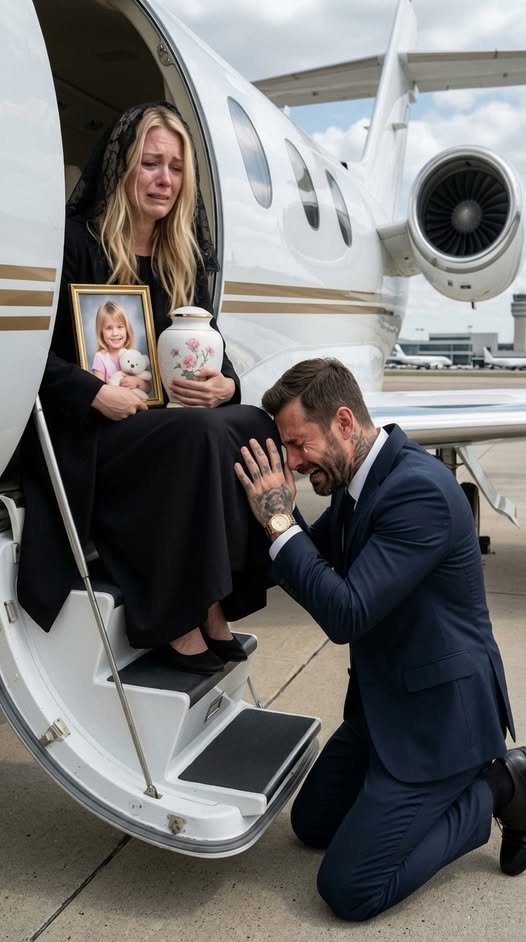
Alexander stood in the sleek Toronto lobby as the full reality of his position settled over him. For years, he had operated under the delusion that his charm, his wealth, and his family’s prominent social standing would protect him from consequences. He had treated our marriage as a convenient background arrangement, a respectable domestic baseline while he ran around playing benefactor to his first love and his enabling family.
“Emily, please,” he begged, dropping all pretenses of authority. He fell to one knee right there on the polished marble floor, uncaring that my colleagues and security staff were watching. “Take half the business. Take all of it. Take the houses, the money, everything! Just don’t leave me like this. Don’t wipe out Grace’s memory by erasing us.”
I looked down at him, feeling no anger, no vengeance, and no triumph. All I felt was a profound, empty clarity.
“Grace’s memory isn’t in your money or your corporate name,” I said, looking down at the broken man at my feet. “Her memory is in the small white urn resting on my desk in my new home. She is with the mother who loved her unconditionally, not the father who traded her safety for an afternoon of praise from people who never cared about him.”
He wept openly then, burying his face in his hands, realizing that no contract he could sign, no check he could write, and no corporate takeover he could execute would ever bring back the little girl who had danced in her room because ‘Daddy promised.’
I turned away from him and walked into the secure elevators, leaving Alexander Hayes kneeling on the cold floor of a city where he had no power, no leverage, and no family left to save him.
Over the next six months, the fallout in Chicago was absolute.
With his corporate liquid accounts frozen by the Canadian and American courts, Alexander’s business partners panicked. News of the forensic audit and the fraudulent diversion of joint marital funds leaked to the financial press. Investors pulled out of his luxury hotel developments. Credit lines were canceled. Within ninety days, his flagship shipping enterprise was forced into involuntary restructuring, and two of his major hotel properties were seized by lenders.
Without his wealth to anchor them, his family disintegrated.
When it became clear that Alexander could no longer fund her lavish lifestyle or pay off her boutique’s debts, Olivia Carter packed her bags and left Chicago without saying goodbye, moving on to another wealthy target in Miami. Madison, stripped of her unlimited credit cards and luxury vehicle, found herself facing personal bankruptcy. His mother, who had spent years sneering at my simple background while accepting my father’s money and quiet generosity, was forced to downsize into a modest suburban retirement facility, abandoned by the high-society friends who only valued her for Alexander’s invitation lists.
As for Alexander, the man who once managed hundreds of employees and multimillion-dollar deals found himself living in a small rented apartment near the Chicago riverfront, stripped of his executive titles, his fleet of luxury cars, and his social standing. His days were spent in courtrooms and depositions, paying off civil settlements and watching the remains of his commercial empire be auctioned off piece by piece.
Meanwhile, in Toronto, I built a quiet, purposeful life.
I established a charitable foundation in Grace’s name, dedicated to providing emergency child-care services and transportation assistance for working mothers in high-stress jobs—ensuring that no mother would ever have to choose between keeping her job and keeping her child safe.
On a warm autumn afternoon, one year after that terrible day, I sat on a bench in a quiet park overlooking Lake Ontario. beside me sat the small, beautifully carved wooden box containing Grace’s ashes, surrounded by a bed of fresh yellow wildflowers—her favorite color.
I looked out at the calm blue water, feeling the cool breeze on my face.
Losing Grace was a wound that would never fully heal, a quiet ache that I would carry for the rest of my days. But losing Alexander was not a tragedy. It was the moment I stopped allowing toxic, selfish people to dictate my worth and define my boundaries.
I touched the smooth wood of the box and smiled through my tears.
“We’re safe now, Grace,” I whispered to the autumn wind. “Daddy isn’t coming. But Mom is here, and I will never let you go again.”