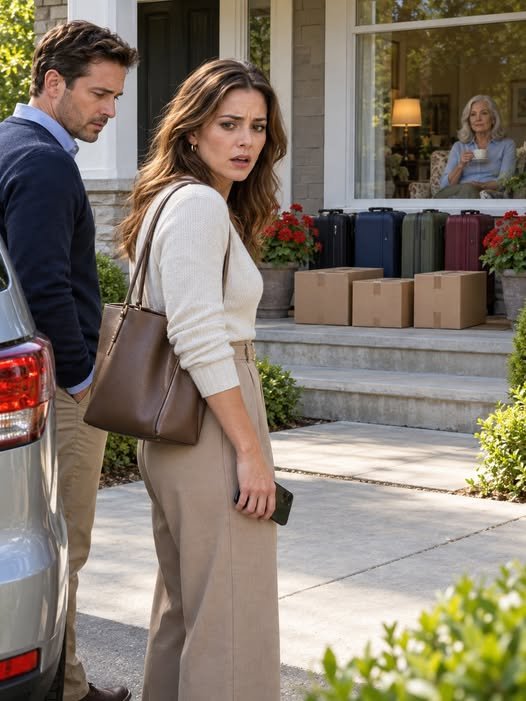
The silence that followed my statement was absolute. The lead mover, sensing the immediate toxicity of the domestic drama unfolding on the lawn, tapped his clipboard against his thigh.
“Ma’am,” the mover asked cautiously, looking at David. “Are we unloading or not? We’re on the clock.”
“You are not unloading,” I told him clearly. “Whatever furniture you have in that truck belongs to my son and daughter-in-law. They will be directing you to their new destination.”
Sarah looked as though she had been slapped. The haughty, unshakeable confidence she had possessed at 9:15 a.m. had completely vanished, replaced by the stark, terrifying realization that she had overplayed her hand in a house she did not own.
“David,” she hissed, pulling on his arm. “Do something! Tell her she can’t do this! It’s illegal! We’ve been living here!”
I couldn’t help the small, bitter laugh that escaped my lips. “Illegal? Sarah, you’ve been in my house for seventy-two hours. You haven’t established residency, you haven’t signed a lease, you haven’t paid a dime, and you don’t even receive mail here. You are guests who have overstayed your welcome by about seventy-one hours.”
David looked down at the four suitcases sitting beside my geraniums. He looked at the moving truck. Then he looked at me. For the first time in twenty-four hours, he wasn’t looking at the floor. He was looking at his mother, really looking at me, perhaps realizing that the quiet woman who had baked his birthday cakes and wept quietly in the garden after his father died was still a woman with a backbone of solid steel.
“Mom,” David said, his voice cracking slightly. “Please. It’s cold out here. Just let us bring the stuff back inside the guest room. We won’t touch the master. I swear. Sarah was just… we were just stressed.”
“Don’t blame this on stress, David,” I said gently. “Stress reveals character; it doesn’t invent it. When Sarah demanded my room, you didn’t say ‘Mom’s been through a lot’ or ‘This is Mom’s house.’ You told me to show respect. You prioritized her entitlement over my dignity.”
“She’s my wife!” David burst out, tears of frustration welling in his eyes. “I had to back her up!”
“Backing up your spouse doesn’t mean enabling her to walk over your mother,” I replied softly. “A good husband guides his wife when she’s wrong, David. He doesn’t help her conquer his mother’s home.”
Sarah grabbed two of the suitcases, dragging them toward the back of the silver SUV with a loud, grinding screech against the pavement. “Fine!” she screamed, her composure entirely shattered. “Fine! We don’t want to live in this outdated, depressing house anyway! It smells like old dust and dead memories!”
“Sarah, stop!” David yelled, but the damage was done.
I didn’t flinch. “The movers can load those suitcases into the truck if they won’t fit in your car,” I said to David. “I’ll give you fifteen minutes to clear my driveway. If the car and the truck are still here at 11:15, I will call the police to report a trespass.”
I stepped back inside the foyer and reached for the heavy brass handle.
“Mom, wait!” David took a step toward the doorway, his hands outstretched. “Are you really doing this to your own son? Over a house?”
I paused, holding the door open just wide enough to look at him one last time.
“It was never about the house, David. It was about whether you remembered who I was. Your father built this life for us so we would never be trampled on. I won’t let you start doing it now.”
I closed the door.
I turned the deadbolt with a solid, satisfying clack.
Through the front window curtains, I watched the chaotic scene unfold in my driveway. Sarah was arguing furiously with the movers, who were refusing to transport the extra boxes without an updated work order and a higher fee. David was sitting on the hood of his SUV with his head in his hands, looking smaller than he had in years.
Eventually, after much shouting and hand-gesturing, the movers loaded the three cardboard boxes into the back of the SUV, secured the luggage, and drove away. David’s silver SUV followed two minutes later, kicking up a small cloud of dry leaves as it pulled out onto the main road.
By 11:20 a.m., the driveway was empty.
The neighborhood was silent again.
I walked slowly up the stairs, my hand sliding along the smooth mahogany banister my husband had polished every spring. I walked past the guest room—now empty, bright, and clean—and stepped into my master bedroom.
I walked over to the window and sat down in my late husband’s oak reading chair. The morning sun was warm on my lap. The house didn’t feel quiet or lonely anymore. It felt safe. It felt preserved. It felt entirely, indisputably mine.
I picked up my cup of tea from the nightstand, took a slow sip, and looked out over the front garden.