Part One — The Man Above the Staircase
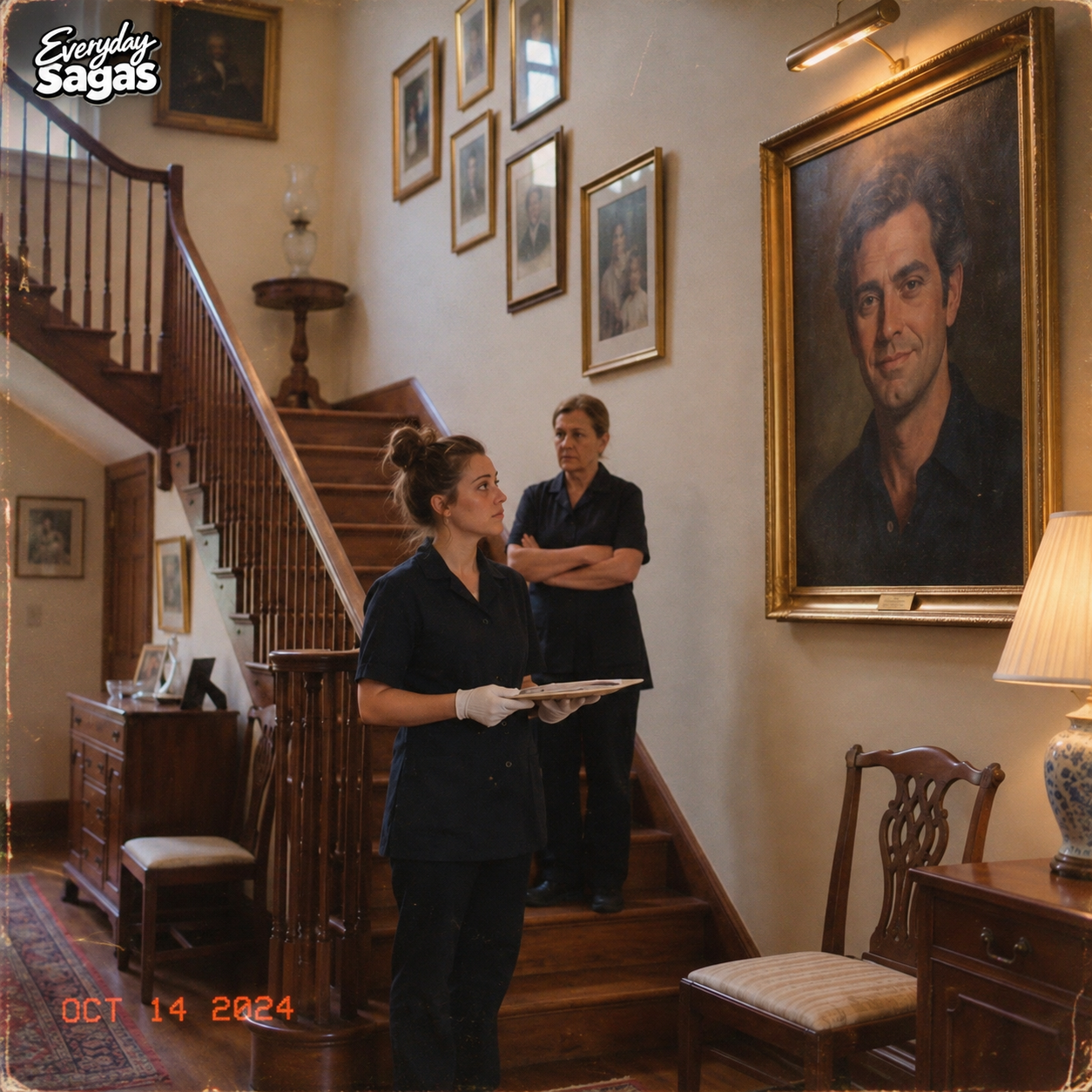
Rachel Turner nearly dropped the silver tray when she saw the portrait.
She had been inside the Caldwell house for less than twenty minutes.
Her supervisor was still explaining which rooms needed attention, where the cleaning supplies were stored, and which doors were considered private.
Rachel heard almost none of it.
She was staring at the man above the staircase.
Dark hair.
Blue eyes.
That slightly crooked smile she had once teased him about.
The face she had spent five years trying to forget.
Her daughter’s face.
Rachel’s fingers went cold around the tray.
“That’s Evan Caldwell,” the supervisor said casually, noticing where Rachel was looking. “Mrs. Caldwell’s only son.”
Rachel couldn’t speak.
Only son.
Caldwell.
She looked again at the enormous portrait, then at the polished marble staircase beneath it.
For five years, she had believed Evan had walked away from her.
Now his picture was hanging in a mansion outside Richmond, Virginia.
And Rachel had just been hired to clean his mother’s house.
“Rachel?”
She blinked.
“Sorry.”
“You okay?”
Rachel forced herself to nod.
“Just nervous. First day.”
The supervisor smiled.
“You’ll settle in.”
Rachel doubted that.
She was thirty-two and lived with her five-year-old daughter, Lucy, in a small duplex forty minutes away.
Lucy had regular medical appointments for a condition her doctors were managing, and Rachel worked almost every job she could find without letting her daughter see how frightened the bills made her.
Bakery counter.
Grocery store.
Office cleaning.
Weekend catering.
When the Caldwell housekeeping position offered steadier hours and better pay, Rachel had taken it immediately.
Three days earlier, she celebrated by taking Lucy to a diner for pancakes.
“Are we rich now?” Lucy had asked.
Rachel laughed.
“Not even close.”
Lucy poured more syrup.
“Are we medium?”
“Maybe we’re medium.”
“I like medium.”
“So do I.”
Now medium felt very far away.
The Caldwell house was enormous but strangely quiet.
Old photographs covered tables.
Books filled walls.
A grandfather clock ticked near the library.
Nothing looked chosen merely because it was expensive.
Everything seemed to belong to somebody.
Someone remembered.
Someone lost.
And everywhere Rachel looked, there were traces of Evan.
Evan beside a fishing boat.
Evan graduating college.
Evan standing next to an older man Rachel assumed was his father.
She finally understood something she’d missed years ago.
The man she had known as Evan Cole had never told her his family was wealthy.
Cole was his middle name.
He had said he used it because he wanted a life that belonged to him rather than his family.
Rachel had never questioned it.
Back then, they were twenty-seven.
He worked for a small architectural restoration company.
Rachel handled purchasing for a local builder.
They met arguing over a shipment of reclaimed brick.
Within six months, they were inseparable.
Then one Friday morning Evan kissed her outside her apartment.
“I’ll call tonight.”
He never did.
His number disconnected.
His apartment was emptied.
The restoration company said his mother had collected his belongings after “a family emergency.”
Rachel called every number she had.
Nothing.
Two weeks later, she discovered she was pregnant.
She searched for him until searching became humiliating.
Eventually she stopped.
Lucy was born without him.
Rachel learned to answer questions about Daddy with:
“I don’t know where he is.”
That had always felt less cruel than:
“He chose not to be here.”
Now she wasn’t sure either answer had ever been true.
“Rachel?”
A woman’s voice came from behind her.
She turned.
Margaret Caldwell stood at the bottom of the staircase.
She was perhaps seventy.
Silver hair.
Straight posture.
No jewelry except a wedding band.
Her eyes moved from Rachel to the portrait.
“You knew my son.”
It wasn’t a question.
Rachel’s heart started pounding.
“I knew a man named Evan Cole.”
Margaret’s face changed.
Rachel continued.
“He disappeared five years ago.”
The older woman gripped the banister.
“How well did you know him?”
Rachel thought about Lucy.
The hospital bills.
Five birthdays.
Five Christmases.
Five years of wondering what she had done wrong.
Then something inside her refused to be polite anymore.
“Why is my child’s father hanging on your wall?”
Margaret went completely still.
The supervisor quietly left the room.
For several seconds, the only sound was the grandfather clock.
Then Margaret whispered:
“Child?”
“My daughter.”
“How old?”
“Five.”
Margaret sat down on the bottom stair.
Rachel had expected denial.
Anger.
Maybe an accusation about money.
Instead Margaret looked frightened.
“What month was she born?”
“February.”
Margaret closed her eyes.
“Oh God.”
Rachel’s hands started shaking.
“Where is Evan?”
Margaret looked up.
And the answer was the last one Rachel expected.
“Alive.”
━━━━━━━━━━━━━━━━━━━━
Part Two — The Five Years They Both Lost
Rachel grabbed the stair rail.
“No.”
“He’s alive.”
“No.”
The word came out sharper.
“You don’t get to say that casually.”
Margaret stood.
“Rachel—”
“Where is he?”
“He lives about thirty minutes from here.”
Rachel stared at her.
Five years.
Thirty minutes.
She almost laughed.
Instead she started crying.
“What happened?”
Margaret led her into the library.
Rachel remained standing.
Margaret did not ask her to calm down.
That helped.
“Five years ago, Evan was in a car accident.”
Rachel stopped breathing.
“He was driving back from Charlottesville. A truck crossed the center line.”
Margaret’s voice became unsteady.
“He had a severe traumatic brain injury. Multiple fractures. He was unconscious for nearly three weeks.”
Rachel sat down.
“He told me he would call that night.”
“I know.”
“How?”
Margaret’s face tightened.
“Because after the accident, I had his phone.”
Rachel understood before Margaret said anything else.
“You saw me calling.”
“Yes.”
“How many times?”
“I don’t remember.”
“Try.”
Margaret looked down.
“A lot.”
Rachel stood again.
“You knew.”
“I knew there was a Rachel.”
“And you never answered?”
Margaret’s eyes filled.
“I answered once.”
Rachel froze.
“When?”
“A few days after the accident.”
“I don’t remember speaking to you.”
“You didn’t.”
Margaret swallowed.
“You left a voicemail saying you were worried and that you loved him.”
Rachel stared.
Margaret continued quietly.
“I deleted it.”
The room seemed to tilt.
“Why?”
“At the time, I knew almost nothing about you. Evan had been pulling away from us for years. His father and I hated that he was using Cole instead of Caldwell. He wanted nothing from the family business. Nothing from the trust.”
“What does that have to do with me?”
“Nothing.”
Margaret said it immediately.
“Nothing. That’s what took me too long to understand.”
She explained that while Evan was unconscious, she convinced herself Rachel was part of the life that had taken him away from his family.
Then Evan woke.
But recovery was not simple.
He had memory problems.
Language problems.
Months of rehabilitation.
He remembered Rachel eventually.
Margaret told him Rachel had stopped calling.
“You told him I left?”
Margaret began crying.
“I told myself I was protecting him from another loss.”
“You were protecting yourself.”
“Yes.”
Rachel looked away.
It was the honesty that kept her from screaming.
Margaret continued.
“By the time Evan was strong enough to look for you himself, your apartment had been rented to someone else. Your old job said you’d left.”
“I was pregnant and working two jobs.”
“He searched your old name.”
Rachel frowned.
“My old name?”
“Rachel Moore.”
Before Lucy’s birth, Rachel had changed her surname back to Turner, her late father’s name, after separating financially from a stepfamily situation.
Evan had never known.
“And you never told him you’d deleted my messages.”
“No.”
“Does he know now?”
Margaret shook her head.
Rachel laughed once.
A terrible sound.
“So he’s spent five years thinking I abandoned him.”
“Yes.”
“And I’ve spent five years believing he abandoned me.”
Margaret covered her mouth.
“Yes.”
Rachel walked toward the door.
“Rachel.”
She turned.
Margaret’s face had collapsed.
“I am sorry.”
“No.”
Margaret flinched.
“Don’t give me an apology while I’m still finding out what you’re apologizing for.”
Then Rachel left.
She didn’t return to work the next morning.
Margaret paid her for the week anyway.
Rachel sent the money back.
She wanted nothing that could be confused with forgiveness.
For three days, she barely slept.
Then an envelope appeared beneath her duplex door.
Not from Margaret.
From Evan.
The handwriting was uneven.
Rachel,
My mother told me what happened. I don’t know how to write this without sounding insane. I thought you left me. I spent years trying not to hate you for it. Now I know you had a daughter. Our daughter, maybe.
Rachel sat on the floor.
The next sentence destroyed her.
Please don’t bring Lucy to meet me because of what my mother did. She shouldn’t have to fix five years that adults lost. If you want to see me, come alone first. If you never want to see me, I will understand.
At the bottom was an address.
Rachel stared at it for two days.
Then she drove there.
The house was small.
One story.
Wide front steps replaced by a ramp.
Evan opened the door himself.
He walked with a cane.
A pale scar ran from his hairline toward his ear.
His right hand curled slightly inward.
Otherwise, he was still Evan.
Older.
Thinner.
Terrified.
Neither spoke.
Finally Evan said:
“You cut your hair.”
Rachel burst into tears.
Of all the things he could have said.
“You disappeared for five years and that’s what you’ve got?”
His crooked smile appeared.
“I had time to prepare. Apparently not enough.”
She cried harder.
So did he.
They did not kiss.
They sat at his kitchen table.
And for four hours, they compared two completely different versions of the same five years.
━━━━━━━━━━━━━━━━━━━━
Part Three — Lucy’s Father
Rachel did not bring Lucy to Evan immediately.
That surprised Margaret.
It surprised Evan too.
But he supported it.
First came paperwork.
Questions.
A paternity test.
Not because Rachel doubted who Lucy’s father was.
Because five years of missing history deserved something more solid than emotion.
The result confirmed it.
Evan was Lucy’s biological father.
Rachel sat alone in her car afterward and cried.
Not because she had wanted the answer.
Because Lucy had spent her entire life with a father who existed thirty minutes away.
Evan took the news quietly.
Then asked:
“Can I see a picture?”
Rachel showed him one.
Lucy at kindergarten graduation wearing a paper cap.
He touched the screen with one finger.
“She has my ears.”
Rachel laughed despite herself.
“I’m so sorry.”
“They’re terrible ears.”
Evan smiled.
Then cried.
He did not say:
I lost five years.
He said:
“She had five birthdays.”
“Yes.”
“Was she happy?”
“Mostly.”
“Good.”
That answer mattered.
Eventually, Rachel told Lucy the truth in words a five-year-old could understand.
“Your dad didn’t know where we were.”
Lucy frowned.
“Why?”
“Some grown-ups made mistakes.”
“Did Daddy make mistakes?”
“Yes.”
Rachel would not turn Evan into a saint just because he had been wronged.
He had stopped searching eventually.
He had accepted Margaret’s version because, during recovery, trusting his mother had been easier than reopening pain.
He owned that.
“So does he love me?” Lucy asked.
Rachel’s chest tightened.
“He wants to know you.”
That was the more honest answer.
Their first meeting happened at a park.
No mansion.
No dramatic reunion.
Evan brought bubbles.
Lucy brought three crayons because she’d decided they might need to draw.
She studied his cane.
“What happened?”
“I got hurt a long time ago.”
“Does it hurt now?”
“Sometimes.”
She nodded.
Then pointed at his face.
“You smile like me.”
Evan looked at Rachel.
Rachel looked away before either of them started crying.
For the first twenty minutes, Lucy called him Evan.
Then:
“Are you actually my dad?”
“Yes.”
She considered it.
“Okay.”
And went back to the bubbles.
Children sometimes accept enormous truths with less theater than adults.
The hard part came later.
Building a relationship.
Evan didn’t become Daddy because biology said so.
He became Dad slowly.
Showing up for pediatric appointments when Rachel invited him.
Learning Lucy hated peas.
Discovering she needed exactly two bedtime stories, never one.
Understanding her medical condition from her doctors instead of barging in with money and opinions.
That last part mattered.
The Caldwell money could have changed Rachel’s life overnight.
Margaret offered.
Rachel refused at first.
Then Evan said:
“Support for Lucy isn’t charity.”
That was true.
So they formalized things properly.
Child support.
Medical expenses.
Education contributions.
Not envelopes from a guilty grandmother.
Not money with access attached.
Legal responsibility from a father who had been absent without knowing he had a child.
Rachel kept working.
She left the Caldwell housekeeping job.
Margaret understood why.
Months later, Rachel returned to the mansion for a different reason.
Lucy wanted to meet Grandma Margaret.
Rachel almost said no.
Then she remembered something Evan told her.
“My mother did something unforgivable to us. But if she changes, I don’t want Lucy carrying my punishment for her.”
So they tried.
Margaret did not sweep Lucy into her arms.
She waited.
Lucy walked into the foyer and immediately spotted the huge portrait.
She stared up.
“That’s Daddy.”
Margaret’s eyes filled.
“Yes.”
“He looks weird.”
Rachel covered a laugh.
Evan said:
“I’ve been saying that for years.”
Lucy pointed at the staircase.
“Mommy said she found Daddy here.”
Margaret looked at Rachel.
“Yes.”
Rachel stepped closer.
There were still things between them that an apology couldn’t erase.
Then Margaret said quietly:
“I took years from you.”
Rachel answered:
“Yes.”
Margaret nodded.
No defense.
No request to be forgiven.
“I can’t give them back.”
“No.”
“But I’d like not to waste the ones left.”
Rachel looked at Lucy.
That was the first time she believed Margaret might understand.
The relationship remained cautious.
Margaret saw Lucy with Rachel or Evan present.
She never complained.
She stopped using money as a shortcut.
Instead she learned how Lucy liked her grilled cheese cut.
She attended one school concert and sat in the back.
When Lucy handed her a crooked drawing labeled GRANMA M, Margaret framed it beside photographs worth far more.
As for Rachel and Evan, everyone expected romance.
People love neat endings.
They didn’t get one immediately.
Too much had happened.
Rachel had spent five years becoming someone who survived without him.
Evan had spent five years learning how to live in a body that worked differently than before.
They were not twenty-seven anymore.
So they started with coffee.
Then dinners.
Then arguments.
Then therapy.
Then, almost two years after Rachel looked up at that portrait, Evan asked:
“If I kissed you, would that be incredibly stupid?”
Rachel thought about it.
“Probably.”
“Good stupid or bad stupid?”
“I haven’t decided.”
He smiled.
That crooked smile.
Lucy yelled from the next room:
“Just kiss already!”
Rachel laughed.
So did Evan.
They did.
But the kiss wasn’t the miracle.
The miracle was everything before it.
Truth.
Consistency.
Showing up.
The willingness to build something new instead of pretending five missing years could be erased.
Three years later, Rachel stood in the Caldwell foyer again.
She was no longer wearing a housekeeping uniform.
She had completed additional training and returned to work in architectural project coordination.
Lucy was eight and sitting halfway up the staircase drawing the portrait.
Her version gave Evan enormous ears.
Margaret pretended not to notice.
Rachel stood beneath the painting that had once made her nearly drop a silver tray.
Evan came beside her.
“Still hate that thing?”
“Yes.”
“My mother loves it.”
“Your mother has terrible judgment.”
From the sitting room, Margaret called:
“I can hear you.”
Rachel smiled.
Then Lucy ran down the stairs holding her drawing.
“Look.”
At the top was the giant portrait.
At the bottom were four stick figures.
Rachel.
Evan.
Lucy.
Margaret.
Nobody’s arms came from the right place.
Rachel loved it.
Years earlier, she thought the portrait had revealed that Evan had lied about who he was.
Instead, it exposed a lie someone else had built around both of them.
But Rachel eventually learned not to make Margaret’s betrayal the center of Lucy’s story.
Lucy didn’t need to grow up believing she existed because two people had been cheated out of another life.
She needed something simpler.
Her mother had loved her before there was enough money.
Her father loved her once he knew she existed.
And neither of them expected a child to repair what adults had broken.
Rachel still remembered her first day in that house.
The silver tray trembling in her hands.
The impossible face above the staircase.
And the question that escaped before she could stop it:
Why is my child’s father hanging on your wall?
For years, Rachel thought the most important answer was:
Because he never left you willingly.
It wasn’t.
The better answer came much later.
Because finding someone is not the same as getting the lost years back.
Sometimes the real gift is discovering there are still years ahead—
and choosing, carefully, what to build with them.