Over the next eleven months, I didn’t engage in family drama. I didn’t bring up the incident at Susette’s house, and I didn’t send angry text messages. I simply went low-contact with my parents and brother, focusing entirely on my catering business, my wife, and my children.
When my mother called in the spring trying to smooth things over, claiming Susette had been “under immense holiday stress,” I cut her off gently.
“Mom,” I said. “Stress doesn’t make someone tell a seven-year-old child he doesn’t belong. Cruelty does. And enabling it makes you complicit.”
She wept on the phone, but I stayed firm.
By November, the annual family holiday discussions began. Susette sent out her usual group text detailing her preliminary seating arrangements and menu plans for Christmas.
I waited until everyone was on the chain, and then I sent my own message.
Dear Family, Nadia and I will be hosting Christmas Dinner at our house this year. As many of you know, I run a professional catering company, so the meal will be fully catered—prime rib, lobster tail, custom wine pairings, and a dessert bar for the kids. We have seating for twenty-four people, complete with personalized handwritten place cards for EVERY single person who attends.
All are welcome. Except Susette.
Garrett, you are your own man and my brother. You are invited, loved, and welcome at our table. But your wife is not permitted step foot inside my home.
The group chat exploded within seconds.
Garrett called me immediately, furious. “You can’t exclude my wife! We’re a package deal!”
“Then you can stay home with her, Garrett,” I said calmly. “For six years, she purposefully excluded my wife and children. She made my son feel like trash in front of the entire family while you sat there and watched. I am giving her the exact courtesy she showed my family.”
“It’s not the same!” he yelled.
“You’re right,” I replied. “It’s not the same. Because I am telling her to her face, months in advance, instead of letting her dress up and show up with a plate in her hand only to find an empty table.”
My mother tried to intervene, begging me to call off the event or lift the ban on Susette. But Uncle Pete was the first to RSVP ‘Yes’ publicly in the family group chat. Then my cousin Sarah RSVP’d for her family of four. Then my aunt and uncle.
One by one, the family members who had silently suffered through Susette’s passive-aggressive, overly formal, and cold holiday dinners over the years began realizing they had an alternative—a professional, warm, welcoming Christmas dinner hosted by people who actually cared about them.
By the second week of December, eighteen out of twenty-two family members had RSVP’d to my house.
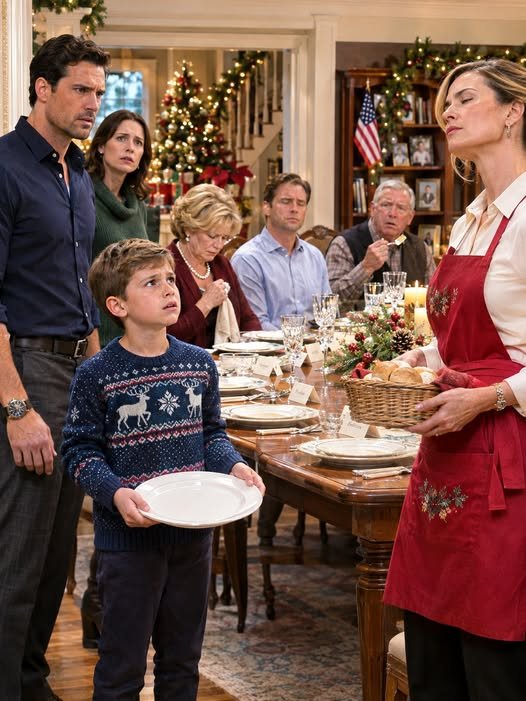
On Christmas Day, our home was filled with light, music, and the incredible aromas of a five-star catered feast. We had rented an extra mahogany dining table to connect to ours, creating a massive, grand banqueting setup in our open-concept living area.
Every single place setting had a polished charger plate, silver cutlery, cloth napkins, and a beautiful wooden place card engraved with each person’s name—including all the children.
Caleb walked down the long table, reading the names out loud just like he had done the year before. But this time, when he reached his seat right next to his father, he found a card with his name written in gold ink. He looked up at me and smiled, his shoulders relaxed and proud.
My parents arrived at two o’clock. They looked hesitant when they walked in, but seeing the joy in the room, Uncle Pete laughing by the bar, and the children playing happily by the tree, their tension melted away. My mother hugged Nadia tightly, whispering an apology through tears that was long overdue.
At four o’clock, we sat down to dinner. The room was loud, chaotic, beautiful, and warm.
Meanwhile, twenty miles away in Ridgewood, New Jersey, Garrett’s huge colonial house sat mostly quiet.
I later learned from my cousin Sarah, who had dropped by Garrett’s house earlier that morning to exchange gifts, that Susette had set her grand fourteen-person table as usual. She had baked her roast goose, arranged her fine china, and placed her calligraphed cards around the room.
Garrett had stayed with her, bound by obligation and guilt, but nobody else came.
The woman who spent six years using dining chairs as a weapon of exclusion spent Christmas Day sitting in a silent, heated dining room, surrounded by twelve empty settings she had prepared for people who chose to be somewhere else.
As I looked around my overflowing dining room, raising a glass to toast my family, Uncle Pete leaned over and clinked his glass against mine.
“Best Christmas ever, Wes,” he smiled.
“Yeah,” I replied, looking down at Caleb and Lily, who were happily eating dessert. “Everyone belongs here.”