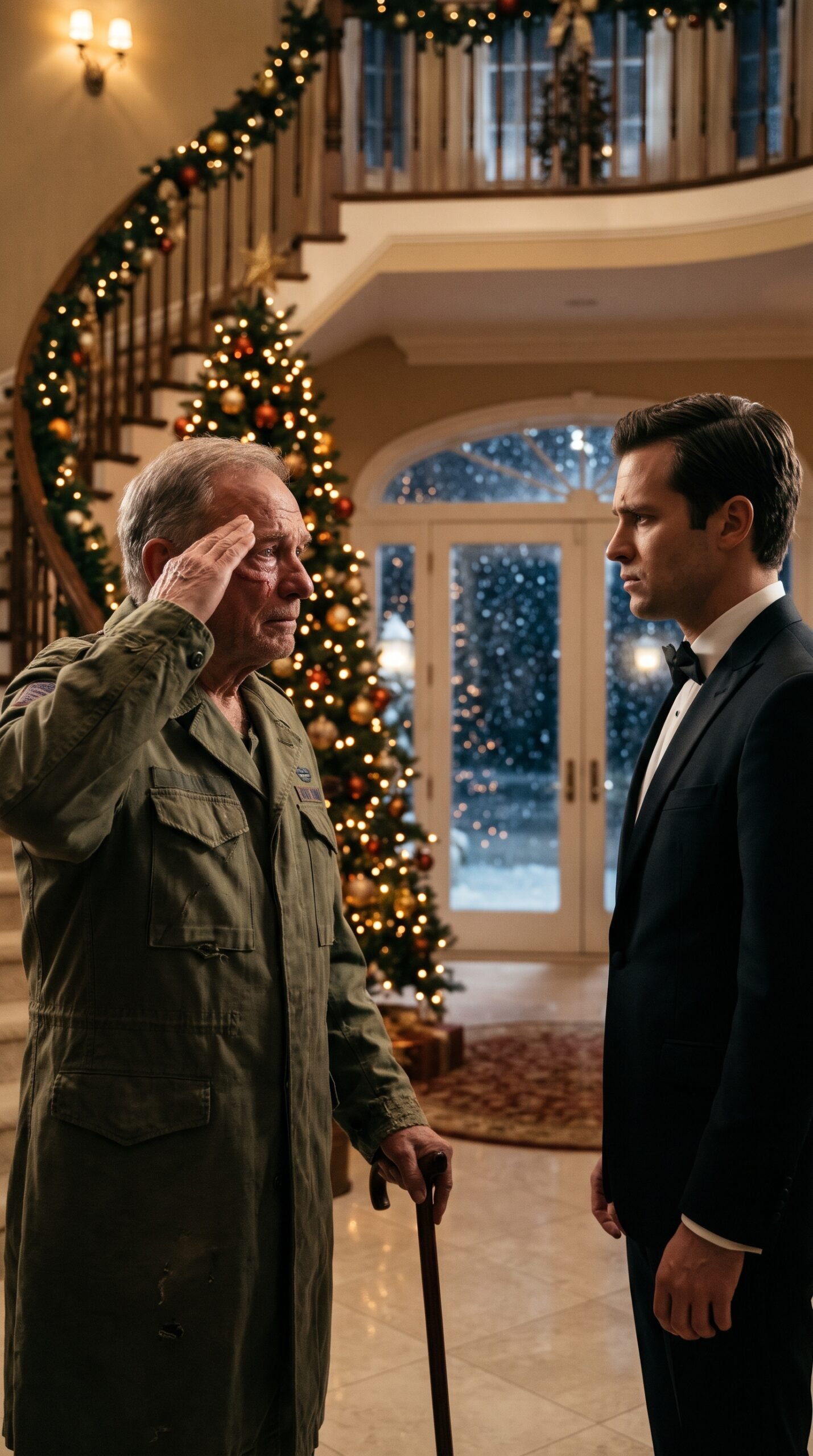
The full disclosure of Julian’s heartless act crashed over the room like a tidal wave when Julian’s fiancé, Eleanor, who had witnessed the quiet interaction in the foyer earlier that evening, finally spoke up. Disgusted by Julian’s superficiality, she openly revealed to Judge Sterling and the entire gathering that Julian had asked his father to leave the party because he was embarrassed by his limp, his trembling hand, and his worn military jacket. A suffocating, horrific silence fell over the grand living room. Senior partners from Julian’s law firm looked at him with utter disgust, realizing that beneath his polished exterior lay a man devoid of basic empathy, gratitude, and honor. Judge Sterling set his glass down on the mantel with a sharp clink, informing Julian that character and integrity were the true pillars of the legal profession, and that a man who was ashamed of the father who bled for his freedom was unfit to represent his firm or receive his endorsement. Within minutes, the atmosphere of celebration disintegrated completely; guests began making quiet excuses, putting on their coats, and walking out, leaving Julian standing entirely alone in his empty, cold mansion. Overwhelmed by a crushing wave of guilt, humiliation, and self-loathing, Julian grabbed his coat, ran out into the blizzard, and drove frantically toward his father’s modest apartment downtown. When he arrived, he found Richard sitting in a small armchair by a dim lamp, wearing his olive-green military jacket, quietly drinking a cup of warm tea while reading an old photograph album of Julian’s childhood. Julian collapsed to his knees beside his father’s chair, bursting into uncontrollable tears, sobbing as he begged for forgiveness for his arrogance, his vanity, and his profound blindness. He confessed how he had treated Richard’s sacrifices as an embarrassment rather than the ultimate display of heroic love. Richard looked down at his crying son, his trembling left hand gently resting on Julian’s shoulder. True to the selfless nature of a warrior and a father, Richard offered no harsh scolding or bitter revenge; he simply pulled his son close, telling him that a father’s love is never conditional on status or pride, but that he was glad Julian had finally seen the truth. In the weeks that followed, Julian’s life underwent a complete transformation. He resigned from his high-society corporate track to take a position at a veteran legal advocacy clinic, dedicating his career to defending disabled veterans and fighting for their benefits. He brought his father back to live with him permanently, proudly displaying Richard’s military decorations in the main entryway of his home and standing beside his father with immense, unshakeable pride at every public gathering. Was the guest right to question the medal? Absolutely. That single inquiry exposed the shallow vanity of a son and restored the dignity of a forgotten hero, proving that true honor is not found in expensive suits or high-society titles, but in the quiet, scarred hands of those who sacrifice everything for the people they love.
The Medal on the Mantel: The Untold Honor of a Forgotten Father