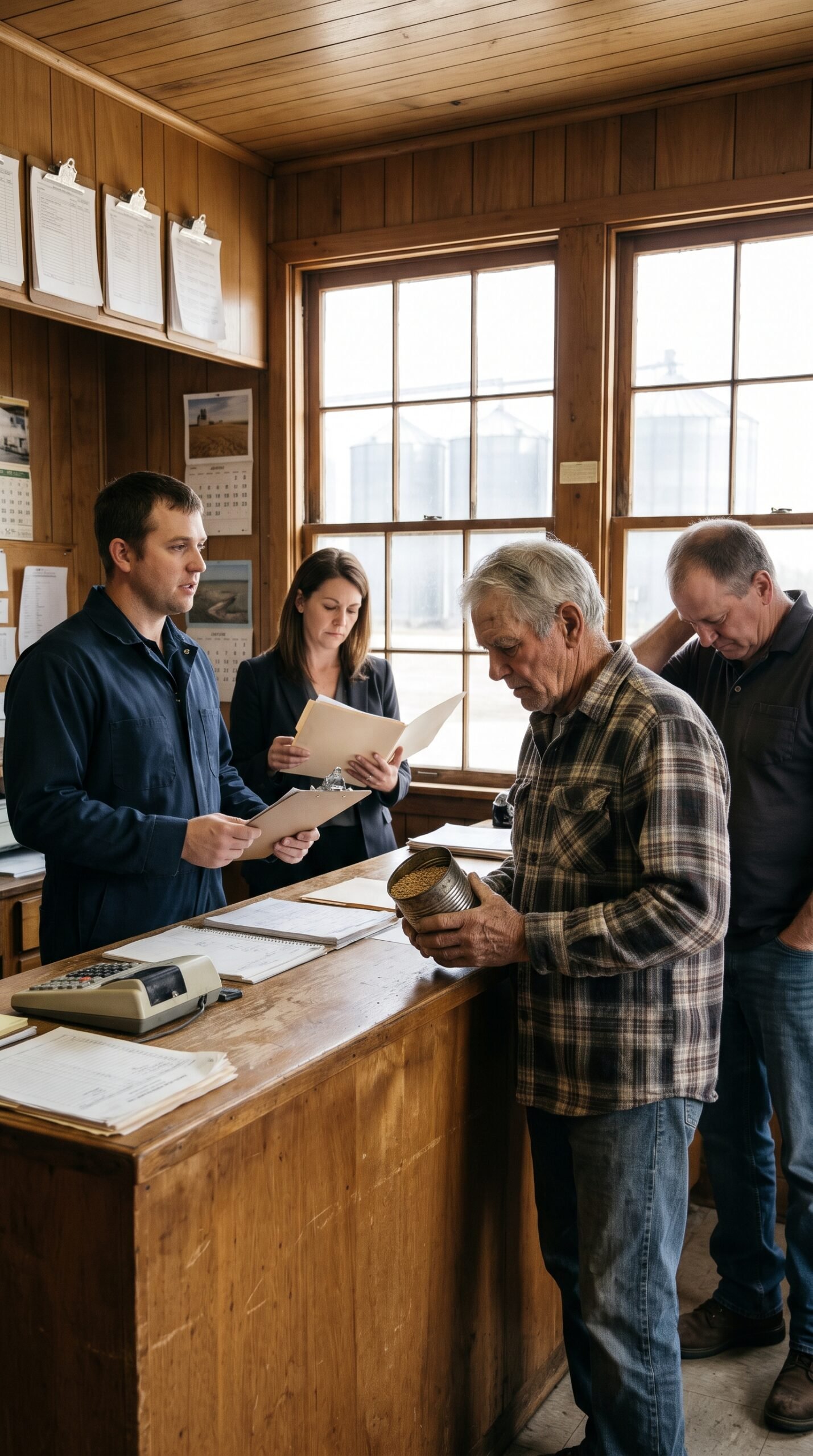
I opened the coffee can and poured a handful of wheat into my palm. I rubbed it between my hands, feeling the kernels, then brought them up to my nose—just like Grandpa Nells had taught me when I was a boy.
My stomach tightened.
The wheat didn’t smell like fresh bread. It smelled like damp cellar concrete and sour mold.
I poured the sample into the tester, ran the moisture probe, and checked the test weight.
“Moisture is seventeen point two percent,” I stated, showing the digital reading to Sarah, the loan officer. “Insect damage on the kernel caps. Storage mold has set in. It’s sample grade, Dad. It’s not human consumption quality anymore. It can only go for animal feed.”
Dad went white. “That’s impossible! Rance said the bin aeration fans were running all summer!”
Rance looked at the floor, his face burning red. “I turned the fans off in June to save on the electric bill… I thought the grain was dry enough.”
Sarah closed her loan folder with a sharp snap. “Roger, if this grain is sample grade, it’s worth less than half of what you listed on your collateral schedule. The bank cannot extend the operating line based on this.”
Dad sank into his chair, looking crushed. The 160-acre home quarter that Grandpa Nells had worked so hard to preserve was mortgaged to the hilt to fund Rance’s failed hunting lodge, and now the crop meant to save it was ruined by neglect.
For a long moment, nobody spoke.
I reached into my desk drawer, pulled out a green spiral notebook, and flipped to a page near the back. Tucked inside was an old, yellowed piece of paper—the seed receipt IOU Dad had written me twelve years ago for $6,000.
“Dad,” I said quietly. “Twelve years ago, you took my paychecks, gave away my inheritance, and told a room full of people that you only had one son because I didn’t go to college.”
Dad looked up, his eyes filled with shame.
“I didn’t need college,” I continued. “I learned the land. I learned the grain. And I built something no one could sign away. I won’t buy this ruined wheat for the co-op, because that would be cheating the members. But I will do this.”
I laid out a personal check on the counter, drawn from my own savings account.
“I’ll buy the home quarter—Grandpa Nells’s 160 acres—directly from you for fair market value. It will pay off the bank loan, clear your debt, and keep the land in the family name. But the title comes to me.”
Dad stared at the check, then at the old IOU sitting beside it. Tears welled in his eyes as he realized the son he had erased was the only one capable of saving him.
With trembling hands, Roger Hogan signed the land purchase agreement.
Full disclosure: I restored Grandpa’s home quarter, farming it with care and respect alongside my daughter, Josie. Dad retired from farming shortly after, living quietly while Rance moved away to take an entry-level sales job in the city. My father and I never became close, but every autumn, when the wheat harvest rolls in, I stand on Grandpa’s land knowing that true worth isn’t given by a title or a toast—it’s built with your own two hands.