Two years after my husband left me for a younger woman, he hammered a For Sale sign into my front yard. His new wife waited in his truck, filing her nails. “Half this house is mine. We’re listing it Monday,” he said. I said, “Come on in, then.” My aunt was sitting at my kitchen table with a folder. She was the county clerk for thirty-one years. She put on her reading glasses and slid one paper across to him…
I ran a home daycare out of my little white house on Locust Street in Pulaski for thirty years. I’ve changed more diapers than the hospital. I’m Lynette, and I’m sixty-six.
My husband, Nick, left me two years ago this past August. He left for a woman named Brooklyn who sang alto in our church choir. She’s thirty-nine.
He told me in the kitchen, holding his coffee cup, like he was telling me it might rain.
“I deserve to be happy, Lynnie,” he said.
Then he moved into her apartment over the tanning salon. The divorce went quick. Nick wanted it quick.
Brooklyn wanted a June wedding, and Nick wanted to give her one. He signed everything his lawyer put in front of him in one afternoon. He kept his bass boat, his camper, and his half of the pension.
I kept the house and Nick’s old recliner, which nobody sits in. I never argued about one thing. I was too tired to.
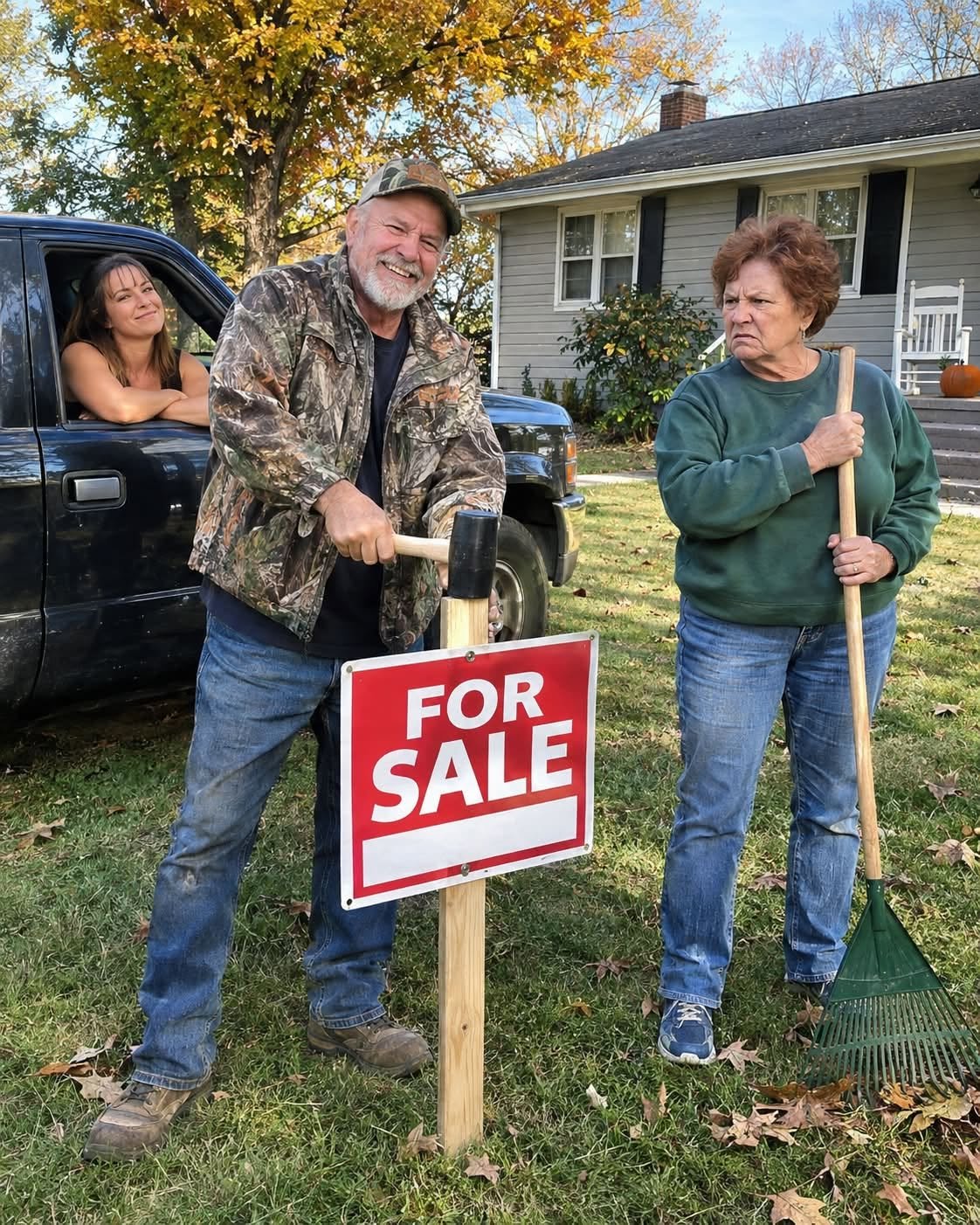
This past Saturday morning, I was out in the front yard raking leaves. Nick’s truck pulled up to the curb. Brooklyn was in the passenger seat with the window down, filing her nails.
Nick got out with a red and white For Sale sign and a rubber hammer. He didn’t say good morning. He walked out in the middle of my yard and started pounding that sign in.
“Nick, what in the world are you doing?” I said.
“Half this house is mine, Lynnie,” he said. “We’re listing it Monday.”
Brooklyn leaned out the window.
“We need a bigger place,” she called out. “With a nursery.”
I just stood there holding my rake, sick to my stomach. Mrs. Pickett from across the street came out on her porch in her housecoat. The Jacksons two doors down stopped walking their dog.
It about broke my heart, watching him do it in front of the whole street. Nick gave that sign one last whack.
“You can stay till it sells,” he said, real generous. “I’m not a monster.”
I leaned my rake against the porch rail.
“Come on in, then,” I said. “Let’s talk about it.”
He grinned at Brooklyn, like I’d just handed him the keys. What Nick didn’t know was that my Aunt Velma was sitting at my kitchen table. She comes every Saturday for coffee and my cinnamon rolls.
Aunt Velma is eighty-two. She was the Giles County clerk for thirty-one years. She’s recorded every deed, every marriage, and every divorce in this county since Nixon.
She’d been watching through my kitchen window the whole time. When Nick and I came in, she already had her big brown folder open on the table.
“Morning, Nicholas,” she said.
Nick stopped in the doorway.
“Velma,” he said. “Didn’t know you’d be here.”
“I’m always here on Saturday,” she said. “You’d know that, if you’d ever come to breakfast.”
Brooklyn came in behind him, still holding her nail file. She looked around my kitchen like she was measuring it for curtains. Nick pulled out a chair and sat down hard.
“Look, Velma, this is between me and Lynnie,” he said.
“The house was bought while we were married,” he said. “Half of it’s mine.”
“Is that what your lawyer told you?” Aunt Velma asked.
“Everybody knows it,” Nick said.
I poured him a cup of coffee, the way I did for thirty-eight years. My coffeepot rattled when I set it down. I’ll tell you the truth, I almost told her to put the folder away.
The night before, Aunt Velma had called me on the phone and told me what was in it. I’d lain awake till three. This is a small town.
If I did this, everybody in Pulaski would say I humiliated him in front of his new bride. They’d call me the bitter ex-wife from now till my funeral. Maybe I should just let him have his half and move into a little apartment.
Then I looked out the window at that sign in my yard. My yard, where thirty years of other people’s babies learned to walk.
“Go ahead, Aunt Velma,” I said.
Aunt Velma put on her reading glasses and took out one sheet of paper.
It had a gold seal on the bottom and a stamp from the courthouse.
“Nicholas, I want you to remember the day you signed your divorce papers,” she said.
“That was the day you were in a big hurry, wasn’t it?”
“So?” Nick said.
“You signed eleven pages in nine minutes,” Aunt Velma said. “I know, because I was the one who recorded them.”
Brooklyn stopped filing her nails.
“Nick?” she said. “What’s she talking about?”
“Nothing,” Nick said. “It’s nothing.”
Aunt Velma slid that paper across my kitchen table to him. She tapped the bottom with one finger, right on the line with his own signature.
“That’s your name, isn’t it?” she said.
Nick leaned over it, and the grin went off his face. And right above his signature, in plain black type, it said he had signed away every interest in the house in exchange for keeping his bass boat, his camper, and his half of the pension.
The paper was the signed divorce agreement, stamped and sealed at the courthouse. The house was mine. Nick’s signature sat right below the part saying so, as plain as his name on the coffee mug he’d used at my table for years.
He stared at it a long time. Aunt Velma left her finger beside the line, not touching the paper now. The kitchen clock ticked, and the coffeepot gave a little rattle on the counter.
“That’s not what I signed,” Nick said.
Aunt Velma pushed her glasses up her nose. “It is, Nicholas. I recorded it.”
He looked at me instead of her. “Lynnie, you know I didn’t mean it that way.”
My stomach tightened. I was furious, and I was also embarrassed that some part of me still wanted to make things easier for him.
Brooklyn had stopped filing her nails. She leaned over the table, but didn’t touch the paper. “What does it say?”
“It says the house is mine,” I told her. My voice sounded thin to my own ears, so I took a breath and said it again. “It says he gave up his interest in it.”
Nick reached toward the page, then stopped when Aunt Velma put her hand over the corner. She didn’t grab or hide it. She just kept it where it was.
“Let me see it,” he said.
“You’ve seen it before,” Aunt Velma said. “You signed it.”
“I signed a stack of papers in a hurry. That doesn’t make this fair.”
“You had a lawyer,” she said. “You had time to ask what you were signing.”
Nick rubbed his forehead. His eyes moved over the page again, fast this time, as if the words might change if he didn’t look at them long enough.
“I thought the house was still half mine,” he said. “We bought it while we were married.”
“You thought that before you signed?” I asked.
He didn’t answer me. Aunt Velma turned the paper a little so the light from the window fell across the stamp. She had kept it in that brown folder because she knew I might need to see it clearly.
“It doesn’t say half,” she said. “It says Lynette keeps the house, and you keep the boat, the camper, and your share of the pension.”
Brooklyn looked from the page to Nick. “You told me you owned half.”
“I did own half,” Nick said. His voice had gone sharp. “We were married when we bought it.”
“That isn’t what she asked,” I said.
He shoved his chair back just enough to make its legs scrape the floor. For a second I thought he might stand up and leave, but his eyes went back to the signature.
“I thought we could work it out,” he said.
Aunt Velma’s expression didn’t change. “You worked it out when you signed.”
I was glad she said that. I had let him make decisions for a long time because a fight seemed worse than whatever I would lose. I was tired then, and now I could see how much he had counted on that.
Brooklyn set her nail file on the table. “You said the sale would pay for the bigger place.”
Nick’s jaw moved before he answered. “We need a bigger place. You said you wanted room.”
“For a nursery,” she said. “I didn’t say you could take Lynette’s house.”
Nobody spoke for a few seconds. Outside the kitchen window, I could see Mrs. Pickett still on her porch. The Jacksons had stopped with their dog near the sidewalk. They couldn’t hear every word, but they’d seen the sign go into my yard.
Nick glanced toward the window. “This is between us. Nobody needs to be standing out there watching.”
“You put the sign out there,” I said. “You told the whole street you were selling my home.”
He looked at me with the same impatience I’d seen when I asked him to slow down and read something. Then he said the thing that stayed with me.
“You never even wanted to fight me before. I thought you’d be too tired to start now.”
I felt that land right in my chest. It was the first time he had said out loud what I’d suspected for years, that my silence had been useful to him.
Maybe he was right about me. I had been tired. I had signed off on a quick divorce without arguing about a single thing, and I’d let him believe that meant I would never stand up for myself.
But I wasn’t going to give him my house because he had mistaken my exhaustion for permission.
“You don’t have a share of this house,” I said. “You signed it over. Take that sign out of my yard.”
He leaned back and let out a short laugh. “You can’t just decide that because Velma found a piece of paper.”
Aunt Velma looked at him over her glasses. “It’s the agreement you signed. It’s recorded.”
“She was the clerk,” he said, looking at me. “Of course she has a paper ready.”
“She didn’t make you sign it,” I said.
That was when Brooklyn looked down at Nick’s signature again. Her face had lost the small, pleased look she’d worn when she first came in. She seemed to be trying to fit the man who had promised her a bigger house together with the man sitting across from her.
“Did you know this was in there?” she asked him.
Nick didn’t answer right away. He glanced at me, then at Aunt Velma. He could have said he’d forgotten. He could have said he hadn’t understood. Instead he said, “I figured Lynette would let me have something after all these years.”
“Something?” I asked. “You came here to sell my home.”
“I need a place for us.”
“You have a place.”
“It’s too small.”
I remembered Brooklyn calling from the truck that they needed a bigger place with a nursery. For a moment I’d thought the house itself was what she wanted. Now I could see she had been believing Nick’s version of what he owned. That didn’t make the sign in my yard any less humiliating, but it changed where the lie had started.
Brooklyn picked up her file and stood. Her chair bumped the table. “You told me she was all right with it.”
“I said we’d talk.”
“You said she knew.”
“Brooklyn, don’t make this into something it isn’t.”
She looked at him, then at me. “You brought me here to watch you tell her she had to leave?”
Nick’s mouth tightened. “I was trying to get us a bigger home.”
“With her house.”
He reached for her wrist, but she pulled her hand back. He didn’t grab her again. I could see the heat rising in his face, and I was worried he would turn on me next. Instead, he said, “We can talk about it in the truck.”
“No,” she said. “You can talk to me when you stop telling me things that aren’t true.”
I stood up too. My knees felt stiff from sitting, and I put one hand on the table to steady myself. I hated that Nick could still make me feel as if I needed to ask permission to keep what was mine.
“Aunt Velma,” I said, “would you stay here a minute?”
“Of course,” she said.
I walked to the front door. Nick followed me, but he didn’t get ahead of me or try to stop me. The sign was tilted a little where he’d hammered it into the ground. I could see Mrs. Pickett watching from across the street, her housecoat pulled close around her.
“Take it out,” I told him.
He looked past me toward the sign. “You want to make this ugly?”
“You already did that. Take it out.”
For a second I thought he’d refuse. Then he walked down the path, grabbed the post, and tugged. The sign came loose with a small clump of dirt at the bottom. He held it under one arm like he didn’t know where to put it.
The Jacksons were still standing by the sidewalk. The dog sniffed at the grass. Mrs. Pickett didn’t wave, but she gave me a small nod. I felt my face burn anyway. I was embarrassed to admit I was relieved they had seen the paper settle the matter, not just the sign go up.
Nick came back to the curb and opened the truck door. Brooklyn didn’t get in on the passenger side. She stood beside him with her arms folded.
“Give me the keys,” she said.
“Why?”
“I’m going home.”
“This is my truck.”
“And you can come with me or not.”
He stared at her, then looked back at the house. I couldn’t hear what he muttered, but he handed her the keys. She went around to the driver’s side and got in. Nick stood on the curb with the sign under his arm as she pulled away without him.
He watched the truck turn down the street. The sign’s metal stake rested against his leg. For once, he had nothing ready to say to me.
I could have told him I was sorry things had gone this way. The old habit rose up in me, that urge to smooth over his anger before it became mine to manage. I let the feeling pass.
“Don’t come back to sell this house,” I said. “It’s mine.”
He looked toward Aunt Velma, who had come to the doorway behind me. Then he looked at the paper still on the kitchen table. His face had gone tired, and I felt no satisfaction in that. I just wanted him to hear the words and understand I wasn’t changing them.
“I know what you signed,” I said. “And so do the people who saw you put up that sign.”
He stood there a moment longer, then set the sign against the curb and walked away. Mrs. Pickett went back inside. The Jacksons started down the sidewalk again with their dog, and the street returned to its Saturday sounds.
Aunt Velma came to stand beside me. “You all right, Lynnie?”
“I will be.”
She reached over and squeezed my hand once. I was grateful she was there, and a little ashamed I’d almost asked her to put the paper away just to spare Nick the embarrassment he’d brought on himself.
We went back into the kitchen. The coffee had gone lukewarm, and the cinnamon rolls were still under the towel. Aunt Velma poured herself another cup and asked if I wanted one. I said yes, and we sat at the table until my hands stopped trembling.
The sign stayed by the curb until Nick was gone. Then I carried it around to the side yard and laid it beside the small garden bed where I plant tomatoes when the weather turns warm. I didn’t throw it away. It was sturdy, and I could use the stake.
When the time came, I pushed it into the soil beside my tomato plants and tied the tallest vine to it. That little white house on Locust Street was still mine, and I was still there to open the door in the morning.
A red-and-white For Sale sign held up my tomatoes while the leaves turned green.