PART 2
The first person to step out was Mateo. The second was a woman in her forties carrying a covered casserole dish. Then came two teenagers, a middle-aged man with a toolbox, and an elderly woman who moved slowly with the help of a cane.
Silas stood behind the living room curtain, completely bewildered. He hadn’t invited anyone. He hadn’t even spoken to Mateo since their usual Tuesday visit, when the boy had mentioned being busy with a school project.
Now seven people were standing in his driveway, looking toward his house.
Mateo spotted movement behind the curtain and waved. Silas reluctantly opened the front door, keeping his cane in one hand.
“Mateo, what’s all this?”
The teenager smiled nervously. “I know it’s not Tuesday, sir.”
“I noticed.”
A few people laughed. Silas didn’t. He looked toward the strangers and felt an uncomfortable tightening in his chest. For six months, he’d barely managed to keep his home presentable. The lawn was overgrown, the porch steps needed attention, and there were unopened letters stacked on his kitchen counter.
He didn’t particularly want an audience inspecting what loneliness had done to his life.
Mateo seemed to sense his discomfort. He walked up the path alone.
“Mr. Silas, this is my mom, Elena. That’s my history teacher, Mr. Bennett, and those are two friends from school. Mr. Bennett brought his brother, who does carpentry.”
Silas nodded politely. “That’s quite a crowd.”
Mateo glanced over his shoulder. “There’s someone else I really wanted you to meet.”
He turned toward the elderly woman standing beside the last car. She wore a light blue coat and held a weathered wooden box against her chest.
“This is my great-grandmother, Lucia Salazar.”
Silas offered a small smile. “Pleasure to meet you, ma’am.”
Lucia approached slowly, studying his face.
Then she asked, “Were you Sergeant Silas Mercer?”
Silas stopped breathing for a moment.
Nobody had called him Sergeant Mercer in decades.
“Yes, ma’am.”
Lucia’s eyes filled. She lowered the wooden box and opened its brass latch.
Inside was a faded photograph.
Three young soldiers stood together in front of a military vehicle, their uniforms dusty and their faces tired. One was grinning widely, another stood with his arm in a sling, and the third looked directly at the camera with an expression Silas recognized immediately.
Because the third soldier was him.
Twenty-two years old.
Standing in Vietnam in 1968.
Silas reached toward the photograph with trembling fingers.
“Where did you get this?”
Lucia’s voice broke.
“My husband kept it beside his bed for fifty years.”
Silas looked at her.
She continued, “His name was Rafael Salazar.”
The cane slipped slightly in Silas’s hand.
He caught himself against the doorframe.
“Rafael?” he whispered. “You mean Sal?”
Lucia began crying.
And Silas suddenly understood why Mateo had been so interested in his old infantry patch.
The visitors moved quietly onto the porch while Silas stared at the photograph. Mateo stood beside him, looking uncertain for the first time since they’d met.
“Mr. Silas, I didn’t know at first,” he explained. “I knew my great-grandpa served in Vietnam, but nobody in the family talked much about where he went. Then you told me the name of your unit, and I remembered seeing a patch like yours in a box of his things.”
Silas looked down at the picture again.
The young soldier grinning beside him was Rafael Salazar, a man he’d known for less than two years and remembered for more than five decades.
They’d shared food when supplies were scarce. They’d argued about baseball. Rafael had teased Silas mercilessly because he’d spent half his free time writing love letters to Martha.
Silas swallowed.
“Sal used to tell me I was the worst poker player he’d ever met.”
Lucia laughed through her tears.
“He told me that too.”
Silas looked up sharply.
“He talked about me?”
She nodded.
“For years.”
Her voice trembled.
“He used to say there were two reasons he made it home. One was that he was lucky. The other was that a stubborn young man from Ohio refused to let him give up when things got bad.”
Silas looked away.
“I didn’t do anything special.”
Lucia smiled sadly.
“That’s exactly what Rafael said you’d tell me.”
Then she reached deeper into the box and lifted out a small envelope, its paper yellowed with age.
Across the front, in faded handwriting, were two words.
For Silas.
He stared at it.
Lucia held it toward him.
“Rafael wrote this many years ago. He tried to find you after he moved, but the old address he had didn’t work anymore. When he became ill, he asked me to keep the letter in case I ever found you.”
Silas couldn’t move.
Mateo gently placed a hand on his shoulder.
“It’s yours, sir.”
Silas took the envelope.
His fingers were shaking so badly that he couldn’t open it.
And for the first time since Martha’s funeral, he began crying in front of another person.
They moved into the living room after Silas invited them inside. Mateo brought the folding chairs from his trunk, but Silas insisted that Lucia take Martha’s old armchair near the window.
It was the first time anyone had sat there since his wife died.
He stood beside the chair for a moment, remembering the way Martha used to curl up with her knitting and complain whenever he turned the television too loud. Then he looked at Lucia, who was carefully setting her wooden box on the coffee table.
“Would you like some coffee?” he asked.
She smiled. “Only if you’re having some.”
Silas nodded. He hadn’t made coffee for guests in months, and the thought of doing something so ordinary made his throat tighten.
Mateo followed him into the kitchen.
“Mr. Silas, are you okay?”
Silas turned toward him. “How long have you been planning this?”
The teenager looked embarrassed. “About three weeks. I asked my mom to help me find old military records, and when we realized Great-Grandpa Rafael had served with you, I showed his pictures to Great-Grandma.”
Silas nodded slowly.
Mateo continued. “My friends wanted to help with the yard, and Mr. Bennett said his brother could look at the broken porch railing. But I should’ve asked before bringing everybody. I didn’t mean to overwhelm you.”
Silas looked through the kitchen window. The visitors were waiting outside rather than beginning any work without his permission.
For a long moment, he said nothing.
Then he smiled faintly.
“Son, I haven’t had seven people in this house since Martha’s last birthday. I’m a little out of practice.”
Mateo looked relieved.
Silas put a hand on his shoulder.
“But I’m glad you brought Lucia.”
When the coffee was ready, Silas returned to the living room and sat across from her.
The envelope lay unopened on his lap.
He turned it over several times, recognizing Rafael’s handwriting. The letters were slanted, and the capital S looked almost like a number eight.
Finally, Lucia spoke.
“He was afraid you’d never know how much you meant to him.”
Silas looked at her.
She nodded toward the letter.
“Go ahead.”
Silas carefully opened the envelope.
Inside were two pages of lined paper, folded neatly into thirds.
He unfolded them and began reading.
Mercer,
If this letter finally reaches you, I hope you’re sitting somewhere comfortable, preferably with a cold drink and somebody you love nearby.
I’ve tried finding you more than once. Every time I hear somebody mention Ohio, I think of that skinny kid who used to complain that the coffee tasted like boiled dirt.
Silas laughed.
His eyes were already wet.
He continued.
I don’t know whether you remember everything that happened in 1968. Sometimes I wish I didn’t. But there’s something I’ve wanted to thank you for.
When I was injured and couldn’t write properly, you sat beside me and wrote letters to Lucia while I told you what to say.
You never complained, even when I made you rewrite the same sentence three times because I wanted it to sound right.
Silas stopped reading.
His hands trembled.
He remembered the hospital ward. Rafael had injured his right hand and spent weeks recovering. Silas had visited whenever he could, bringing cigarettes he never smoked and paper for letters home.
Rafael had been terrified that Lucia would believe he’d stopped writing because something terrible had happened.
So Silas had written for him.
He’d never considered it important.
It was simply what friends did.
He continued reading.
I married that girl, Mercer. We had a daughter. I watched her grow up, graduate, and have children of her own.
I got to become the old man I never expected to be.
And I want you to know that some of those ordinary moments came from having a friend who wouldn’t leave me alone when I needed him.
Silas’s vision blurred.
He wiped his eyes and kept going.
I hope you made it home to Martha. I hope you got the life you talked about when we were young and thought we understood everything.
If we ever meet again, the first soda is on me.
Your friend,
Rafael.
Silas lowered the letter.
For a long time, nobody spoke.
Then he looked toward Lucia.
“Did he have a good life?”
Her eyes filled.
“He did.”
She smiled through her tears.
“We were married fifty-three years. He loved our family, complained about the weather, and never learned to put his shoes where they belonged.”
Silas laughed through his tears.
“That sounds like Sal.”
Lucia reached across the table and took his hand.
Then she whispered, “You helped my husband come home to me. I’ve wanted to thank you for a very long time.”
Silas covered his face.
And cried.
The visitors stayed for most of the afternoon.
But what surprised Silas wasn’t the reunion or even Rafael’s letter. It was the way Mateo handled everything afterward.
The boy didn’t make a speech about helping a lonely veteran. He didn’t ask Silas to pose for photographs or tell the others what an extraordinary thing he’d accomplished.
Instead, he sat beside him and quietly asked, “Would you like everybody to stay, sir? It’s okay if you don’t.”
Silas looked toward the porch.
Mr. Bennett’s brother was examining the loose railing. The two students were standing beside their car with gardening gloves and a few tools, waiting for permission to begin.
“What’s all that about?”
Mateo smiled nervously.
“I told them about how Martha used to love the garden. I thought maybe we could help you get it ready for winter.”
Silas stared toward the window.
The flower beds had been neglected since Martha became ill. Her roses were tangled, weeds had overtaken the path, and the little wooden bench where she used to sit had disappeared beneath fallen leaves.
He’d stopped looking out the back window months earlier because he couldn’t bear seeing it.
Then he asked quietly, “You want to work on my garden?”
Mateo shrugged.
“Only if you want us to.”
Silas looked down at Rafael’s letter.
Then back at the teenager.
“Your great-grandfather would’ve liked you.”
Mateo smiled.
“I wish I’d known him.”
Silas nodded.
Then he said something that made everyone in the room smile.
“Well, if you boys are going to dig around in my yard, you’d better let me tell you which plants are flowers and which ones are weeds.”
By four o’clock, Silas’s backyard looked different.
Not perfect.
Not professionally landscaped.
But cared for.
The leaves had been cleared from the path. The roses were properly trimmed, and Martha’s old wooden bench was visible again beneath the maple tree.
Mr. Bennett’s brother identified the repairs needed for the porch railing and offered to return another day with the right materials.
Silas insisted on paying for them.
Mateo tried to object.
Silas gave him a look.
“Son, if you’re going to spend your Saturday working for me, the least I can do is pay for some screws and lumber.”
Mateo laughed.
“Yes, sir.”
Then Silas surprised himself.
He invited everyone to stay for supper.
The refrigerator didn’t contain much beyond eggs, bread, and a few vegetables, so Elena offered to order pizza. Silas protested for a moment, then agreed to contribute.
They carried chairs into the backyard.
The younger students talked about school. Mr. Bennett asked Silas about the factory where he’d worked after leaving the Army. Lucia told funny stories about Rafael’s attempts to repair household appliances.
At one point, Mateo asked whether he could take a photograph of Silas and Lucia sitting together.
Silas hesitated.
Then nodded.
“Just one.”
Mateo smiled.
He took the photograph.
And for the first time in six months, Silas saw himself smiling without having to pretend.
That night, after everyone went home, the house became quiet again.
But it was a different kind of quiet.
There were pizza boxes on the counter, muddy footprints near the back door, and an extra folding chair in the living room.
Silas looked around.
For months, he’d kept the house exactly as Martha had left it. Her knitting basket still stood beside the armchair. Her favorite mug remained on the second shelf. He’d been afraid that changing anything would mean losing another little piece of her.
Now he understood something he hadn’t before.
Martha hadn’t loved the house because everything stayed in the right place.
She’d loved it because people gathered there.
She’d filled the kitchen with laughter, invited neighbors over for coffee, and insisted on making enough food for anyone who might stop by unexpectedly.
He walked toward the photograph of her on the mantel.
“Well, sweetheart,” he whispered, “you would’ve liked today.”
For a moment, he could almost hear her.
Then why don’t you invite them back, you stubborn old man?
Silas laughed softly.
Then he picked up his phone.
His hands were stiff, and it took him several attempts to type the message correctly.
Mateo, thank you for today. Tell your grandma the coffee’s on me next time.
He pressed send.
A minute later, the phone buzzed.
You’re welcome, Mr. Silas. See you Tuesday at 4:15.
Silas stared at the screen.
Then smiled.
Because for the first time in months, he believed it.
The following Tuesday, Mateo arrived carrying the groceries and a thick algebra textbook.
Silas noticed immediately.
“What’s that?”
Mateo sighed.
“My personal nightmare.”
Silas laughed.
“Still struggling with algebra?”
The teenager dropped into his folding chair.
“I got another bad test grade. I think I’m just not good at math.”
Silas studied him for a moment.
Then reached for the book.
“Let me see.”
Mateo looked surprised.
“You know algebra?”
Silas raised an eyebrow.
“Son, I worked as a machinist for thirty-four years. If I couldn’t handle measurements and calculations, the factory would’ve fired me before lunch.”
Mateo laughed.
Silas opened the book.
For the next hour, they worked through equations together.
Silas didn’t rush.
When Mateo made a mistake, he asked him to explain his reasoning. When the boy became frustrated, Silas reminded him that not understanding something immediately wasn’t a personal failure.
At one point, Mateo pushed the textbook away.
“I don’t know why I can’t get this.”
Silas leaned back.
“Did I ever tell you about the first time I tried to rebuild a carburetor?”
Mateo shook his head.
“Took it apart in forty minutes. Took me three days to put it back together. Then I had four pieces left over.”
Mateo burst out laughing.
Silas smiled.
“Sometimes learning means being willing to look foolish for a while.”
Mateo nodded.
Then picked up his pencil.
They worked until the sun began setting.
And when Mateo finally solved a difficult problem without help, Silas clapped his hands.
“There you go!”
The boy grinned.
For a moment, he looked like a little kid who’d just learned to ride a bicycle.
And Silas felt something warm settle inside his chest.
He’d spent months believing he had nothing left to offer the world.
Now a teenager was sitting on his porch, learning something because Silas had taken the time to teach him.
As winter approached, the Tuesday visits continued.
Sometimes Mateo came with groceries.
Sometimes he came with homework.
Occasionally, he brought Lucia, who never failed to remind Silas that Rafael had considered him the world’s worst poker player.
Silas began making coffee before they arrived.
He repaired the old porch bench.
He started walking to the mailbox every morning instead of waiting until the mail piled up.
And one afternoon, he surprised himself by calling a neighbor to ask whether she’d like to come over for tea.
She accepted immediately.
“I’ve wanted to check on you for months,” she admitted. “I just didn’t know whether you’d want company.”
Silas looked down.
Neither had he.
He’d spent so long avoiding people after Martha died that he’d begun believing nobody wanted to see him.
But sometimes loneliness had made him reject the very connections he needed.
The realization was uncomfortable.
It was also freeing.
He couldn’t change the months he’d spent alone.
But he could stop making every new day look exactly like the last one.
In December, Mr. Bennett invited Silas to speak to his high school history class.
Silas refused at first.
“What would a bunch of teenagers want to hear from an old man?”
Mr. Bennett smiled.
“They’ve spent weeks studying the Vietnam War. They know the dates, the major events, and the political debates. But history means something different when you can speak with someone who lived through it.”
Silas hesitated.
He hadn’t spoken publicly about Vietnam in decades.
Some memories were painful.
Others were complicated in ways he’d never been able to explain.
Then Mateo spoke.
“You don’t have to talk about anything you don’t want to, sir.”
Silas looked at him.
The teenager continued.
“You could just talk about what it was like to come home. Or about Martha. Or about the people you knew.”
Silas thought about Rafael.
About the letters.
About the men whose names he still remembered.
Then he nodded.
“All right. But no speeches calling me a hero.”
Mateo grinned.
“Deal.”
The classroom was smaller than Silas expected.
Twenty-six students sat at desks arranged in a semicircle. A map hung beside the whiteboard, and photographs from the period were displayed along one wall.
Silas entered wearing his old olive-green jacket.
The same jacket that had caught Mateo’s attention outside the grocery delivery.
At first, he was nervous.
His hands trembled slightly as he sat down.
But Mr. Bennett introduced him simply as a local resident who’d served in Vietnam and later worked for decades in manufacturing.
Then the students began asking questions.
What was the food like?
Did he miss home?
Was he frightened?
What did he think about the war now?
Silas answered carefully.
He told them that military service had been more complicated than the stories people sometimes told afterward. There were moments of friendship and courage, but also fear, loss, and experiences he’d spent years trying to understand.
He didn’t romanticize it.
He didn’t pretend every memory was a good one.
Then a girl near the front raised her hand.
“Mr. Mercer, what’s the one thing you remember most?”
Silas thought for a long moment.
Then he reached into his jacket pocket and pulled out Rafael’s letter.
“A friend,” he said.
The classroom became quiet.
He explained how he’d helped Rafael write letters to Lucia while his hand healed.
He described the silly arguments they’d had about baseball and coffee.
Then he told the students that, fifty years later, Rafael’s great-grandson had knocked on his door with groceries.
Several students turned toward Mateo.
Silas smiled.
“Sometimes the things you do for somebody seem very small at the time. You don’t know whether they’ll matter tomorrow, much less fifty years later.”
He looked toward the letter.
“But that friend went home and raised a family. And now one of his great-grandchildren is sitting right there.”
Mateo lowered his head.
His eyes were wet.
Silas continued.
“I’ve received a few medals in my life. I’ve kept them in a drawer for years.”
He paused.
“But this letter is something I want to leave where I can see it.”
The room remained silent.
Then a student asked, “Why?”
Silas smiled sadly.
“Because it reminds me that a person’s life can matter to someone long after they think their useful days are over.”
After the presentation, several students approached him.
One asked about his years working in the factory.
Another wanted to know whether he’d ever met anyone famous.
A third thanked him for speaking honestly about how difficult returning home had been.
Silas answered every question.
Then Mr. Bennett asked whether he’d consider participating in a small oral-history project, with complete control over what he shared and whether anything would be published.
Silas agreed to think about it.
He wasn’t ready to have his entire life recorded.
But he liked the idea that young people might learn something from the people living quietly around them.
On the drive home, Mateo glanced toward him.
“You were really good today.”
Silas chuckled.
“I talked too much.”
“No, you didn’t.”
Silas looked out the window.
For years, he’d believed his stories would disappear with him.
Now there were twenty-six teenagers who knew Rafael’s name.
And one boy who understood why an old letter meant more than a medal.
In spring, Mateo received the results of his final algebra exam.
He drove to Silas’s house immediately.
It wasn’t Tuesday.
It wasn’t even grocery delivery day.
Silas opened the door and found the teenager standing on the porch, holding a folded sheet of paper.
“What’s wrong?”
Mateo grinned.
“Nothing.”
He handed Silas the paper.
Across the top was his final grade.
A B.
Silas stared at it.
Then looked up.
“Well, I’ll be.”
Mateo laughed.
“I did it.”
Silas pulled him into a hug.
“You certainly did.”
For a moment, neither spoke.
Then Mateo stepped back.
“There’s something else.”
He reached into his pocket and pulled out an envelope.
It was from a technical college.
He’d been accepted into a program in mechanical engineering technology.
Silas read the letter twice.
Then smiled.
“Looks like somebody’s going to learn how to build things properly.”
Mateo laughed.
“Maybe you can finally teach me how to fix that old carburetor.”
Silas chuckled.
“Only if you’re prepared to spend three days putting it back together.”
Then he became quiet.
“Mateo?”
“Yes, sir?”
Silas looked at the acceptance letter.
“Your great-grandfather would’ve been proud of you.”
The teenager’s smile softened.
Then he whispered, “I think you would be too.”
Silas’s eyes filled.
“I am, son. Very much.”
Graduation arrived in June.
Silas hadn’t attended a school ceremony in decades.
He wore the dark blue suit Martha had helped him choose for their fiftieth wedding anniversary. It was a little loose now, but he’d had the trousers adjusted and polished his shoes until they shone.
Lucia sat beside him in the auditorium.
Elena sat on his other side.
The room was filled with families holding flowers, cameras, and congratulatory signs.
Silas felt slightly overwhelmed by the noise.
Then Mateo’s name was called.
The teenager crossed the stage in his cap and gown.
His mother began cheering.
Lucia clapped so enthusiastically that Silas worried she’d hurt her hands.
And Silas stood.
He applauded until Mateo disappeared behind the curtain.
Afterward, families gathered outside for photographs.
Mateo found them near the school entrance.
He hugged his mother.
Then Lucia.
Then he turned toward Silas.
“Mr. Silas, will you take a picture with me?”
Silas looked surprised.
“Me?”
“Of course.”
The teenager put an arm around his shoulders.
Elena raised her phone.
“Ready?”
Silas smiled.
The camera clicked.
And when Mateo looked at the photograph, he grinned.
“That’s going on my desk.”
Silas looked at him.
“Your college desk?”
“Yeah.”
The old man swallowed.
Then whispered, “Well, make sure you study at it.”
Mateo laughed.
“I will.”
That summer, Silas made a decision he’d been avoiding since Martha died.
He began sorting through her belongings.
Not throwing everything away.
Not trying to remove her from the house.
Just deciding what he wanted to keep close and what might be useful to somebody else.
He donated some of her clothes.
Gave a neighbor her extra knitting supplies.
And organized the photographs that had been scattered through drawers.
Mateo helped him carry boxes.
One afternoon, they found an old notebook beneath a stack of recipe cards.
It was Martha’s handwriting.
Inside were lists of things she wanted to do after Silas retired.
Visit the mountains.
Go fishing.
Plant more roses.
Invite friends over for Sunday dinners.
Near the bottom of one page was a sentence written in red ink.
Make sure Silas doesn’t spend the rest of his life sitting in that chair.
Mateo stared at it.
Then looked toward Silas.
The old man laughed.
“Sounds like her.”
But his voice trembled.
He sat down at the kitchen table and ran one finger over the words.
For a long time, he didn’t speak.
Then he whispered, “She knew me too well.”
Mateo pulled out a chair.
They sat together quietly.
Finally, Silas looked up.
“Son, do you think your mother would mind if I invited everybody here for Sunday dinner?”
Mateo smiled.
“I think she’d love that.”
The first dinner was a disaster.
Silas burned the roast.
Mateo forgot the rolls.
Elena brought a salad nobody seemed particularly interested in eating.
And Lucia spent most of the evening explaining how Rafael used to ruin perfectly good meals by adding too much pepper.
They laughed until their faces hurt.
Afterward, Silas stood in the kitchen washing dishes while Mateo dried them.
The teenager glanced toward the living room.
Everyone was talking.
Lucia sat in Martha’s old chair.
Elena was helping Mr. Bennett find a photograph.
The younger students were discussing school plans.
And the house was full of ordinary noise.
Mateo looked toward Silas.
“Pretty good night, huh?”
Silas smiled.
“Best one I’ve had in a long time.”
They worked quietly for a few minutes.
Then Mateo asked something that caught him off guard.
“Mr. Silas, what was the hardest thing about being alone?”
Silas stopped washing the plate.
He thought about the six months after Martha died.
The days when he didn’t bother shaving.
The meals he ate standing at the kitchen counter.
The unopened mail.
The television playing simply because silence had become unbearable.
Then he answered honestly.
“It wasn’t that nobody needed me. It was that I started believing nobody ever would again.”
Mateo looked down.
Silas continued.
“When you’re young, people are always asking things of you. At work. At home. Your family needs rides, help, advice. Sometimes you get tired of it.”
He smiled sadly.
“Then one day the house gets quiet. And you realize you’d give anything to have somebody ask you for one more little thing.”
Mateo swallowed.
For a moment, neither spoke.
Then he looked toward the stack of dishes.
“Well, I’ve got a pretty important question.”
Silas raised an eyebrow.
“What?”
Mateo grinned.
“Can you teach me how to make that roast without burning it?”
Silas burst out laughing.
“Son, apparently I’m the last person you should ask.”
And they laughed together.
The years didn’t suddenly become easy.
Silas still missed Martha every day.
Some mornings, grief surprised him while he was making coffee. Sometimes he reached for the phone to tell her something funny before remembering she wasn’t there to answer.
His knees still ached.
His hands still trembled occasionally.
And there were days when he’d rather stay home than attend another community gathering.
But he no longer assumed loneliness was the only future available to him.
He kept his Tuesday visits with Mateo whenever the boy’s college schedule allowed.
He began attending a monthly veterans’ coffee gathering at the community center.
And occasionally, Mr. Bennett invited him to speak with another group of students.
Sometimes Silas talked about military service.
Other times, he talked about his work as a machinist, the importance of learning practical skills, or the way people could spend decades underestimating the value of ordinary kindness.
He didn’t become a celebrity.
He didn’t want to.
He simply became part of the world around him again.
And that was enough.
One afternoon, almost two years after Mateo first knocked on his door, Silas received a package.
It wasn’t groceries.
It was a framed photograph.
He opened it carefully.
Inside was the picture taken on Mateo’s graduation day.
The teenager stood proudly in his cap and gown, one arm around Silas’s shoulders.
Silas was smiling in his dark blue suit.
At the bottom of the frame was a small engraved plate.
To the man who taught me that getting older doesn’t mean you stop having something to give.
Love, Mateo.
Silas sat down.
For several minutes, he stared at the photograph.
Then he looked toward the mantel.
Martha’s picture stood beside Rafael’s letter.
He carefully placed the graduation photograph between them.
Three reminders of different kinds of love.
The woman who’d shared his life.
The friend who’d survived beside him.
And the young man who’d arrived when Silas believed the meaningful part of his life was already over.
He wiped his eyes.
Then he smiled.
Last Tuesday, Mateo arrived at exactly 4:15 p.m.
His car was still old.
The paint was fading, and one of the doors made an alarming noise whenever it opened.
But he’d saved enough money from his part-time job to replace the worst of the mechanical problems.
Silas was waiting on the porch.
Two folding chairs stood beside the railing.
Two cold sodas sat on the little wooden table.
And the garden behind the house was full of late-blooming flowers.
Mateo carried the groceries up the steps.
“Afternoon, Mr. Silas.”
Silas smiled.
“Afternoon, son.”
They settled into their chairs.
For a while, they talked about college.
About Mateo’s new classes.
About a difficult instructor.
About the old car.
Then Mateo looked toward the faded infantry patch on Silas’s jacket.
“Can I ask you something?”
Silas chuckled.
“You’ve been asking me questions for two years. Why stop now?”
Mateo laughed.
Then he became serious.
“Do you ever think about that first day we met?”
Silas looked toward the driveway.
He remembered the grocery bags.
The rusty sedan.
The autumn wind.
And the boy who’d stopped instead of turning away.
“Every Tuesday,” he said.
Mateo smiled.
“I almost didn’t ask you about your jacket.”
Silas looked surprised.
“Why not?”
“I thought you might think I was being nosy.”
Silas laughed softly.
Mateo continued.
“But I remembered how much I wished I’d asked Great-Grandpa Rafael questions before he died. And I thought maybe I shouldn’t miss another chance to hear somebody’s story.”
Silas looked down at his hands.
Then he whispered, “I’m glad you asked.”
Mateo nodded.
“Me too.”
For a while, they sat quietly.
Then Silas reached into his jacket pocket and pulled out a small photograph.
It was the one of him and Rafael in Vietnam.
He’d had a copy made.
He handed it to Mateo.
The teenager stared at it.
“Mr. Silas, you don’t have to give me this.”
Silas smiled.
“I know.”
Mateo looked down at the photograph.
Then back at him.
“Thank you.”
Silas nodded toward the picture.
“Your great-grandfather was a good man, son. I want you to remember him.”
Mateo’s eyes filled.
“I will.”
Sometimes people assume the most important moments in our lives arrive with tremendous noise.
A wedding.
A graduation.
A promotion.
A dramatic announcement.
But Silas learned that some of the moments that change us forever arrive quietly.
With grocery bags.
A rusted car.
And four words spoken by someone who could easily have walked away.
Where’d you serve, sir?
He’d spent six months believing nobody had time for him.
Six months watching delivery drivers leave without saying more than hello.
Six months sitting in a house filled with memories, wondering whether the world had already moved on without him.
Then a teenager noticed an old patch on his jacket.
And stopped.
That small decision led to a friendship.
The friendship led to a letter.
The letter led to a family he’d never expected to meet.
And somewhere along the way, Silas found reasons to get out of bed, keep his garden alive, and share the stories he’d thought nobody wanted to hear.
Mateo’s life changed too.
He found a patient teacher.
A friend who listened without judging him.
Someone who believed he was capable of more than his test scores suggested.
And a connection to the great-grandfather he’d never had the opportunity to know.
But neither of them believed one had rescued the other.
That wasn’t what their friendship was about.
They had simply made room for each other.
Silas still keeps his old infantry jacket hanging beside the front door.
The fabric is faded.
The stitching is worn.
And the patch that caught Mateo’s attention is beginning to fray at the edges.
He could replace the jacket.
He could buy something warmer.
But he never does.
Because every time he sees it, he remembers the afternoon a teenage delivery driver looked past his age, his cane, and his quiet house.
A boy who didn’t ask whether Silas needed money.
Didn’t ask whether he wanted charity.
Didn’t tell him he should be grateful someone had stopped by.
He simply asked about his life.
And then he listened.
Last Saturday, Silas sat at his kitchen table looking at the three photographs on his mantel.
Martha.
Rafael.
Mateo.
He thought about everything that had happened.
Then he opened the notebook Martha had left behind.
On the final page, below her list of places she wanted to visit, he wrote something in his own shaky handwriting.
Dear Martha,
You were right.
I wasn’t supposed to spend the rest of my life sitting in that chair.
I met a boy named Mateo. He’s Rafael’s great-grandson, if you can believe it.
He comes over on Tuesdays.
Sometimes he brings homework. Sometimes he brings groceries. Sometimes he just sits and talks.
I wish you could meet him.
You would’ve loved him.
Silas paused, wiping his eyes.
Then he wrote one final sentence.
“I thought the best part of my life ended when I lost you, but somebody reminded me there’s still a little more living to do.”
He closed the notebook.
And smiled.
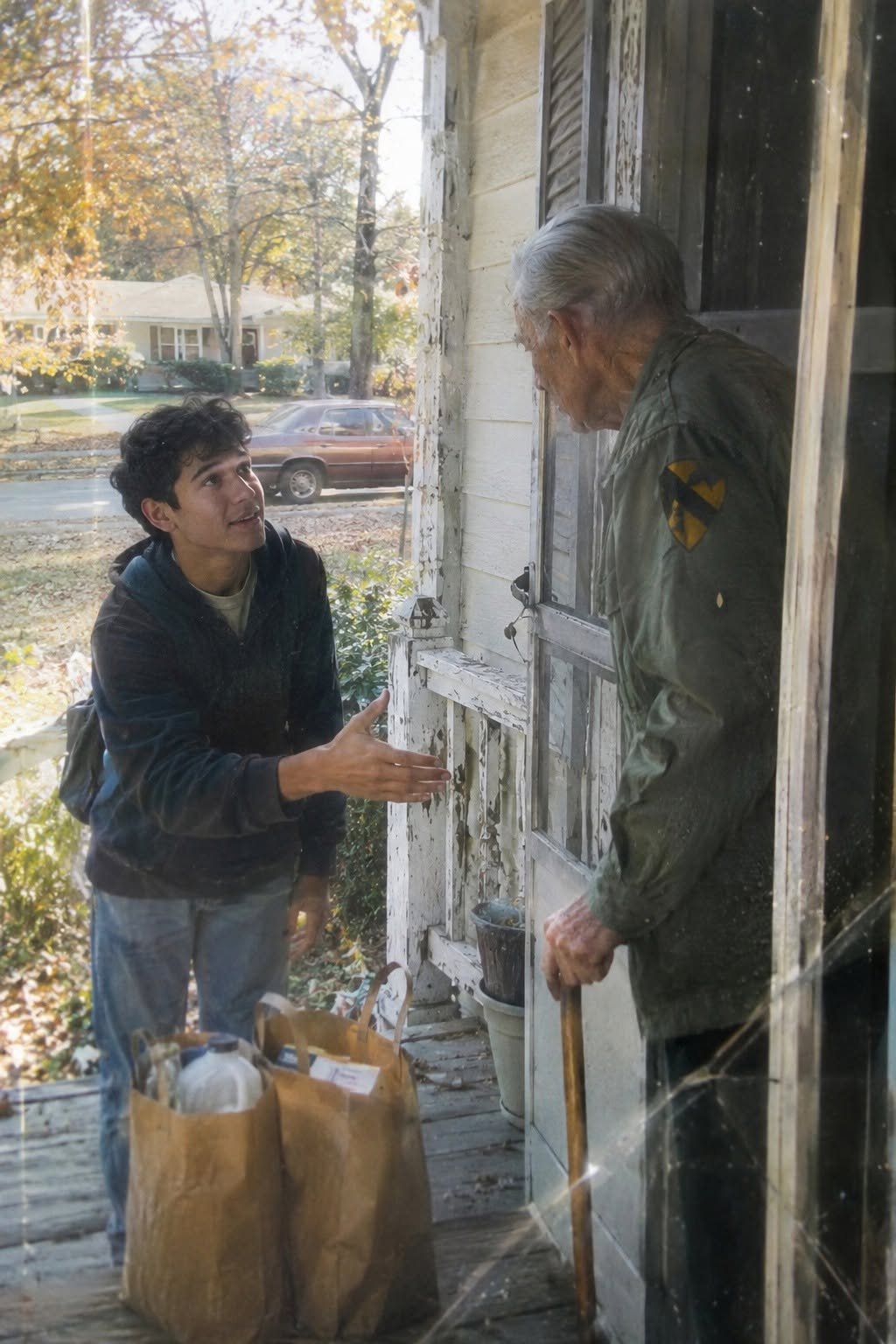
An eighty-year-old combat veteran hadn’t had a visitor in six months.
Then a teenage delivery driver stopped at his porch and asked four simple words.
“Where’d you serve, sir?”
The boy didn’t know he was about to discover a connection between his great-grandfather and the lonely man standing behind the screen door.
He didn’t know that an old letter had been waiting decades to reach the person it was written for.
And he certainly didn’t know that one ordinary conversation would become the beginning of a friendship neither of them wanted to lose.
Silas had spent decades believing his most meaningful acts belonged to the distant past.
Mateo showed him that kindness didn’t stop mattering when someone grew old.
And Silas showed Mateo that wisdom wasn’t something people outgrew the need for.
Today, the two folding chairs are still on the porch.
Every Tuesday, when the weather allows, Silas places two sodas on the little table and watches the clock approach 4:15.
Sometimes Mateo is late because of class.
Sometimes he calls because his car won’t start.
Sometimes the visit lasts only twenty minutes.
But Silas doesn’t sit by the window wondering whether the boy will remember him.
He knows.
And the young man doesn’t visit because he feels sorry for an elderly veteran.
He visits because he has a friend.
One man thought he had nothing left to offer.
One boy thought he had nobody who understood him.
Then four simple words reminded them both that a life can change when someone takes the time to listen.
And on a quiet porch in Ohio, two chairs remain waiting—not for a delivery, but for another conversation.