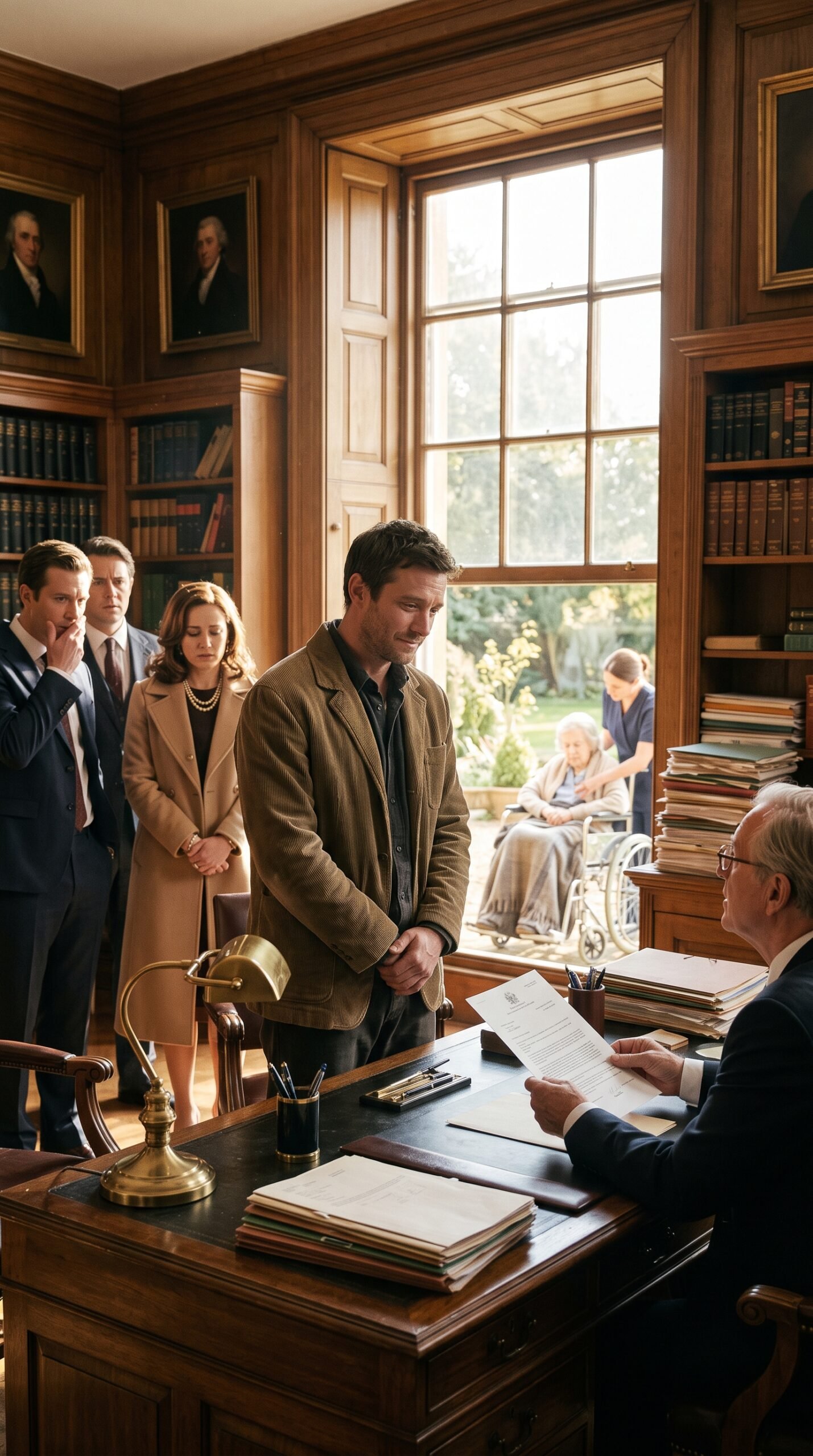
Mr. Hastings adjusted his glasses and began to read.
“To my children, Victoria, Daniel, and Ethan. If you are hearing this, I am gone, and I owe you the truth I was too proud and too tired to tell while I lived.“
Victoria’s fingers tightened on her pen.
“Three years ago, your mother’s illness began to cost more than I had. I was too stubborn to ask for help. I told myself I could manage. I couldn’t. When the bills grew heavy, it was Ethan who quietly stepped in.“
Ethan stared at the table. His ears had gone red.
“He never asked me for a dime. Instead, he opened an account at his own expense and paid the pharmacies, nurses, and specialists directly. He did this so that I would never see the totals and lose sleep. I only learned the truth when I found an unpaid invoice in his jacket and demanded an explanation. He told me not to worry. He told me it was handled.“
Mr. Hastings turned a page.
“I have documented every payment I could trace. The ledger is attached, with copies of receipts, statements, and bank records, all verified by my attorney. Over three years, my son Ethan paid a total of one hundred and twelve thousand, four hundred dollars toward his mother’s care. He drained his savings. He liquidated his retirement. He sold his tools. He worked a second job. And when you two came to visit, he never said a word.“
The room had gone silent. Daniel had gone pale. Victoria had lowered her pen and was staring at the ledger as though it might bite her.
“To the extent that you have heard rumors about missing funds, I will explain. The withdrawals from my accounts, which total ninety-one thousand dollars, were not taken by Ethan. They were deposits I made into his account, over his protests, in an attempt to repay him. He refused to use them. He kept every cent in escrow, untouched, and returned the full amount to my estate last month, with a note that said, ‘This is Mom’s, not mine.’“
A small, strangled sound came from Victoria’s throat.
“I know, because I saw the note. I kept it.“
Mr. Hastings lifted a slip of paper from the binder and set it on the table. It was in Ethan’s blocky handwriting. This is Mom’s, not mine.
Daniel put his face in his hands.
“Victoria and Daniel, I love you both. I am proud of the lives you have built. But pride is not the same as presence, and I would be failing you if I let you believe that comfort and love are the same thing. Your brother has been the one who stayed.“
Mr. Hastings paused. “Mr. Brennan’s wishes for the estate are as follows.”
He read the terms slowly. The family home and the remaining assets, valued at just under two million dollars, were to be divided into three parts. Victoria and Daniel would each receive one-fifth of the estate, enough, Arthur wrote, to honor them without spoiling them. The remaining three-fifths would go to Ethan, along with the deed to the house and the full ledger of his father’s gratitude.
“I am not rewarding Ethan for what he spent,” Mr. Hastings read. “Money can’t repay a son’s sacrifice. I am rewarding him because he never demanded recognition, and a man like that should never again have to carry a family alone.“
He closed the binder.
For a long time, no one moved. The only sound was the rhythmic ticking of a wall clock and the soft rustle of Margaret’s blanket as she turned her head, as if listening to something far away.
Victoria was the first to speak. Her voice, usually so controlled, cracked in half. “Ethan, why didn’t you tell us?”
“I didn’t want you to worry.”
“We accused you.” She pressed her hand over her mouth. “We said you stole from Mom.”
“You didn’t know.”
“We didn’t ask!” She was crying now. “We looked at the numbers and decided what kind of person you were, because it was easier than asking what we’d missed. We were never there.”
Daniel’s shoulders shook. “I’m so sorry, Ethan. I told Dad’s friends you were a thief. I told the neighbors.“
Ethan looked at his brother. The anger he might have felt had worn down long ago, replaced by something heavier and quieter. “I’m not going to pretend it didn’t hurt,” he said. “It did. But I’d do it all again. She’s my mother.”
Margaret, who had been silent through all of it, reached for his hand. Her fingers trembled, but her eyes, for once, were clear.
“Ethan,” she said, in a voice like a bell, “your father was right. You are the best of us.”
He laid his forehead against her hand, and for the first time in three years, he let himself cry.
In the weeks that followed, Victoria and Daniel did what they could. They called every cousin, aunt, and neighbor who had heard the rumor and corrected the record, one painful phone call at a time. Daniel drove to the hardware store and stood in front of the former employee who had turned his back, and said, “I was wrong. My brother is the finest man I know.” Victoria sat down with Ethan and, with real humility, offered to contribute her share toward Margaret’s ongoing care. He tried to refuse. She wouldn’t let him.
“Let us carry some of it,” she said. “Please. We don’t know how to be the people who show up, but we’d like to learn.”
So they learned. Victoria rearranged her schedule and began visiting every Tuesday. Daniel took Thursdays, awkwardly at first, then with a growing tenderness, bringing soup from his own restaurants and sitting patiently through the long afternoons. The three of them rotated nights at Margaret’s bedside as her condition worsened.
Ethan used a portion of the inheritance to pay off his debts, rebuild his savings, and, at last, buy back his father’s old workbench. He found it in the garage of the man who’d purchased it, and the man, hearing the story, refused to take payment. “Tell your dad I said thanks for the dovetail joints,” he said.
Margaret lived another eighteen months, long enough to see her three children sitting together at her kitchen table, laughing about a story from their childhood she could no longer quite remember but loved hearing all the same. She passed in spring, with the windows open and the smell of lilacs drifting in, her hand held by all three.
At the funeral, Ethan gave the eulogy. He stood before a full church and spoke without notes.
“My father kept a ledger,” he said. “He believed in writing things down. But I don’t think love can be recorded in a book. I think it’s recorded in who sits beside you in the dark.”
He looked at Victoria and Daniel, who sat in the front row, eyes red, holding hands.
“My brother and sister learned that late. But they learned it. And I am grateful to have them.”
On the first anniversary of Arthur’s death, the three siblings gathered in the old hardware store, which Ethan had reopened as a small community woodshop for local kids. Above the register hung a framed page from the ledger, the last entry in Arthur’s careful hand: My son never asked to be thanked. So let this be the thanks.
Daniel stood in front of it for a long time.
“Do you think he knew we’d come around?” he asked.
“I think he hoped,” Ethan said. “He hoped for everything.”
Victoria slipped an arm through his. “Then let’s make sure he was right.”
That evening, they sat on the old porch, three grown children with their father’s pencil marks still etched into the doorframe, and watched the sun go down over the empty street. No one spoke for a while. They didn’t need to.
Because the loudest people in a family are rarely the ones who carry it. Often it’s the one who works in silence, pays in silence, and loves in silence, and who asks for nothing but to be believed. And sometimes the truest justice isn’t a verdict or a victory. It’s a ledger, kept faithfully by a father who saw everything, and who made sure his son would never again have to prove what he’d always been.