Lily’s fifth-grade teacher, Mrs. Alvarez, listened to the entire story at recess. When Lily finished, the teacher sat very still.
“Lily,” she said, “Veterans Day is in two weeks.”
“That’s why I’m asking.”
By Wednesday, the principal had agreed to a special assembly. The school librarian helped Lily dig through old records, and a retired history teacher who volunteered with a veterans’ group helped her trace the names in the 1970 article. One name led to a man who was still alive.
Colonel Daniel Whitaker, eighty years old, retired, lived three states away.
Lily wrote to him in her neatest handwriting.
Dear Colonel Whitaker, my name is Lily Dalton. My grandfather is Sergeant Frank Dalton. I think you know him. He never told anyone what happened on the river road, and I want his family to hear it. Please come if you can.
She mailed it herself. Then she waited, and no answer came.
On the morning of the assembly, Frank had no idea what was happening. Lily had told him only that the school wanted a guest for Veterans Day.
“Me?” He buttoned his old tweed jacket. “Honey, I can’t speak in front of a whole school.”
“You don’t have to speak. Just sit up front.”
Her mother, Karen, drove them with a puzzled frown. Michael and David had agreed to come after Lily phoned them herself. “It’s for Grandpa,” she had said, and because she was eleven and they were out of excuses, they cleared their calendars with a sigh.
The gymnasium was packed. Children sat cross-legged on the floor, and parents lined the walls. On a small stage stood a flag and a single chair. Frank sat in it, hands on his knees, looking baffled.
Lily stepped up to the microphone, which was far too tall for her. The principal lowered it.
“My name is Lily Dalton,” she said. Her voice wobbled, then steadied. “I want to tell you about my grandfather.”
She told them everything: the attic, the medals, the yellowed clipping, and the seven trips into the fire. Frank’s eyes were wide and his jaw was tight. In the third row, Michael had put his phone away.
“For forty years,” Lily said, “my grandfather has sat at our Thanksgiving table, and we told him to stop talking. I’m not saying this to be mean to my family. I’m saying it because I think we were wrong. And I think he deserves to be thanked out loud.”
The gym was silent.
Then a deep voice from the back said, “He certainly does.”
Every head turned.
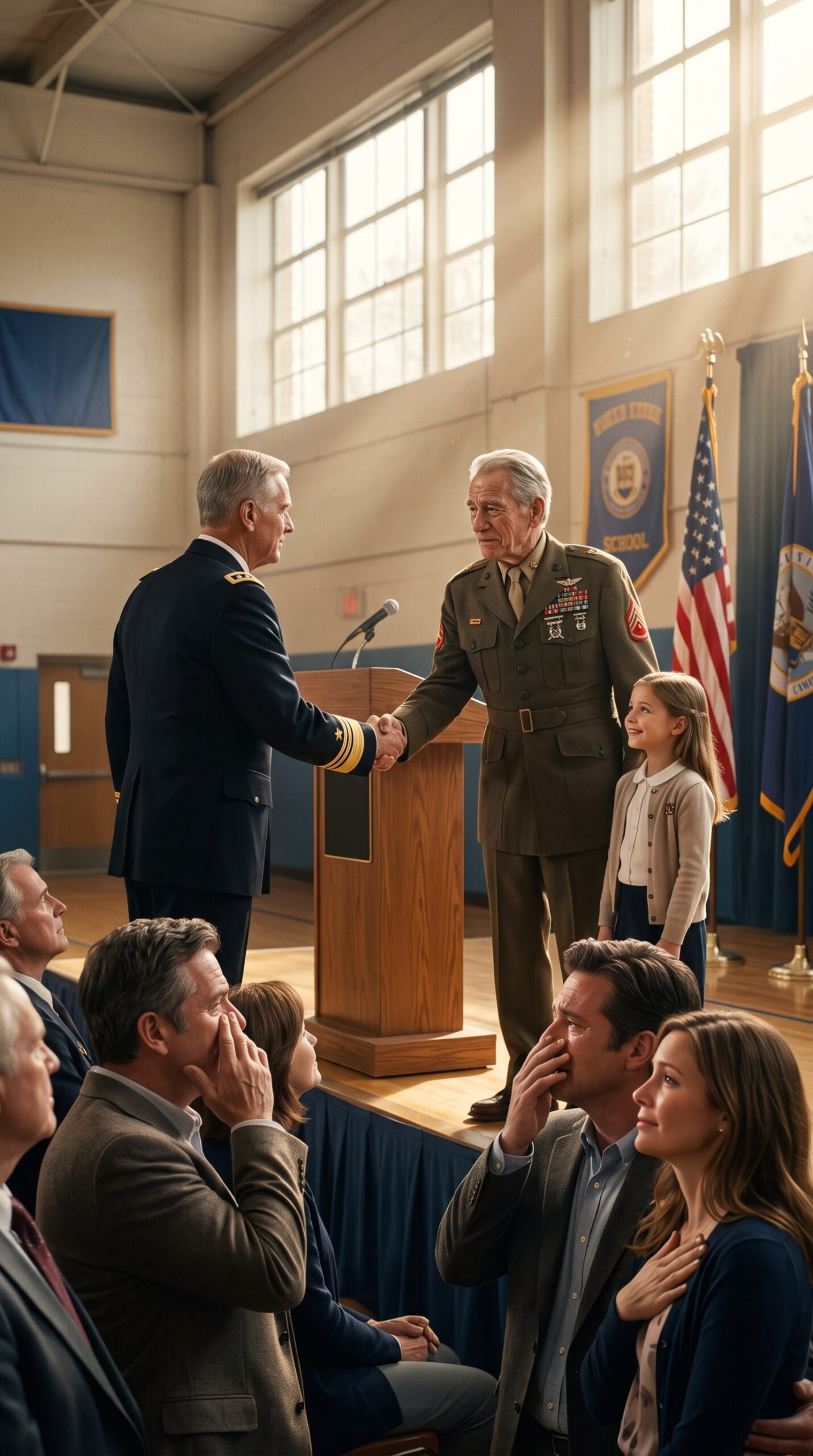
An elderly man in a dress uniform stood in the doorway, leaning on a cane, his chest heavy with ribbons. Two other men in their seventies stood beside him, wearing the same unit patch.
Frank rose slowly from his chair.
“Lieutenant?” he whispered.
Colonel Whitaker walked down the center aisle, and the children moved aside without being told. When he reached the stage, he looked at Frank for a long time.
“Sergeant Dalton,” he said, and his voice broke.
Frank’s hand rose to a salute he hadn’t made in fifty years. The colonel returned it. Then he dropped his hand, stepped forward, and wrapped his arms around Frank, cane and all.
“I’ve been looking for you for twenty years,” he said. “The Army told me the trail went cold. And all this time you were sitting at a kitchen table three states away.”
“I didn’t think anyone needed to find me, sir.”
“Every one of us needed to find you.”
He took the microphone. “Your granddaughter’s letter reached me nine days ago. I read it in my kitchen and wept. Then I called the last two men from our platoon, and we booked flights. I want to tell you what happened on that river road, because your grandfather never will.”
“March 14th, 1970. I was a twenty-three-year-old lieutenant commanding forty-four men in a supply convoy. We were hit at dawn. Rockets from the north bank, machine guns from the south. The lead truck burned first, then the fuel truck behind it, so hot we couldn’t see through the smoke. Shrapnel tore into my leg and I went down in the road. I thought that was where I’d die.”
The gym held its breath.
“The captain on the radio ordered a retreat. Sergeant Dalton was twenty-one and had no orders to go back. But he looked at those trucks and said four words I will hear until my last day: Nobody gets left behind.“
The colonel’s hand trembled on the microphone.
“He went in seven times. He carried me out first, then Private Okafor, then Corporal Reyes, who was bleeding badly. He wrapped his own jacket around a man who was burned. His hands were blistered to the wrists and his eyebrows were gone, and he kept going back, because he had counted the names and knew someone was still inside.”
He gestured to the men behind him.
“Forty-one of us walked out of that ambush alive. Three did not, and he carried every one of them out anyway, so their families could bury them. When the Army wanted to send him on a speaking tour, he refused. He said he didn’t want thanks for doing what any decent man would do.”
His voice softened. “But not every man would have. I’ve seen the other kind. Your grandfather is the first kind.”
In the third row, Karen was crying openly. David had both hands over his face. Michael sat frozen, staring at his father as if at a stranger.
A statue, he thought. We treated him like furniture.
The children rose to their feet, all three hundred of them, and clapped until the floor shook. The two other veterans came forward and took Frank’s weathered hands.
“Corporal Reyes,” said the smaller man, smiling through tears. “You carried me past a burning truck, Sergeant. I have four grandchildren because of you.”
“Private Okafor,” said the other. “I named my son Francis.”
Frank, who had walked into fire seven times without flinching, covered his face and wept.
Michael reached him first. He pushed through the crowd, his expensive coat catching on a folding chair, and stopped in front of his father. A man who negotiated million-dollar settlements for a living could not find a single word.
“Dad,” he finally said. “I’m so sorry.”
“For what?”
“For every Thanksgiving. For ‘can we skip the war stories.’ For forty years of never asking you one real question.” His voice cracked. “I was too busy telling you about my life.”
“You had a good life to tell me about,” Frank said gently. “That’s all I ever wanted for you.”
“That’s not an excuse.”
“No,” Frank agreed. “But it’s forgiven.”
Karen and David joined them, and the four of them stood together, a family that had shared a table for decades and was only now truly seeing one another.
“Mom would have been so proud,” Karen whispered. “And so angry at us.”
Frank laughed, a wet, surprised laugh. “She’d have put a fork through all three of you.”
Then they turned to Lily, who stood at the edge of the stage twisting her hands, unsure whether she had done something wonderful or terrible. Frank crossed the stage and knelt in front of her, his knees creaking.
“You did this,” he said.
“I’m sorry if I made you cry, Grandpa.”
He took her face in his scarred hands. “In seventy-six years, nobody has done a kinder thing for me. You listened. Do you know how rare that is?”
She threw her arms around his neck, and he held her the way he had once held wounded men on a burning road, with everything he had.
That evening, the whole family gathered in Frank’s living room. Michael looked at his father. “Dad, would you tell us about it? Not the headline. All of it.”
Frank hesitated. Then he carried the olive-green footlocker down from the attic, set it on the coffee table, and lifted out the medals one by one. For the first time in fifty years, he told his children the story of his life.
It took three hours. Nobody checked a phone.
The next Thanksgiving, the table was different. David had skipped his work trip. Karen had set Frank’s chair at the head of the table, where Margaret used to keep it for him. Colonel Whitaker, Corporal Reyes, and Private Okafor sat as guests of honor with their families, and Lily sat at her grandfather’s right hand, swinging her feet.
Before the meal, Michael tapped his glass.
“Dad, for forty years nobody asked you the right question. So I’m asking it now. Frank Dalton, tell us a story. We’re listening.”
Frank looked around the table at his children, his granddaughter, and three old soldiers who owed him their lives. He straightened his jacket out of habit, and then he smiled.
“Well,” he said. “There was one Thanksgiving in Vietnam…”
This time, every person at the table leaned in.
Frank lived six more years, and he told his stories at every holiday to anyone who would listen. At the end of each one, a small hand always found his.
When he passed, a line of veterans saluted his casket. The plaque on the lid, designed by Lily and paid for by Michael, read:
FRANCIS “FRANK” DALTON. HE NEVER LEFT ANYONE BEHIND.
Every Thanksgiving since, the family keeps an empty chair at the head of the table. Nobody sits in it, but everyone talks about him, and everyone listens.
The End.