I opened the door, and there he stood in his barn coat with the porch light on his gray hair, holding two pieces of my lace against his chest with both hands. A bit of coffee grounds clung to one edge.
“Evening, Junella,” Wendel said. His voice was low and rough, like he hadn’t used it much that day. “I know it’s late.”
“Wendel.” I couldn’t think of another word.
“I got it out of the trash,” he said. “I thought you’d want it. I know the stain won’t come out, but the lace is whole. It’s just the bodice that got cut.” He held it out like something alive. “My grandma made every Sunday shirt I ever had. I know what this is.”
My throat closed. I took the two halves from him, and they felt weightless and heavy at once.
Then he stepped aside.
Behind him, under my porch light, leaning on a cane in her good wool coat, stood Vela Kuyper. She was ninety-one years old, with white hair pinned in the same braided crown she had worn for as long as I’d known her. She was the woman who had sewn every bride in our church for fifty years and taught me to smock.
“Vela,” I whispered. “It’s eleven o’clock at night.”
“I know what time it is, Junella.” Her voice was thin, but it still carried the way it did in the sewing circle. “I’m old, not stupid. Wendel, help me in. These steps are not what they were.”
She sat at my kitchen table with her cane across her knees and looked at the scraps of gown scattered over my cutting mat, the second dress I’d started in my stubbornness at nine o’clock.
“You were going to make another one,” she said.
“I was going to try. There isn’t enough lace.”
“No.” She ran a finger along the cut edge of the ruined bodice, the way a doctor checks a wound. “But there is enough for what matters. Hand me those.”
Wendel set the kettle on without being asked. He found my cups on the second try. I sat down across from Vela, because my legs had decided to.
“How did you know?” I asked.
“Wendel called me at ten o’clock,” she said. “He said, ‘Mrs. Kuyper, there’s a dress that needs saving, and I don’t know how to do it.’ So I put my coat on.”
I looked at Wendel. He was staring at the kettle.
“Why?” I said. “You’ve barely said ten words to me in two years.”
He turned around slowly. He was a big man, broad in the shoulders, and he suddenly looked like a boy caught doing something kind.
“I’m not good at talking,” he said. “My father wasn’t, and I learned it from him. When I’m around somebody I admire, I go quiet. I get scared I’ll say something foolish.”
“Admire?” I said.
“You raised Lorenda by yourself half the time while you worked. You do everybody’s taxes for nothing at church. You made that little girl a dress out of your own wedding gown, Junella. I drove Rennie to every fitting because I wanted to see it.” He cleared his throat. “I would sit in that truck with the radio on and think, I’m marrying into a family where somebody does that. I thought I didn’t deserve it.”
I had spent two years reading shyness as snobbery. My eyes stung.
“I should have told you,” he said. “I’m sorry I didn’t.”
“And your mother?” I asked, more gently than I felt.
His jaw tightened. “She did what she did. I walked in when it was done. I found it in the trash. I took it out.” He looked at the floor. “I’m forty-six years old, and I’ve let her run my life since my father died. I’m done with that. I told her tonight.”
“What did you tell her?”
“That if Rennie wasn’t wearing your dress, I wasn’t getting married in that hall.” He took a breath. “She didn’t take it well.”
Vela waited until the tea was poured. Then she spread the lace on the table and began, with her knobby fingers, to sort pieces.
“Claudine Voss,” she said, almost to herself. “I sewed her wedding dress in 1974. She sat in my chair and told me the smocking was ‘old-fashioned.’ I told her it was the only part of the dress worth keeping.” A thin smile. “She’s been afraid of anything handmade ever since. She thinks it means you couldn’t afford better.”
“She cut it in half, Vela.”
“I know. And she’ll answer for it, but not tonight.” Vela picked up the lace sleeve, the one I had saved from the cedar chest, uncut. “Look at this. You can’t cut around what a person’s hands have made. The shears only got the bodice and the skirt panel. The smocking on the yoke survived. So did both sleeves and the whole hem.”
I stared. In my grief I hadn’t looked. She was right.
“A flower girl’s dress needs very little,” Vela said. “A yoke, sleeves, and a skirt. We can use the satin from your wedding train for the body. You kept it?”
“It’s in the chest.”
“Then we have everything.” She looked at Wendel. “Young man, do you know how to thread a needle?”
“I can sew a button on a coat.”
“Then you’ll hold the light.”
We worked until four in the morning.
Vela sat at the head of the table, directing. I ran the machine. Wendel held a gooseneck lamp over our hands, so steady that Vela remarked he’d make a decent surgeon. When my eyes blurred, he put another cup of tea at my elbow. When Vela’s hands cramped, he rubbed them gently between his own palms without being asked.
At one point I caught him looking at the half-finished yoke and then at me, and he said, very quietly, “Rennie’s going to cry.”
“She better not drip on the satin.”
He laughed, a real laugh, startled out of him, and I realized I had not heard it before.
Around three, Vela paused with the needle in her hand.
“Junella,” she said, “you asked me thirty years ago to teach you to smock, and I said you’d never be fast enough. Do you remember?”
“I remember.”
“I was wrong.” She held up the finished yoke, every pleat even as rain. “Your hands are better than mine were. I should have said so.”
I put my hand over my mouth. At seventy-two years old, I cried at my own kitchen table over a compliment from a woman I’d feared since I was a bride.
The wedding was Saturday at two o’clock.
I walked into the church with the dress in a garment bag. Lorenda met me in the vestibule, still in her robe, her curlers half out.
“Mama, I’m so sorry,” she whispered. “I should have stood up to her. I should have…”
“You were scared, honey.”
“I was a coward.”
“You were a bride two days before the wedding. That’s allowed.” I unzipped the bag. “Go get your daughter.”
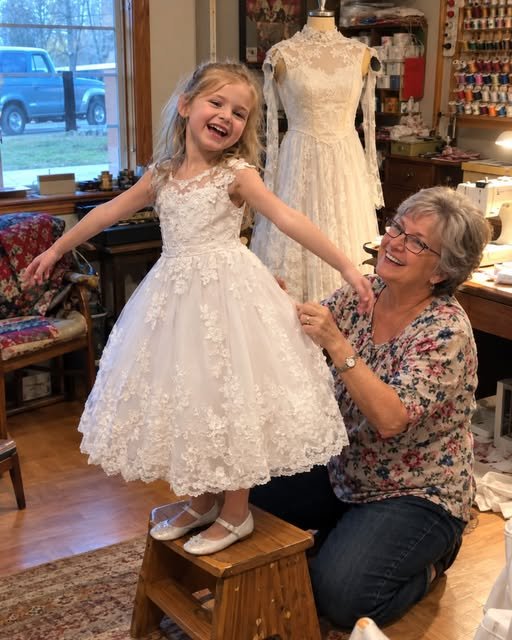
Rennie came running in her slip. When she saw the dress, the smocked yoke, the lace sleeves, the soft ivory skirt that I had stitched in the dark hours with two friends, she stopped, and her mouth fell open.
“Grandma. It’s the same one.”
“It’s a new one,” I said. “But it’s made out of the old one. The best parts.”
She put it on. She turned in front of the mirror, and then she hugged me so hard I nearly toppled.
“Do I look like a princess?”
“You look like a Bakker.”
Claudine arrived ten minutes later with her purse clutched in both hands, and she saw the dress before she saw me.
For a long moment she said nothing. The vestibule went very still. Wendel stepped up beside me, and I felt him there, solid as a post.
“Mother,” he said. “Say what you came to say.”
Claudine’s mouth worked. Her eyes slid to Vela, who sat in the front pew with her cane, watching with the expression of a judge who has already reached a verdict.
“I was wrong,” Claudine said, so quietly I almost missed it. “I was embarrassed. I didn’t know how to be, in front of all of you.” She looked at me. “Junella, it was cruel. I’m sorry.”
It cost her more than it had cost me to be silent. I knew it.
“Thank you, Claudine,” I said. “Sit by me at the supper. We’ll talk about the cake.”
She nodded, and a tear slid down her cheek that she didn’t bother to wipe.
Rennie walked down the aisle scattering petals, solemn as a bishop, in a dress that had been cut apart and sewn back together. Every woman in the church leaned forward to look at the smocking. Afterward, three of them asked me to teach their granddaughters.
At the reception, Wendel found me by the coat rack.
“Thank you for letting me in,” he said. “Last night.”
“Thank you for showing up.”
He hesitated, then held out his arm, stiff and formal. “Would you dance with me, Junella? Not a long one. I’m not good at it.”
“I’m seventy-two, Wendel. I’m not good at it either.”
We danced one slow song in the middle of the hall, badly, while Rennie twirled in her dress beside us until I begged her to hold still.
On Monday, Vela sent me a note in her old shaky hand. It said only: Bring your machine Thursday. Fourteen girls want to learn.
I did. I’ve been teaching ever since, at the same long table in the church basement, where the lace still hangs in a frame on the wall, and the girls ask whose it was.
“A bride’s,” I tell them. “And a flower girl’s. And, a little, everyone’s who ever sat down at the table and picked up the needle.”