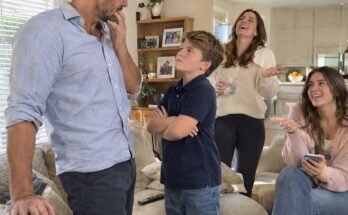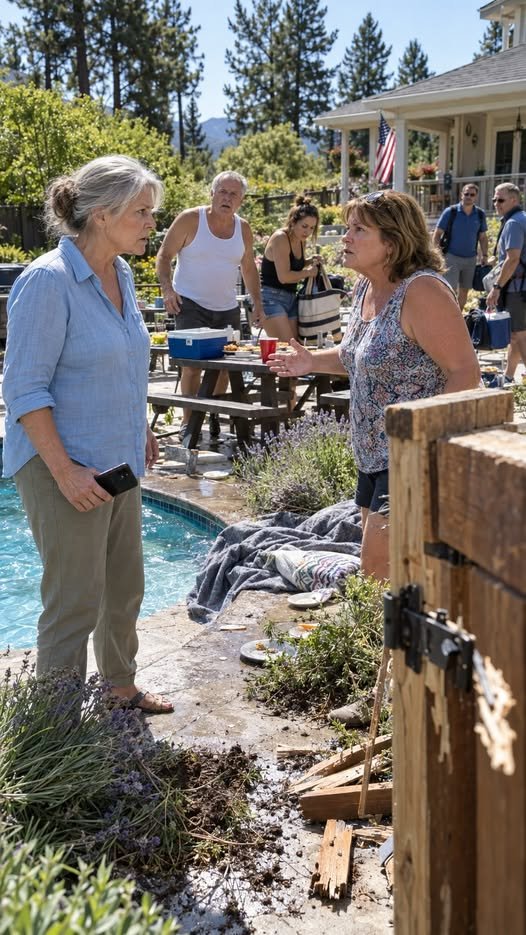
Roy pointed to the line beside the signature. “Our company requires proof of ownership before we rekey a residence. Mrs. Ross’s daughter-in-law told the office she had a notarized power of attorney.” He tapped the box. “It’s blank. Nobody ever attached one.”
David looked at the empty box, then at his wife. “You told them you had power of attorney over Mom’s house?”
“I told them what I had to,” Carrie said, her voice climbing. “Nobody was getting anywhere, David. Your mother refuses to make any decisions. We were helping her.”
“I haven’t been asked to make a single decision,” I said quietly.
I opened the white envelope and laid its contents on the island one at a time, the way I used to lay out records at the municipal office.
“This is the deed,” I said. “Dan and I bought this house in 1995. In 2019, we retitled it into the Ross Family Trust, with Dan and me as trustees. When Dan passed, I became the sole trustee. This”—I set down a second page—”is the trust document. It says the house stays in the trust for my lifetime, and that only the trustee may authorize changes to the property, including locks, sales, or occupants.”
Janice’s smile had vanished. “That’s a lot of paper for a simple family arrangement.”
“Paper is how simple arrangements stay simple,” I said. “Dan used to say that.”
Then I picked up the last item, a letter on cream stationery. “And this came last winter, from Dan’s attorney, Mr. Whitfield. Dan left it with him to be delivered one year after he passed.”
My voice caught, but I read it anyway.
Helen, if you are reading this, I am sorry I’m not there. I know you. You’ll try to keep everyone comfortable until there’s nothing left of you. Don’t. This house is yours. If anyone ever asks you to leave a room in it, remember who built the rooms. I love you. Dan.
Nobody spoke. David had gone pale. Carrie stared at the letter as if it were a summons.
“You never told us there was a trust,” she said finally.
“You never asked,” I said. “You asked where I’d sleep.”
David set the floor plan down and looked at me for a long moment. I saw the boy who had once cried over a broken kite, and I saw his father in the set of his jaw.
“Mom, I’m sorry. I should have seen it. You told me they were taking over, and I told you to keep the peace.” He swallowed. “I thought peace meant you swallowing it. That was never fair.”
“I let you think so,” I said. “That part’s mine.”
He turned to his wife. His voice was quiet, which was worse than anger. “Carrie, did you plan to move your parents in without asking my mother?”
“We were going to tell her after it was done,” Carrie admitted. “She’d never agree. You know how she is.”
“How is she?”
“Stubborn. Difficult. She holds on to everything.”
“She holds on to her house,” David said. “She holds on to my father’s chair. Those aren’t flaws.”
Frank, who had been standing at the foot of the stairs with a suitcase in each hand, set them down very gently and said what none of us expected. “Janice, I told you this wasn’t right.”
“Frank!”
“I did.” He rubbed the back of his neck. “I said it three times. I’m sorry, Helen. I should have stopped it. I didn’t want a fight.”
“Nobody wants a fight, Frank,” I said. “That’s how they keep happening.”
Roy, who had stayed politely silent throughout, cleared his throat. “Mrs. Ross, I’ll cancel the order. No charge for the visit. And I’d recommend rekeying anyway, with you holding the only set.” He gave a small nod. “Quietly, I mean.”
I almost laughed. “That’s the best idea anyone’s had this morning.”
By noon, the suitcases were back in Janice’s car. She had tried once more to argue, something about “family contributions” and “the house being too big for one person,” but David cut her off.
“Janice. My mother owns this house. You and Frank can visit when you’re invited. Not before.”
She left with her chin high and her purse clutched like a shield. Frank paused in the doorway, said “I’m sorry” once more, and followed.
Carrie remained at the island, gripping its edge. When it was only the three of us, her composure finally cracked.
“I wasn’t trying to hurt you,” she said to me. “I grew up in a tiny apartment where everyone shared everything. When I came here and saw all this space, all this quiet, I thought, why is she alone in it? Why does one person get so much?”
“That’s an honest question,” I said. “Here’s an honest answer. Because I earned it. And because I’m not alone. I have David, and I have you, if you want to be someone I can have.”
She wept then, quietly, with her hand over her mouth. I didn’t comfort her, not yet. Some tears have to run their course.
David took a long breath. “Carrie, you and I are going to talk tonight. Not here. And you’re going to apologize to my mother properly, not because I told you to, but because you mean it.”
“I do,” she whispered.
“Then say it to her.”
Carrie looked at me. Her eyes were red, her makeup streaked. “Helen, I’m sorry. I took your home and treated you like a guest in it. I let myself believe I was helping because it was easier than admitting I wanted what you had.”
It was the most truthful thing she had ever said to me.
“Thank you,” I said. “I’ll hold you to every word of it.”
The weeks that followed were awkward. Carrie and David went to counseling. They moved out of the room they had been using in my house and rented a small place of their own across town, which Carrie decorated herself, proudly, with a secondhand couch she had refinished. Janice did not call for a month. When she finally did, it was to ask, stiffly, whether she might bring over a casserole on Sunday.
“Call first,” I said.
“I will.”
She did. The casserole was dry, and I ate two helpings.
Dan’s photograph went back on the mantel. David found his father’s chair in Amber’s apartment, where it had quietly been taken, and carried it back himself in the bed of his pickup. Amber sent a note apologizing for the patio furniture. I framed it, just for fun, and hung it in the pantry.
On the first anniversary of that morning, I invited everyone for dinner. Carrie, David, Janice, Frank, Amber. I set the table with Dan’s mother’s china. I cooked a ham, and nobody ate it before I sat down.
Before the meal, I stood at the head of the table and tapped my glass.
“I want to say something,” I said. “A year ago I thought being a good mother and a good mother-in-law meant disappearing a little at a time. I was wrong. Love doesn’t mean giving away every room in your house. It means keeping the door open and keeping the key.”
Carrie raised her glass. “To the key,” she said, and her voice shook.
“To the key,” said David.
After dinner, as the others did dishes, I took my blue mug to the back porch and sat in Dan’s chair, which David had carefully refinished. The evening was soft, the yard full of the trees we had planted thirty years before. Behind me, through the open window, I could hear laughter in my kitchen, and not one person in it was rearranging my cabinets.
I held the mug up toward the darkening sky.
“They’re learning, Dan,” I whispered. “Slowly. But they’re learning.”
I slept that night in my own bedroom, in my own bed, behind a door with a lock that only I could open. And in the morning, I made my coffee in peace.