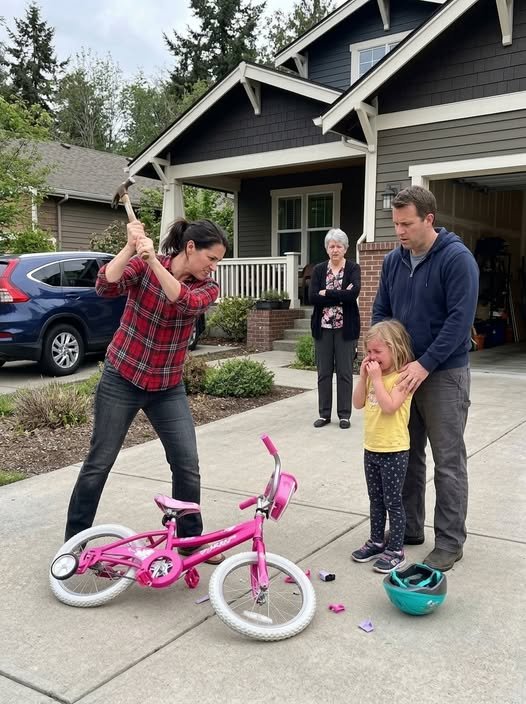
Nobody moved. Somewhere inside, the cartoon theme song started, bright and tinny, and it made the quiet on the driveway feel even heavier.
“What is that supposed to mean?” Claire said. She tried to laugh, but it came out thin. “Don’t be dramatic, Emma. It’s a bike.”
“It was Lily’s bike,” I said. “And you did it on purpose, in front of her. I want to be sure I remember it exactly right.”
I took my phone out of my back pocket and turned the screen toward them.
The red recording dot was lit.
“Our doorbell camera covers the driveway,” I said. “It records audio. It got the hammer, the three strikes, and every word either of you said. I’d also like to thank you, Mom, for repeating yourself so clearly.”
My mother’s mouth opened and closed. “You wouldn’t.”
“I’m not threatening you,” I said, calmly enough to surprise myself. “I’m telling you what happens next. I’m going to take my daughter for ice cream. Then I’m going to file a police report for destruction of property and for deliberately frightening a child. Then I’m going to call my lawyer about the house.”
Claire’s face changed. “What house?”
I should explain about the house.
Three years earlier, when Dad died, he left his small brick home on Alder Street in a trust. My mother lived there, and Claire, who had “temporarily” lost her apartment, had been living in the basement ever since. I was named trustee. Dad had known exactly who in this family could be trusted to read a document before signing it, and who could not.
The terms were simple. Mom could live there for her lifetime. Claire could stay as long as she contributed to household costs and “treated all members of the family with respect.” If either condition failed, the trustee, me, could require her to leave. Claire had paid nothing in two years. I had never enforced it, because enforcing it meant a fight, and I had spent my whole life avoiding fights with her.
“You’d put your own sister on the street over a bicycle?” my mother said, her voice shaking.
“No, Mom. I’d ask my sister to leave the basement because she paid no rent for two years and then brought a hammer to my daughter. The bicycle is just the part that’s on camera.”
“Emma, please.” Her hand went to her chest. “Think about what your father would want.”
I looked at her for a long moment. “I have thought about it. Dad kept a rule in the trust because he knew Claire. He wrote it down so that I wouldn’t have to be cruel. I only have to be fair.”
She had no answer. For once, nobody offered an explanation for why I had caused it.
I went inside and found Lily on the couch with her knees pulled up, the cartoon playing to nobody. She had her little silver bell in her hand. She must have run out the side door and picked it up from the grass while we were arguing.
“It’s okay, baby,” I said, sitting beside her. “You can tell me anything.”
“Did I do something bad?” she whispered.
“No. Not one thing.”
“Aunt Claire said I was spoiled.”
“Aunt Claire was wrong.” I pulled her against me. “You were happy about a bike, and that is not spoiled. That’s what a happy kid looks like.”
She cried then, finally, the way she hadn’t on the driveway. I held her until it passed.
“Can the bike be fixed?”
I thought about the twisted frame. “I don’t think so, sweetheart. But I know somebody who’s going to buy you a new one.”
“Who?”
“Aunt Claire.”
Her eyes widened. “Really?”
“Really,” I said, and I meant it more than I had ever meant anything.
Claire called that night, then again, then eleven more times. I didn’t answer. I texted her once.
I’ll speak with you after the police report. My lawyer will send the paperwork.
By morning she had sent a string of messages, each angrier than the last, and then one that was different: Emma, please. I lost it. I was so jealous. Mom bought her the bike? I mean, YOU bought it, and I just. I don’t know. I’m sorry.
I read it three times. Then I read the earlier ones again.
Mom came by at ten, alone. She stood on my porch, small and gray, without her usual armor.
“Can I come in?”
I let her. We sat at the kitchen table.
“I’ve been awake all night,” she said. “I keep hearing myself. You shouldn’t have bought it for her. In front of that child.” She pressed a tissue under her eyes. “I’ve been saying things like that to you since you were little. ‘Don’t make a fuss.’ ‘Let Claire have it.’ I thought I was keeping the peace. I think I was just keeping you small.”
I did not say anything. I had waited thirty-four years to hear it.
“I’m sorry,” she said. “To you. And to Lily. I don’t know if that’s worth anything.”
“It’s worth something,” I said. “It’s not worth everything. Not yet.”
“What do I do?”
“You tell Lily yourself. You tell her you were wrong, and that it wasn’t her fault. And then you stop deciding which of your daughters gets to be hurt.”
She nodded slowly, wiping her face. “I can do that.”
Claire came on Saturday.
She stood in my driveway, in the exact spot where the bike had been, and looked as if she wanted to be anywhere else. She held a brand-new pink bicycle with streamers and a silver bell. She had paid for it out of her last paycheck. She had even replaced the bell.
Lily watched from the doorway.
“Lily,” Claire said, her voice cracking. “I did a terrible thing. It wasn’t because of anything you did. I was angry at your mom, and I took it out on something you loved. That was wrong, and I’m so sorry.”
Lily thought about it with the grave attention of a six-year-old judge.
“Why were you mad at Mommy?”
Claire glanced at me. “Because she’s good at things I’m not. And it’s easier to be mad than to say that.”
“Oh.” Lily considered this. “I get mad at Mommy when she says it’s bedtime.”
Claire laughed, a wet, startled sound. “That’s about the size of it.”
Lily came down the steps, took the handlebars, and rang the new bell once. It chimed bright and clear.
“Do you want to see how I ride?” she asked.
The police report went forward, because I had promised it would. Claire pleaded to a misdemeanor, paid restitution, and completed a counseling program the court required. She moved out of the Alder Street basement in the spring and took a lease on a small apartment across town. She paid rent on time, which surprised everyone but my father, in spirit.
It was not a perfect reconciliation. We were two people learning to be sisters from the other side of a bright line. But the lessons she taught my daughter that day were not the last she ever gave.
The last one came the next summer, on the sidewalk outside my house. Claire stood behind Lily, who was wobbling toward the corner on two wheels without training wheels for the first time. Claire held the back of the seat. She let go when Lily said to, and she cheered so loud that the neighbors came out on their porches.
“I’m doing it!” Lily shrieked. “Mommy, look, I’m doing it!”
“I see you, baby,” I called, and I was crying.
My mother stood beside me, holding a camera. “That girl,” she said softly. “She doesn’t even know how brave she is.”
“She will,” I said. “We’ll tell her. Every day.”
At the end of the block, Lily turned in a wide, wobbly arc and rode back toward us, streamers flying in the sun, bell ringing like a small silver promise. Nobody on that sidewalk had a hammer in their hand.