Daniel barely slept for the next two weeks.
Between his classes and his delivery shifts, he made phone calls, knocked on doors, and wrote the same message so many times he could have recited it in his sleep. He started with the neighbors at Maple Court. Mrs. Alvarez on the first floor, who baked, said she would bring three trays of food. The retired mechanic in 3C offered to hang decorations. The family in 2A volunteered their teenage son, who played trumpet in the high school band.
Then Daniel widened the circle. He walked into the local VFW post and asked to speak to whoever was in charge. A gruff man named Ray listened to the whole story, wiped his eyes with the back of his hand, and said, “Give me a week. I’ll call every veteran in Montgomery County.”
A local diner offered to cater. A frame shop donated a handsome glass shadow box for the medals. A reporter from the local news station heard about the plan and ran a short story under the title “Neighbor Seeks to Honor Forgotten Hero.” The story was shared hundreds of times. Then thousands.
Meanwhile, Tyler Pruitt called Daniel nearly every day with updates. Walter Pruitt, now eighty-one, had been told the news in his living room in Cincinnati. He had sat in silence for a full minute, then said only, “Get me my good suit.”
Tyler also found three other men from that patrol who were still living, along with the children and grandchildren of the ones who had passed. In all, eleven families had a reason to be there. Eleven families who existed because one young sergeant had refused to leave.
Robert came home from the hospital quietly, with a cane and a bottle of pills. He had no idea what was being planned. Daniel simply knocked on his door one Saturday evening and said, “Mr. Haines, would you do me a favor and come down to the community room? There’s something I need help with.”
Robert sighed, buttoned his good flannel shirt, and followed him down the stairs, grumbling gently the whole way.
Daniel opened the door.
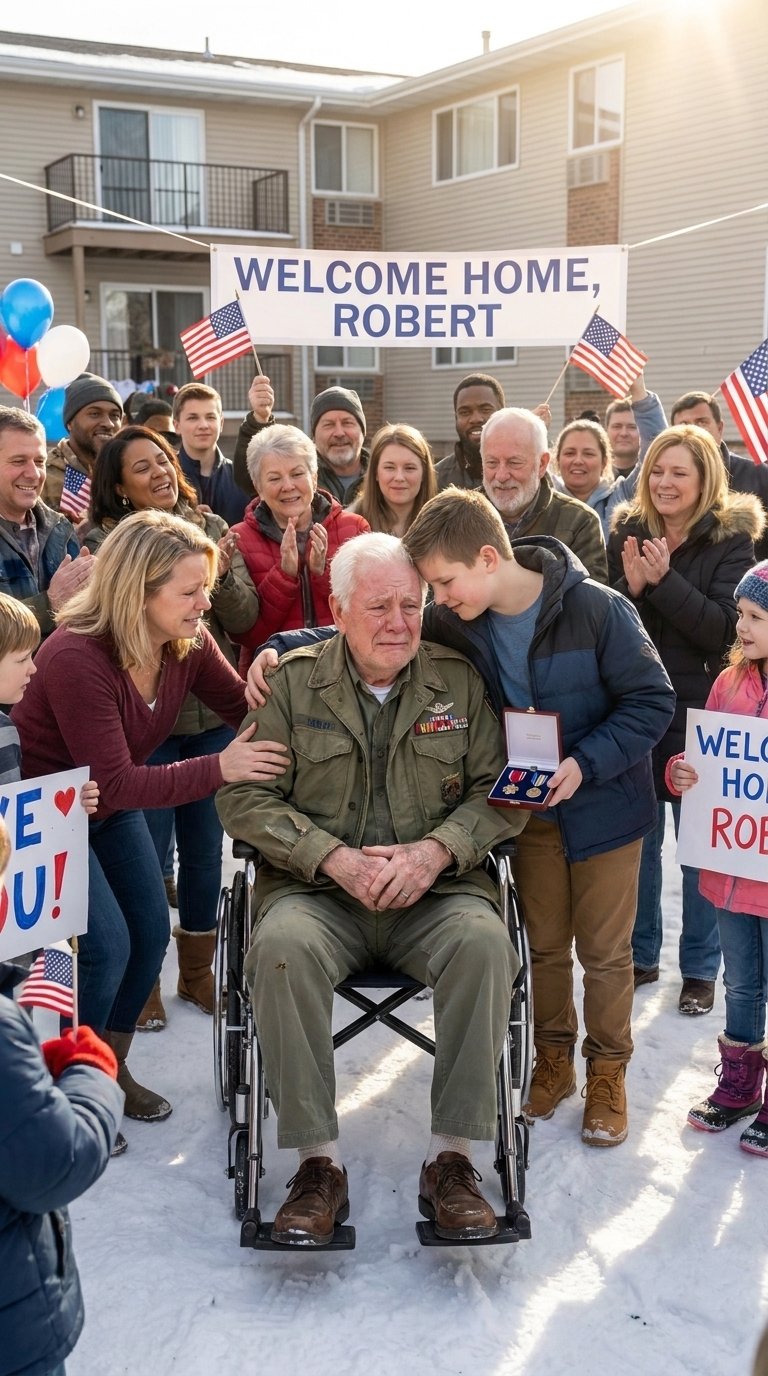
The room was packed. More than two hundred people filled the space and spilled into the hallway. Veterans in worn caps and pressed jackets stood shoulder to shoulder with grandmothers, schoolchildren, nurses, and neighbors Robert had passed in the parking lot for years without ever really knowing. Red, white, and blue streamers hung from the ceiling. In the corner, a teenager with a trumpet lifted his instrument.
And as Robert stepped through the doorway, every single person in that room rose to their feet.
The applause started slowly, then swelled until the windows shook. Robert stopped dead, one hand clutching his cane. His mouth opened but nothing came out. His chin trembled.
Then a figure rolled forward through the crowd in a wheelchair, an elderly man in a suit that was a size too big, with a chest full of faded ribbons and tears running freely down his face. Tyler pushed the chair to a stop in front of Robert.
“Sergeant Haines,” the old man said, his voice cracking. “It’s Walter. Walter Pruitt. March 1969. You carried me out.”
Robert stared at him. Fifty-seven years collapsed in an instant.
“Pruitt?” he whispered. “The kid with the broken leg who wouldn’t stop cursing at me?”
Walter laughed and sobbed at the same time. “That’s me. I’ve been looking for you my whole life. I have four children and nine grandchildren because of you. Every one of them is in this room tonight.”
He pushed himself up out of the wheelchair on trembling legs, refusing help, and stood at attention. Slowly, painfully, he raised his hand in a salute.
One by one, every veteran in the room did the same.
Robert, who had never once asked anyone for anything, finally broke. He wept openly, the cane clattering to the floor, and Walter pulled him into an embrace that lasted a long, long time. Behind them, people were crying and no one was embarrassed.
The other survivors came forward, one by one. A man named Eddie, whose daughter held a newborn: “This is your namesake.” A woman holding a photograph of her late father: “He talked about you until the day he died.” Ray from the VFW stepped up with the shadow box, the medals mounted perfectly on dark blue velvet, and pinned the Bronze Star back where it belonged.
“These aren’t just for the ones who didn’t come home,” Ray said. “They’re for you, too.”
Then the crowd parted at the back of the room.
Two people stood in the doorway, snow melting on their coats. A woman in her fifties with her father’s eyes. A man a few years younger, clutching his car keys as if he’d forgotten how to let go.
“Dad,” Karen said.
She had seen the news story on a friend’s phone. She had read the headline, then the article, then called her brother in tears. They had booked the first flights they could find. The two of them had been traveling for eleven hours.
“We didn’t know,” Michael said, his voice breaking. “You never told us. Dad, we didn’t know any of it. But that’s no excuse. We should have asked. We should have been here.”
Karen stepped forward. “I told a stranger I was too busy to come see my own father in the hospital. I will never forgive myself for that. I’m so sorry, Dad.”
Robert looked at his children for a long moment. Then he held out both arms.
“Come here, you two,” he said gently. “Come here.”
They fell into him, and for the first time in a very long time, the Haines family held each other.
Later that night, after the speeches and the food and the trumpet playing a slow, steady rendition of Taps, Robert found Daniel by the door, trying to slip away.
“Son.”
Daniel turned. “Mr. Haines.”
Robert took the young man’s hand in both of his. “I carried eleven men,” he said quietly. “You carried me. I won’t ever forget it.”
Daniel, who had spent two weeks holding it together, finally let his tears fall.
The Ending
Robert didn’t spend his next birthday alone.
On a cold, clear October morning a year later, more than a hundred people packed into the Maple Court community room. Walter Pruitt came with all nine grandchildren. Karen and Michael flew in with their families and stayed for a week. The VFW brought a cake the size of a door. Daniel, now a registered nurse, stood near the front with a plate of Mrs. Alvarez’s tamales.
In the center of the table sat a single vanilla cupcake with one small candle.
Robert looked at it, then at the faces around him, and laughed.
“Make a wish, Dad,” Karen said.
He shook his head, smiling. “I don’t have one. I’ve already got everything.”
Then he blew out the candle, and the room erupted.
The wooden box is still on the shelf above his television, but it is empty now. The medals hang in their shadow box on the living room wall where every visitor can see them, and there are many visitors these days. Neighbors drop by for coffee. Daniel comes for Sunday dinner. Karen calls every night.
And whenever anyone at the pharmacy says, “Thank you for your service,” Robert no longer looks away. He looks them in the eye and says, “Thank you for remembering.”
The lesson: Behind every quiet neighbor is a story we haven’t heard yet. Sometimes the greatest heroes live right down the hall, waiting for someone to simply knock on the door.
❤️ If this story touched you, share it, and take a moment today to call or visit someone who may feel forgotten.