I turned the handle and pushed the door open.
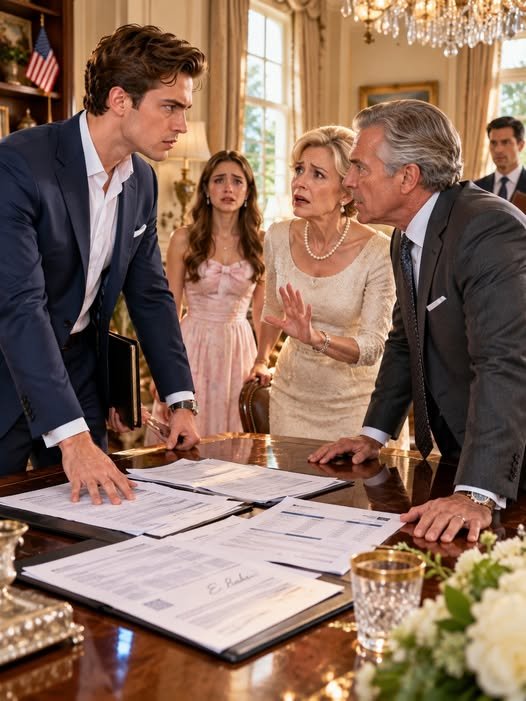
Four faces swung toward me. Dad stood at the head of a small conference table with a pen in his hand. Mom sat beside him, and Madison perched on the edge of a chair, a glossy folder open in front of her. The man in the navy suit had a document half-slid across the table, a yellow flag marking the signature line.
“Ethan,” Dad said, recovering first. His smile came on like a light switch. “Perfect timing. We were just about to come find you.”
“I’m sure you were.” I stepped inside and closed the door behind me. “Please, don’t stop on my account. $180,000, I think I heard?”
The man in the suit glanced at my father. “Mr. Baker, I was told your son was aware of…”
“I wasn’t,” I said. “And you are?”
He stood and offered a card with a slightly damp hand. “Gerald Whitcomb, Whitcomb Capital Advisors. I was retained to prepare an investment agreement for your sister’s boutique.”
“With my signature already typed on it.”
Nobody answered.
I walked to the table and read the page upside down, then turned it around. It was a personal guarantee. Whatever Madison’s business borrowed, Ethan Baker would be legally responsible for repaying. Beneath it was a line for my signature and a second line, prefilled, for a notary.
“Mr. Whitcomb,” I said, “did my father tell you I’d agreed to this?”
“He said you’d verbally consented and would sign tonight.”
“Then you’ve been misled.” I set my phone on the table. “And I should tell you that I’m recording this conversation. Georgia is a one-party consent state, so it’s perfectly legal. I’d think carefully about your next sentence.”
Mr. Whitcomb’s face went gray. He began gathering his papers.
“Sit down, Ethan,” Dad said, his voice dropping into the register that had once made me shrink. “You’re making a scene.”
“That’s the second time tonight someone’s accused me of that,” I said. “The first was never said aloud, only implied. Let me tell you what I’m actually doing.”
I laid the bank documents on the table one by one.
“This is the custodial account Grandma Ruth opened for me when I was nine. Eighty-one thousand dollars at the last statement before the withdrawals began. Over four years it was emptied into a card in Mom’s name. These are the withdrawal forms, which carry my signature. It isn’t mine. I’ll be happy to prove that to a forensic document examiner.”
Mom’s hand went to her throat. “Ethan, we were going to pay you back.”
“With what? And when? You told me today that sons are stable and daughters need a leg up. You never said you were sorry.” I turned to Madison. “Did you know?”
Her lips parted. For a moment she looked younger, almost frightened.
“I knew there was money,” she said quietly. “They said it was a family fund. That Grandma wanted me to have the arts program. I didn’t know it was yours.”
“You heard Dad say we’d make your brother suffer.”
“I didn’t mean…” She stopped. “I thought he meant make you uncomfortable about turning me down. I thought it was talk.”
“It wasn’t talk,” I said. “Because earlier tonight, someone put my name on this.”
I took out the printed email from my pocket, the Baker card held for payment, and beside it the slip the manager had signed.
“This dinner. Tonight’s bill. Your plan was to charge it to my credit line and have me co-sign the boutique loan in the same evening, while I stood in the next room smiling for photographs. That’s not family helping family. That’s fraud.”
Dad’s face hardened. “Don’t use that word.”
“Forgery, then. Identity misuse. Financial exploitation. Pick whichever the prosecutor prefers.”
Silence settled like dust.
“Here’s what you don’t know,” I continued, and now my voice was steady. “Two hours ago, while you were all taking pictures, I went to my room, logged into my bank, and moved every dollar I own into an account none of you has ever heard of. I froze my credit at all three bureaus. I placed a fraud alert on my Social Security number. And I emailed the whole file, everything on this table, to my attorney in Boston and to the bank’s fraud department.”
Dad’s pen clattered onto the wood.
“The account Grandma opened is now under investigation,” I said. “And the card you tried to charge tonight? It was declined, remember? Because I’d already told the manager to remove it.”
“Ethan.” Mom was crying now. “You’re ruining your own family.”
“I’m not the one who did that.”
A quiet voice spoke from the doorway. “No. You are not.”
Grandma Ruth stood there, leaning on her cane. She was eighty-four, small and silver-haired, and she’d been so still at dinner that I’d assumed she hadn’t followed any of it.
She’d followed all of it.
“I’ve been sitting in that hall for three hours listening to my son compare my grandson to an asset,” she said. “I opened that account because Ethan was the child who gave away his lunch money. I thought, this boy will need a cushion someday, because he’ll never ask for one.”
“Mother,” Dad began.
“Do not Mother me, Richard.” She stepped inside. “I received a statement last spring that didn’t make sense. I called the bank. They said the accounts were fine. I wrote the whole thing off as an old woman’s confusion.” She looked at me, her eyes bright with tears. “I’m so sorry I didn’t push harder, darling.”
“It’s not your fault, Grandma.”
“It is partly,” she said. “And I’ll make it right. Mr. Whitcomb, please take your papers and leave. Richard, you’ll be hearing from my attorney, too. I’ve amended my will.”
Dad’s mouth opened and closed like a fish’s.
Whitcomb fled. The door swung shut behind him, and the room felt suddenly very large.
Madison stood up. Her hands were shaking. “Ethan, I’m sorry. I really didn’t know how much. I’ll… I’ll give back everything. I’ll close the boutique plan. I never wanted it like this.”
“I believe you,” I said, and I did. “But belief and trust aren’t the same thing. It’s going to take a long time.”
The investigation took eleven months. The forged signatures were confirmed. My father, who had practiced as a respected local accountant, surrendered his license and agreed to restitution, with five years of probation. My mother repaid what she could by selling the house. Madison took a job at a gallery, living in a modest apartment, and sent me a check every month, small at first, then larger. The first one came with a note: I’m learning what things cost.
I recovered $79,000 of the original account, and Grandma Ruth made up the difference out of her own savings, over my objections.
“It was always meant for you,” she said, pressing my hand.
I used it to buy a small brick house in Brookline with a garden. Grandma visited every Sunday. We drank tea on the porch, and she told me stories about my grandfather, and for the first time in my life, nobody asked what I could pay for.
Last spring, Madison came for dinner. She stood awkwardly on my doorstep holding a canvas wrapped in brown paper.
“I painted this,” she said. “You don’t have to hang it.”
It was the porch, drawn from memory: Grandma Ruth in her chair, a teacup in her hand, and in the corner, a younger boy with secondhand colored pencils, grinning.
I hung it in the hallway.
Some wounds don’t close completely. But on quiet evenings, when the light came through the window and lit that small painted boy, I thought I could finally see him the way Grandma always had: not soft, not convenient, not an asset.
Just a person worth protecting.