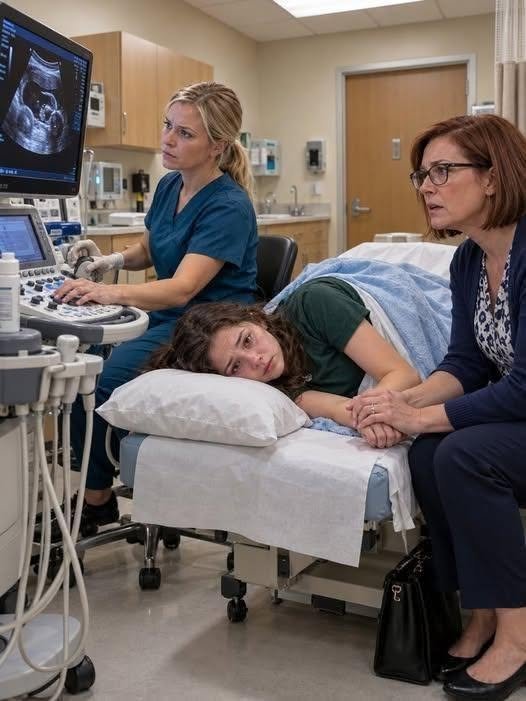
I let the phone ring until it stopped. Then I turned it face-down on the exam bed and took my daughter’s hand.
“Maya, look at me. Whatever he told you, you’re not in trouble. Not now, not ever.”
Her voice came out small. “He said if I told you, you’d worry, and then you’d have to find money we don’t have. He said the doctors just wanted to sell us tests.” She wiped her nose on her sleeve. “He said he’d handle it. But he never did.”
The doctor, whose name tag read Dr. Okafor, pulled his stool closer. “Mrs. Reyes, your daughter has a large ovarian cyst, about eleven centimeters. It’s been growing, and there’s a real risk it could twist and cut off its own blood supply. That’s an emergency, and it’s very painful. The good news is that it appears benign, and we can treat it. But she needs surgery within days, not weeks.”
My knees felt weak. “If we’d waited longer…”
“I won’t speculate,” he said gently. “You came in today. That matters.”
My phone buzzed again. Then a text: Where are you two? School says you signed her out. Call me NOW.
Dr. Okafor stepped out to arrange a surgical consult, and a hospital social worker named Renata came in. She was kind and unhurried, and she asked me questions I hadn’t known I needed to answer. Who handled the insurance? Who managed the bills?
“My husband,” I said. “Always. He said I had enough on my plate.”
Renata nodded, as if she’d heard that sentence many times. “Would you like to check the insurance status together? Just so we know what’s covered.”
It took her ten minutes on the phone with the insurer. When she hung up, her face was careful.
“Mrs. Reyes, the policy through your husband’s employer was cancelled in June. Nonpayment of the premium after his hours were cut.”
June. My daughter’s first visit had been five weeks ago. They’d been told her visit would be covered, and then the bill had arrived.
“He knew,” I whispered. “He knew we had no coverage, and he let me keep believing…”
“Many parents panic when they can’t pay,” Renata said. “It doesn’t excuse what he told her. But it may explain it.”
I wasn’t ready for explanations. Not yet.
Maya’s surgery was scheduled for the next morning, at the hospital’s expense through a financial-assistance program Renata helped me apply for in under an hour. I signed forms in a hallway, my hands shaking, while my daughter dozed.
At six that evening, Dan walked into the room.
He looked terrible. His collar was crooked, his eyes were red, and he stopped just inside the doorway when he saw Maya in the hospital gown.
“Claire,” he said. “Why didn’t you tell me?”
“Why didn’t you tell me?” I stood, keeping my voice low because Maya was asleep. “Five weeks ago, Dan. You took her to a doctor who recommended follow-up imaging. You told her it was nothing. You told her not to tell me.”
His face crumpled. For a moment I thought he’d deny it. Instead he sank into the visitor chair and put his head in his hands.
“I got a letter in June,” he said. “Insurance cancelled. I’d been covering for the hours cut at the warehouse, and I got behind. I thought I could fix it before you found out. I took a second job loading trucks at night. I didn’t want you to know that I’d failed.”
“You didn’t fail by losing a job,” I said. “You failed by hiding it.”
“When the doctor said she needed an ultrasound and a specialist, I did the math. Four thousand dollars. Maybe more.” He looked up, tears running openly now. “I told myself it was probably cramps. She’s a teenager. Girls get cramps. I told myself the doctors were exaggerating.”
“And when she told you it hurt?”
He winced. “I said she was doing it for attention.”
“Dan.”
“I know.” His voice broke. “I said it because if she was exaggerating, I didn’t have to be a man who couldn’t pay for his daughter’s care. I heard the words coming out of my mouth and I couldn’t stop them. I’m so ashamed.”
I wanted to scream at him. I wanted to forgive him. I did neither.
“Maya is going into surgery at eight tomorrow,” I said. “She’ll be fine. The doctors are confident. But you’re going to understand something first. She stopped telling you when it hurt because you taught her that pain was a burden. That’s what you did. That’s what it cost.”
He nodded, unable to speak.
Maya stirred. “Dad?”
He was at her bedside in an instant, kneeling by the rail. “Sweetheart, I’m here. I’m so sorry. You weren’t lying. You were never lying.”
She looked at him for a long time, her small hand resting on the blanket.
“You said it was attention,” she whispered.
“I was wrong. I was scared, and I was wrong, and I will spend the rest of my life making that right.”
She didn’t say it’s okay. She didn’t say anything. But after a minute, she let him hold her hand.
The surgery went smoothly. Dr. Okafor removed the cyst, saved the ovary, and told us the pathology was clean. Maya spent three days in the hospital and six weeks recovering at home, bored and sore and gradually herself again.
The recovery for the rest of us was slower.
Dan and I started counseling in November. He told the therapist everything: the hidden bills, the unpaid premiums, the night job, the lies he’d told to avoid shame. For the first time in years, I learned exactly how much our household had been carrying while I thought we were fine. Some of it was his fault, and some of it was mine for never asking harder questions. Renata connected us with a credit counselor and a program for families in medical debt, and we cut our expenses to the bone.
Dan moved into his brother’s spare room for four months. During that time he never missed a visit with Maya, and he never skipped a therapy session. He attended her follow-up appointments, sitting quietly in the waiting room, and he started asking her, every single day, one question: “How are you feeling? Really?”
Eventually she started answering.
On the day Maya turned sixteen, Dan arrived at our door with a small gift bag. Inside was a framed copy of the discharge note from that first visit, the one he had hidden.
“I wanted you to have it,” he said to her. “So you’d always know that you were right and I was wrong. And that you’re allowed to be believed.”
Maya studied the page, then looked up at him.
“Dad,” she said, “you can come in for cake.”
It wasn’t forgiveness, not completely. But it was a door held open.
Months later, he moved home. Our marriage is quieter now, and more honest. Every Sunday, the three of us sit at the kitchen table and go through the week’s bills together, out loud, with Maya listening if she wants to. No secrets. No surprises.
Last week, after her final checkup, Maya sat beside me in the car and said, “Mom, thank you for signing me out of school that day.”
“You told me the truth,” I said. “That’s all it took.”
She smiled and leaned her head against my shoulder. “I’ll always tell you.”
And I believed her.
If you’d like, I can split this into the Facebook-style multi-part format with “Next” prompts, make it more emotional, or adjust the length.