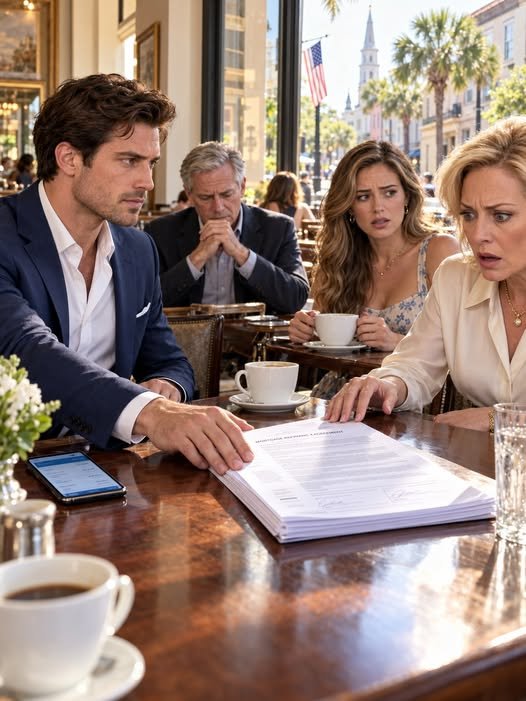
I clicked Open.
The document loaded slowly, and with each page the room seemed to get quieter. It was a refinance agreement for the Charleston house. Cash-out refinance, $240,000. The borrower of record was Beck Calder. The signature at the bottom was a decent imitation of mine, and the verification code I’d read to my mother weeks earlier was logged as my electronic consent.
I read it three times. Then I picked up my phone and, for the first time in thirty-one years, answered my mother’s call.
“Beck, thank God.” Her voice was breathless. “Take down that comment, and we can talk about this like adults.”
“Mom, I’m looking at a refinance agreement with my name on it.”
Silence. I could hear a restaurant’s clatter behind her, glasses and laughter.
“It’s just paperwork,” she said at last. “The bank needed it. Your father and I were going to explain.”
“Two hundred forty thousand dollars. Explain it now.”
“Don’t use that tone. Your sister needed help with her business, and you’ve always been so generous…”
“Maris’s business.”
“It’s a family investment!”
“It’s a loan in my name that I never agreed to.” My voice stayed level, which surprised me. “Where’s the money, Mom?”
She hung up.
I didn’t sleep. By six a.m. I was on the phone with the bank’s fraud department, then with a real estate attorney Tess recommended, a sharp woman in Charleston named Priya Nair.
“Don’t call them back,” Priya said after I explained. “Forward me everything. Do you have the original verification email, and the bank’s confirmation?”
“I have both. And screenshots of every message from last night.”
“Good. Keep them all.” I heard her typing. “Beck, the funds were disbursed on the fourteenth. Do you know where they went?”
“No.”
“Let’s find out.”
It took four days. The loan servicer’s records showed $240,000 wired in two transfers. One for $90,000 went to the escrow account of a law firm. The other, $150,000, went to an LLC called Maris Calder Studio.
I stared at the screen. “My sister’s company.”
“Registered eight months ago,” Priya said. “No revenue filings, no employees listed. And the $90,000 went to pay off a private lender. A woman named Colette Voss.”
“Who’s that?”
“A hard-money lender. Your sister borrowed from her last year at a brutal rate. Beck, she was in serious trouble. I think your parents were covering for her.”
I thought of Maris’s perfect smile, the polished photographs, the way she always seemed to be thriving. I’d believed it for thirty years.
“So they cut me out of the party,” I said slowly, “because they knew I’d ask questions if I sat at the table.”
“Or because they didn’t want you near Maris while the paperwork was in motion.”
It hurt in a way the exclusion never had. It wasn’t carelessness. It was strategy.
Priya filed a fraud claim with the lender and a complaint with the state banking regulator. The bank froze the loan, flagged the account, and opened an investigation. I flew to Charleston the following week.
I didn’t go to my parents’ house first. I went to Priya’s office, where a bank investigator named Mr. Holloway laid out a timeline on the conference table.
“The verification code was requested from an IP address registered to your parents’ home,” he said. “The e-signature was applied twenty minutes later from the same device. Your father’s browser history shows the loan portal.”
“My father did this?”
“Your mother made the call to you, and your father completed the forms. Your sister provided the instructions. The three of them exchanged emails over six weeks, subject line, quote, ‘The Beck Plan.'”
I laughed. It came out cracked and wrong.
“They named it.”
Holloway slid a printed email across the table. In my father’s words: Beck will never notice. He’s too busy being dependable. If he does, he’ll forgive us. He always does.
I read it twice. Then I set it down very carefully, because my hands had started to shake.
The next day, my parents asked to meet. Priya advised against it, but I wanted to see their faces. We met in a conference room at the bank, with Holloway and a security officer present.
My mother arrived in a cream blazer, her face composed. My father looked ten years older. Maris wasn’t with them.
“Beck,” Mom began, “this has gotten out of hand.”
“You forged my consent to borrow $240,000.”
“We were going to repay it.”
“With what? You can’t afford your own mortgage. I’ve been paying it for three years.” I laid my hands on the table. “I don’t want an explanation. I want the truth. Why was I not invited to your anniversary?”
My mother looked at my father. He looked at the wall.
“Because Maris was going to announce the studio’s launch that night,” Dad said quietly. “We’d told the relatives she’d secured investors. We couldn’t have you there asking where the money came from.”
“So you hid me.”
“We thought if you didn’t see it, you wouldn’t be hurt.”
“I was never hurt by missing the dinner.” My voice finally cracked. “I was hurt by what it meant. I’ve paid for your roof, your taxes, your insurance, and you wouldn’t even let me sit at your table. You didn’t see me as a son. You saw a wallet that could be kept in a drawer.”
Mom’s composure broke. “We never meant to hurt you.”
“You never thought about me at all.”
Nobody spoke. Finally, my father put his face in his hands.
“I’m so sorry, Beck,” he whispered. “I let her treat you like that for thirty years. I told myself it was just how she is. It was cowardice.”
It was the first time my father had ever said it out loud.
The investigation ended three months later. The loan was voided as fraudulent. The bank recovered $190,000 by freezing Maris’s accounts and seizing the LLC’s assets, and the remaining $50,000 was written off against the servicer’s insurance. My parents were not prosecuted, after I declined to press charges against them, though they signed a binding agreement acknowledging the forgery and surrendering all claims on my accounts. Maris, who had arranged the scheme, pleaded guilty to wire fraud and received probation and restitution.
I stopped paying their mortgage. They refinanced in their own names at a higher rate, sold the Charleston house the following spring, and moved into a smaller condo near my aunt.
For a long time, I didn’t speak to them. I didn’t send frames or cards. I went to work, I slept, I ate dinner at Tess’s apartment on Fridays, and slowly I began to feel like a person who belonged to himself.
In November, my father sent a letter. Not a text, not an email. Two pages in his square, careful handwriting. He didn’t ask for money or forgiveness. He wrote about the day I was born, how small my hands were, how he promised my grandfather he’d teach me to build things. He wrote that he had watched me become an architect and had never once said he was proud of it.
I’m proud of you, he ended. I’m sorry it took thirty-one years and a crime to say so.
I kept the letter. I didn’t answer it for another two months.
When I did, I invited him to coffee, just the two of us, at a café in Denver halfway between my office and the airport. He came alone, hat in his hands, looking nervous.
“I’m not ready to be what I was,” I told him. “But I’d like to try being something new.”
He nodded, eyes bright. “That’s more than I’ve earned.”
We talked for two hours. He asked about my work. I showed him the plans on my phone for a small library I was designing, and he studied them with real attention, asking questions about the load-bearing walls.
At the end, he stood and hesitated. “Can I buy the coffee?”
“Yes,” I said. “You can.”
It was a small thing. But when he reached for his wallet and paid for two cups of coffee, I watched my father give something to his son for the first time in my life.
The silver anniversary frame is still on my counter. I never took it out of the wrapping. One day, I might frame a photograph of the two of us and give it to him.
But not yet.
Some things you build slowly, with good materials and a sturdy foundation, and you don’t rush the roof.