I unfolded the note with shaking hands. The lawyer stood quietly in my doorway, his hat against his chest.
My name is Carl Whitaker. Thirty-two years ago, I was eight years old, and I was alone in a burning apartment building in Toledo. A firefighter named Daniel Brooks carried me down four flights of stairs. I never forgot his face.
I stopped reading. “That’s my father’s name.”
“Keep going,” Mr. Delaney said softly.
He saved me and went back in for an elderly neighbor. The ceiling collapsed. He didn’t come out. I was told he left behind a wife and a little girl who was about to turn six. I never learned your names until I was grown. When I did, I promised myself I would find out whether you were all right.
I sat down on the floor of my own entryway.
I remembered the funeral. I remembered a folded flag, a hat too big for my head, and my mother’s hand gripping mine so tightly it hurt. I had grown up on the story of my father, the hero who ran toward the fire. I had never heard about the boy he saved.
You were fine, at first. Your mother worked two jobs. But when you were fourteen, she got sick, and the medical bills piled up. A sum arrived from the “Firefighters’ Benevolent Fund.” It paid the hospital in full. The fund didn’t exist. That was me. I was twenty-two, working construction, and I had never felt so useful.
When she died, I couldn’t come to the funeral. I was ashamed. Your father gave his life for mine, and I had done nothing with it. So I worked. I saved. I started a company. I tried to become someone worth saving.
Then I got sick. And I needed to see you once, without telling you who I was.
I was crying so hard the words swam. Mr. Delaney handed me a handkerchief and said nothing.
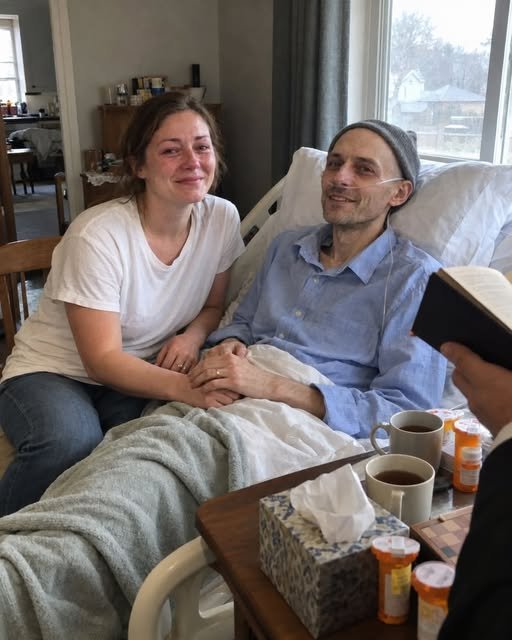
I volunteered for the hospice program because I had learned it was where you worked. I knew I had months. I only wanted to sit at a table with Daniel Brooks’s daughter and hear her laugh. You beat me at Scrabble. You brought me soup with too much pepper. You told me about your father and didn’t know you were telling the story to the boy he saved.
When I asked you to marry me, I wasn’t lying about being afraid to die alone. But I had another reason, and I have to explain it. I have no family. Without a will, my estate goes to the state, and a will can be challenged. A spouse can’t be so easily set aside. It was the only way I knew to make sure what I built would reach you.
I’m sorry I wasn’t honest. I’m sorry I took your kindness without telling you what it meant to me. If you’re angry, I understand. But please understand this too: those ten days were the only ones in my adult life when I felt I was exactly where I was supposed to be.
Carl
I read it four times before I could speak.
“Mr. Delaney,” I said at last, “is any of this proven? Or is it a dying man’s story?”
“I thought you’d ask.” He opened his briefcase and set out a stack of documents. “Fire department records from 1994, listing a rescued child named Carl Whitaker. A newspaper clipping with your father’s photograph. Bank records for the so-called Benevolent Fund, paid from Carl’s personal account. And these.”
He set down a shoebox. Inside were dozens of small, folded drawings.
I recognized them instantly. They were mine. Crayon horses, a lopsided house, a stick figure with a helmet. I had mailed them to the fire station as a child, to thank the men who had come to my father’s service.
“The captain of Station Nine kept them,” Delaney said. “Carl visited the station when he was nineteen. He asked if there was anything he could do for the family. The captain gave him the drawings and said, ‘Take care of her.’ He never stopped.”
I held a drawing of my father, drawn in green crayon because I had run out of blue.
“There’s more,” Delaney said gently. “Carl left you his house and his savings, roughly eight hundred thousand dollars. He also asked me to give you this.”
It was a small velvet pouch. Inside lay a tarnished brass whistle on a thin chain.
“Your father’s,” he said. “Carl was carrying it the night of the fire. Your dad had hung it around his neck to calm him down. He wore it for thirty-two years. He said he’d never earned the right to keep it, and that it belonged with you.”
I closed my hand around it. It was warm from the lawyer’s briefcase, or maybe from me.
I didn’t sleep that night. Near dawn, I drove to the cemetery where Carl was buried. It was a small plot at the edge of a hillside, the headstone still raw. The inscription read only: CARL WHITAKER. He was carried, and he carried on.
I sat on the damp grass and cried until the sun came up.
I was angry. I won’t pretend otherwise. I was angry that he hadn’t told me, that I had married a man whose life was entangled with mine, and that he had let me comfort a stranger when I’d actually been comforting a ghost of my own history. I was angry that I’d never gotten to say what I should have: Thank you for living.
But the anger had no place to settle. I thought of him at the kitchen table, his hands wrapped around a teacup, laughing at my terrible Scrabble words. He had known exactly who I was, and he’d still asked about my day as if it mattered. Nobody, I realized, performs that kind of gentleness for thirty-two years just to deceive.
Over the following weeks, I visited the old fire station. A retired captain, white-haired now, shook my hand for a long time.
“Your father would’ve been proud of you,” he said. “And proud of that boy, too. Not everyone turns a rescue into a life.”
I used part of Carl’s savings to establish the Brooks-Whitaker Fund, which pays the medical debts of first responders’ families. I kept the house, a small brick cottage with a garden he’d planted but never lived to see bloom. In the first spring, tulips came up along the walk in a perfect line, red and yellow, and I wondered how long ago he’d chosen the bulbs.
I hung the brass whistle by the front door. Every morning, I touch it on my way out.
On the anniversary of Carl’s death, I went back to the cemetery with a thermos of tea and a Scrabble board. I set it on the grass between us and played both sides, badly.
“I won,” I told the headstone. “Don’t argue.”
The wind moved through the trees. It may have been only wind. But I smiled, and for the first time since the knock on my door, I felt the two men who had shaped my life standing quietly together, one who ran into the flames and one who spent his years trying to deserve it.
I wore a white T-shirt that day, on purpose.
Because I had married him on a whim and a kindness, and it turned out to be the truest thing I’d ever done.