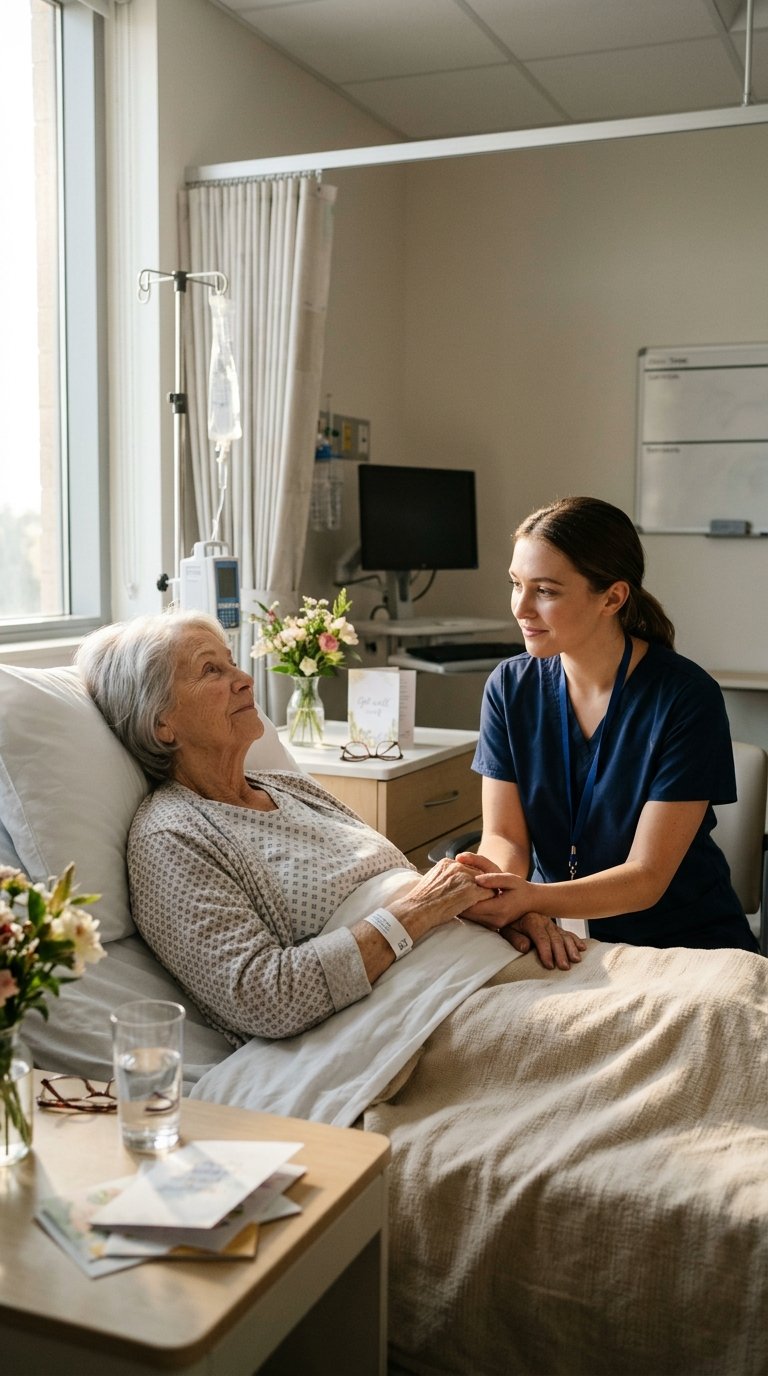
“Tell me about the fourth floor,” Priya said.
So Linda did.
She talked about the winter blizzard of 1996 when half the staff couldn’t get home and the nurses slept in empty rooms. She talked about the patient who proposed to his wife in the ICU, with a ring made from a paper clip. She talked about the night a young man died holding her hand, and how she had gone to the supply closet afterward, leaned against the shelves, and let herself cry for exactly ninety seconds before washing her face and returning to work.
Priya listened without checking her watch, even though the pre-op bay was filling up and a second nurse had poked her head in twice. At one point, Priya’s hand tightened slightly, and she said, “That sounds like it cost you something.”
“It did,” Linda said. She had never said it out loud before. “It cost me more than I let on. I never had anyone to hold my hand afterward. I just got very good at not needing it.”
The monitor read 78. Her breathing had slowed. The trembling had stopped.
“I owe my patients an apology,” Linda whispered.
Priya tilted her head. “For what?”
“For all the times I said ‘you’ll be fine’ and walked away. I thought I was being kind.” Her eyes filled. “I didn’t understand. Now I understand my patients differently.”
Priya’s own eyes shone. “I think you were kind. And I think the ones who needed more got it from you anyway. They remembered you, Linda. People remember the one who stays.”
At 6:40, the transport team arrived. A big, cheerful man named Reggie unlocked the brakes on the bed. The surgeon appeared in her cap and mask, gave a thumbs-up, and said, “Ready when you are.”
Priya stood. She kept hold of Linda’s hand for as long as she could, walking beside the bed down the long white corridor, past the double doors marked Authorized Personnel Only. At the threshold, she had to let go.
“I’ll be right here when you wake up,” Priya said. “I promise.”
“You’re off at seven.”
“Then I’ll stay late.”
“Priya, you don’t have to…”
“I know I don’t.” The young nurse smiled. “I want to.”
The last thing Linda saw before the doors closed was the navy scrubs, the ponytail, and a small wave.
She had a single clear thought as the anesthesia crept up her arm, and it wasn’t about the surgery. It was this: So that’s what it feels like to be held by someone who didn’t have to.
The operation took three hours and ten minutes.
It went exactly as planned. The surgeon found everything she had hoped to find and removed everything she had hoped to remove, and when she came out to the family waiting room, she looked around for someone to tell.
Nobody was there. So she walked to the recovery bay herself.
Linda surfaced slowly, in pieces. Light first, then sound: the familiar hum, the beeps, the squeak of a cart. Then a voice, close and warm.
“Mrs. Marchetti? You’re all done. It went beautifully.”
She turned her head. In the chair beside the bed, still in her navy scrubs, sat Priya, with a cardboard cup of tea in one hand and dark circles under her eyes.
“You stayed,” Linda said, her voice a croak.
“Four extra hours. My manager’s thrilled.” Priya grinned. “Do you want some ice chips?”
“Please.”
While Priya fed her ice chips with a plastic spoon, Linda noticed something else. On the windowsill sat a vase of yellow daffodils. On the bedside table lay a stack of cards, signed in a dozen different handwritings.
“What is all this?”
Priya’s grin widened. “Well. After you told me about the fourth floor, I may have texted Dolores.”
“Dolores?”
“She told a few people. And those people told a few people.” Priya gestured to the cards. “Seven of your old nurses came in this morning. They couldn’t be in the surgical area, but they signed everything. They sat in the lobby for three hours.”
Linda stared at her. Her mouth opened, then closed.
“And there’s one more person,” Priya said gently. “But I think you should see her yourself.”
She stood and pulled back the curtain.
Dolores Whitfield stood at the foot of the bed.
She was sixty now, gray-haired and broad-shouldered, in a crisp cardigan, holding a bag from Linda’s favorite bakery. She’d been a trembling twenty-two-year-old trainee when Linda first met her. Now she was the nurse manager of the fourth floor.
Behind her, a line of faces waited, all nurses, all retired or off-shift, in street clothes: Maureen, Beth, Carlos, Jamila, and others Linda hadn’t seen in years. They crowded into the narrow space, a little awkward, a little teary, every one of them holding something: a card, a flower, a casserole they weren’t supposed to bring.
“Linda,” Dolores said. Her voice broke. “You taught us all to say ‘You’re not alone.’ We figured it was time somebody said it to you.”
Linda’s face crumpled. She had held it together through the diagnosis, through the cab ride in the dark, through the cold bay and the long hallway. But this, this, she could not hold back.
She cried the way she had never allowed herself to cry, openly, out loud, with her hand over her mouth and her shoulders shaking. The nurses surrounded the bed. Someone took her left hand, and Priya took her right. Dolores leaned down and pressed her forehead to Linda’s.
“We’ve got you,” she whispered. “We’ve got you.”
Linda spent four days in the hospital.
Her sister Rosemary flew in on Thursday and found a room that looked like a florist’s shop. Nurses stopped by between shifts. Priya came every morning before work. Dolores brought soup. The surgeon reported that the pathology was clear and the recovery was ahead of schedule.
On the last morning, Linda sat in the chair by the window, dressed in her own clothes, while Rosemary packed the cards into a bag.
“I’ve been thinking,” Linda said.
“Uh-oh,” said Rosemary.
“When I’m strong enough, I’d like to volunteer. Not as a nurse. I’m retired, and I mean it.” She watched the light move across the daffodils. “I’d like to be the one who sits in the empty chair. For the patients who come in alone.”
Rosemary smiled. “I think that’s exactly what you were born to do.”
Six months later, on Tuesday mornings, a silver-haired woman in a bright blue volunteer vest began appearing in the pre-op area of St. Brendan’s. She carried a thermos of tea and a canvas bag of hand-knit blankets. She didn’t check vitals. She didn’t chart.
She just pulled up a chair beside whoever was waiting alone, and said, softly, “Do you mind if I sit with you?”
On one particular morning, a frightened young man in a thin gown looked up at her and whispered, “Why would you do that for a stranger?”
Linda took his hand, and for the first time in her life, she knew exactly what to say.
“Because somebody once did it for me,” she said. “And I’ve never forgotten. Even those who spend their lives caring for others sometimes need someone to care for them. That’s not weakness, sweetheart. That’s just being human.”
The monitor above him beeped, steady and slow.
“You’re not alone,” Linda said. “I’m right here.”