They did not leave that night.
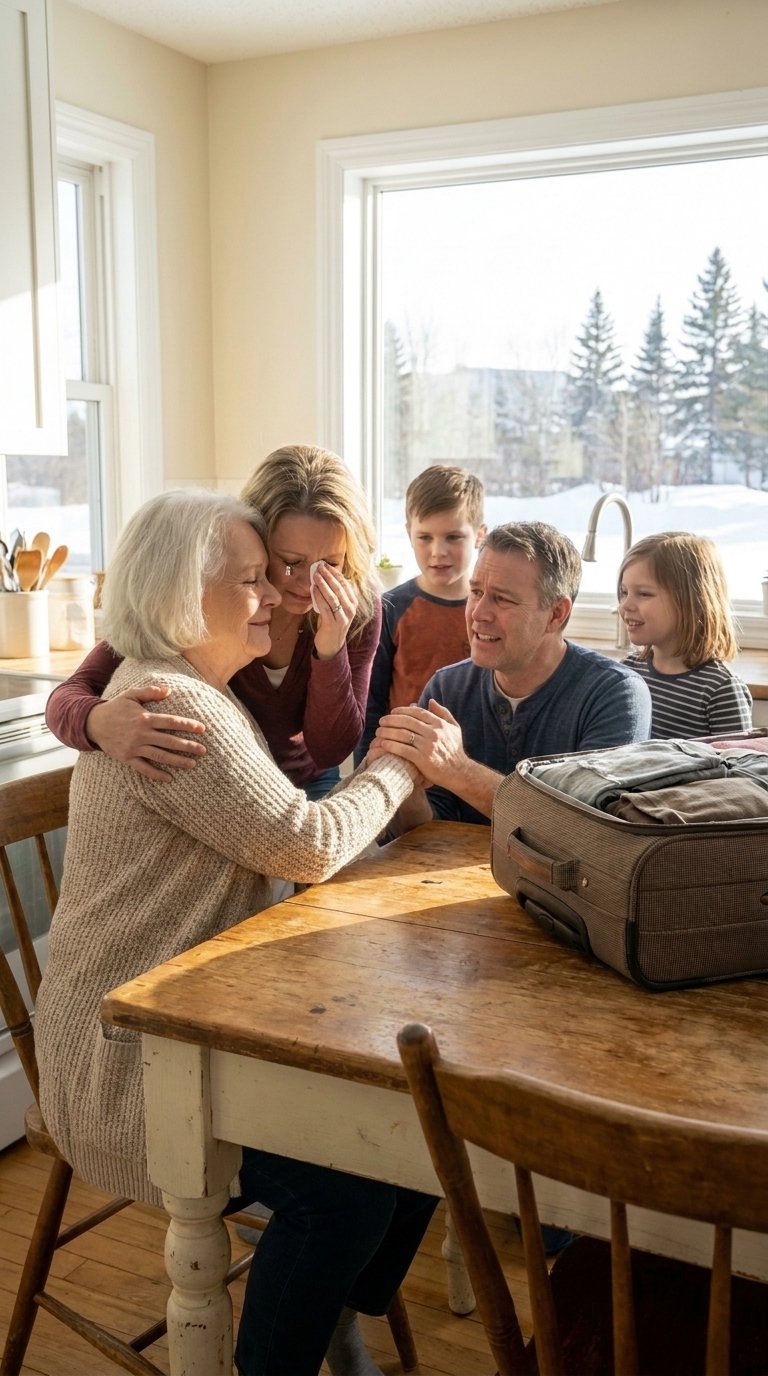
Nobody suggested it. Linda cleared the plates, and Michael washed, and Daniel dried. Grace got her two kids down on the living room sofa with a quilt, and the children slept right through the quiet murmur of grown-ups in the next room. For the first time in years, the Carters sat at the same table with nothing left to hide.
Ruth made fresh coffee and set the shoebox in the center of the table.
“I want to say something, and I’d like you to listen to the whole thing,” she said. “I did not do this to make you feel guilty. I did it because it was the only way I knew how to love you. But I’ll be honest. It was a mistake.”
“Mom, no…” Linda began.
“It was. Let me finish.” Ruth folded her hands. “I thought that if I kept it quiet, I’d be protecting your pride. But all I really did was make sure each of you thought you were alone. You spent four years hating each other over things that were never real, and I let you. That part is mine to apologize for.”
“You don’t owe us an apology,” Michael said roughly.
“I owe you the truth, which is that no family can survive on one person’s secret sacrifice. You can’t pour from an empty cup. And mine was running dry.”
She nodded toward the box.
“There are forty-one envelopes in there. I’ve kept every receipt. That’s about thirty-eight thousand dollars in two years. I’m not telling you so you’ll pay me back. I’m telling you so you’ll see what it looks like when love is silent. I don’t want any of you to ever do it that way. Not for me. Not for each other. Not for anyone.”
Daniel reached across the table and took her hand. “Then tell us what you want.”
“I want a rule,” Ruth said, and her old church-secretary voice came back, firm and kind. “A simple one. Nobody in this family suffers alone. Ever. If you’re behind on rent, you call. If you lose a job, you call. If you’re sad, you call. The phone works both ways. And whoever answers doesn’t ask ‘why didn’t you tell me sooner?’ They just say, ‘I’m coming.'”
“That’s it?” said Grace.
“That’s all of it.”
One by one, her children put their hands on top of hers.
“Nobody suffers alone,” Daniel said.
“Nobody suffers alone,” said Linda.
“Nobody,” said Michael, and his voice cracked.
“Nobody,” whispered Grace.
The next morning, they began to work it out.
They gathered around the kitchen table with a legal pad, and the practical Carter instinct kicked in. Daniel’s shop was salvageable, he realized, if he stopped hiding the books. Michael had training in logistics management, and he knew exactly what Daniel’s busted parts-ordering system was missing. Linda, a lifelong teacher, offered to do the shop’s invoicing and tutor Grace’s kids in the afternoons. Grace, who had a cosmetology license she hadn’t used in years, could work out of Linda’s spare room, since Linda’s house now had two empty bedrooms and no husband.
“Wait,” Linda said. “You’d move in with me?”
“If you’ll have us.”
“I would love you to,” Linda said, and burst into tears all over again.
By Sunday, they had a plan. By the end of the month, Daniel’s shop had a new accountant and a fresh coat of paint on the sign. Michael left the warehouse and took over operations, for a salary, and for the first time in three years told the truth when someone asked what he did for a living. Grace and the kids moved into Linda’s house, and the walls rang with children’s footsteps. Linda started tutoring again, and the kitchen smelled like pencil shavings and cinnamon.
None of it was perfect. Money stayed tight. There were arguments about dishes and chores and whose turn it was to pick up the kids. But the arguments were small and open, the kind you have in a house where everybody is present.
Ruth bought back her piano in March.
It wasn’t the same one, of course. That had been sold to a young couple in Springfield. But Daniel found one just like it in a church basement, a worn upright with chipped ivory keys, and the four of them chipped in to buy it. They carried it up the front steps of her house on a freezing Saturday, grunting and laughing and nearly dropping it twice.
“This is ridiculous,” Ruth said from the porch, hands pressed to her face. “I don’t need a piano.”
“You need a piano,” Linda said firmly. “You need it more than any of us needed anything.”
Michael had also bought back Dad’s old toolbox, tracked down through a pawnshop in Dayton, and he set it on the porch without a word. Ruth ran her hand across the lid, and her eyes filled.
“How much was that?”
“Mom,” said Daniel. “Don’t ask what it cost. It’s called passing it along.”
She laughed, helplessly, and let them carry her piano inside.
That night, after supper, she sat down at the keys and played “Abide With Me,” the hymn she’d played at their father’s funeral. The notes were uneven, and her hip ached on the bench, but she played it all the way through. Her children stood around her, singing off-key, and nobody minded.
When she finished, she sat with her hands resting on the keys.
“I was so afraid I’d go before you knew,” she said softly.
“We know, Mama,” Grace said.
“All of it?”
“All of it.” Grace kissed the top of her head. “And you don’t carry it anymore. We do. All of us.”
Ruth lived another eleven years.
She saw Daniel’s shop reopen with a second location. She saw Michael married, at forty-three, to a woman he met at the church supper, and she cried through the whole ceremony. She saw Linda go back to teaching and, eventually, to love again. She watched Grace’s children grow tall, and the youngest one learn to play the piano.
And every Sunday, without fail, the four of them came to her house, and the table was full.
At her funeral, the church overflowed. Daniel spoke first. He did not talk about her sacrifices, though there were many. He talked about the shoebox, about the night she’d untied the twine and set free four people who had been drowning alone.
“My mother carried all of us,” he said, “for years, in silence. And when she finally set it down, she didn’t ask us to carry it back. She just asked us to carry each other.”
He looked at his siblings in the front pew, shoulder to shoulder, holding hands.
“We’re still carrying,” he said. “It’s the lightest thing we’ve ever held.”
On the piano at home, beside the old photographs, sat the shoebox, now empty. Inside the lid, in Ruth’s careful handwriting, someone had taped a single index card. It had been there since the night of the reunion, and no one had dared to take it down.
It read: Nobody suffers alone.