I kept the chain on the door and opened it two inches. Up close, the man looked less threatening and more exhausted, like someone who hadn’t slept in a day or two.
“My name is Martin Hale,” he said. “I’m an attorney. Please, Mrs. Doyle. You need to see this right now.”
He knew my name. I hadn’t given it to anyone at Target.
“How do you know who I am?”
“Because the woman who lost that ring has been looking for your family for six years.” He slid the envelope through the gap. “Open it. If you still want me to leave afterward, I will.”
Behind me, Harper padded into the hallway in her pajamas, hugging her stuffed rabbit. I told her to wait in the kitchen. She stayed exactly where she was, the way she always does when she senses something important.
I opened the envelope with shaking fingers.
Inside was a photograph. It showed a young couple in front of a small bakery, flour on their aprons, grinning at the camera. The man had my son’s crooked smile. The woman was his wife.
Harper’s parents.
Beneath the photo was a legal document with a gold seal, and a handwritten letter.
I took the chain off the door.
Martin sat at my kitchen table with his hands folded, while I read the letter aloud for Harper, because she had asked me to.
Dear Mrs. Doyle,
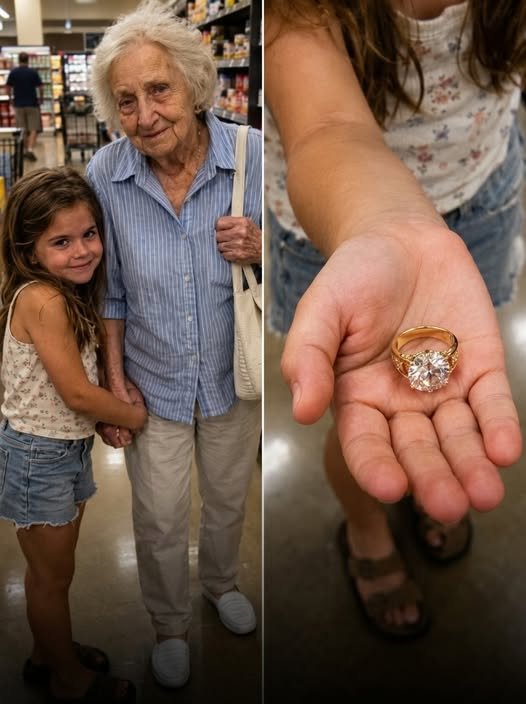
My name is Vivian Ashby. Yesterday, your granddaughter returned a ring that I would have given anything to find. But the ring is only part of why I’m writing.
Eight years ago, I was a young pastry cook who had just lost her job. I had no money, and I was three days from being homeless. A couple named Daniel and Rachel Doyle ran a small bakery on Fulton Street. They had never met me. I walked in one morning and asked if I could sweep their floors for a sandwich.
I stopped. Daniel and Rachel. My son and his wife.
They hired me that day. They taught me everything. They let me sleep in the storeroom for four months while I saved for an apartment. When I was too proud to take their help, Rachel said, “Nobody makes it alone, Viv. We’re just passing along what somebody gave us.”
Years later, I opened my own business. A small catering company grew into something I never imagined. I wanted to thank them. I went back to Fulton Street, and the bakery was closed. The neighbors told me what happened. I was heartbroken. I tried to find you, but the bakery had been sold, and the records were a mess.
I had to stop and press a napkin to my eyes. Harper climbed into my lap without a word.
“There’s more,” Martin said gently.
He took out the legal document. “Ms. Ashby’s company, Ashby Table, is now valued at about forty million dollars. Eight years ago, she signed a handwritten agreement with Daniel and Rachel on the back of a bakery receipt. She promised that if she ever succeeded, they would share in it. They laughed and said it was nonsense. She kept it anyway.”
“A receipt?” I whispered.
“We found it. In a box, in her old apartment, in January. It names your son and his wife as founding partners, entitled to five percent of the company.” He paused. “Which passes, under their will, to their daughter.”
I looked down at the small head against my shoulder. “To Harper?”
“To Harper. Held in trust until she’s twenty-five, with a monthly allowance and expenses paid to you as guardian beginning immediately.”
I couldn’t breathe. “That can’t be right. Nobody told us.”
“Nobody knew. Ms. Ashby spent six years searching. She hired two investigators. She wrote to every Doyle in three states. She had just gotten a lead on your address when she stopped at Target yesterday to buy flowers for a meeting with the attorneys.” He smiled faintly. “She took off the ring to wash her hands in the restroom and set it down. Twenty minutes later she realized it was gone.”
“She said it wasn’t her wedding ring.”
“No. It was her mother’s. Her mother died last spring, and it was the only thing she had left.” He met my eyes. “And the phone call that scared her? It was my office, telling her we had finally found you. She thought she had lost the ring and lost you in the same afternoon.”
At that moment, a car door closed outside.
A woman stood on my porch, with no black SUV and no bodyguard, wearing yesterday’s cardigan. Her mascara was gone. She held a small paper bag, and her hand shook as she lifted it.
I opened the door.
“Mrs. Doyle,” Vivian said. “I know it’s early. I didn’t know how else to do this.” Her voice cracked. “I couldn’t sleep. I brought croissants. It’s the only thing I know how to give.”
I stepped aside, and she came in. When she saw Harper standing in the kitchen doorway, she dropped to her knees on my worn linoleum.
“Hello,” she whispered. “You’re the girl who found my ring.”
“Yes,” said Harper, solemn. “Did you stop crying?”
Vivian laughed and cried at once. “Mostly.”
“Good.” Harper considered her. “Grandma says if somebody’s sad, you should bring them a snack. Is that a snack?”
“It’s a croissant.”
“Okay.” Harper took the bag, peered inside, and nodded. “You can sit down.”
We talked for three hours. Vivian told me stories about my son I had never heard: how Daniel sang off-key while he kneaded dough, how Rachel kept a jar of coins by the register for anybody who came in short. I told her about the funeral, the empty house, the pills I split in half to make them last.
When I finished, she took my hand across the table.
“Mrs. Doyle, I’m not here out of charity. I’m here because your son and his wife did me a kindness that built my entire life, and I never got to repay it. If I can repay it to Harper, that would mean more to me than any contract.” Her eyes filled. “And I think they’d want her to know how good they were.”
I looked at the leak stain on my ceiling, the one I’d been staring at for three winters.
“I’ll accept it,” I said slowly. “For her. But not as charity.”
“It isn’t.”
“Then let’s call it what Rachel called it,” I said. “Passing it along.”
The roof was fixed that month. Vivian wouldn’t let me pay a cent, and then said her contractor had “an opening.” The prescriptions stopped being a decision. Harper got new shoes, then another pair, because she kept growing, and a bookshelf for the books Vivian brought every time she visited.
She visited often. She came on Sundays, and she baked in my kitchen, and she taught Harper to fold dough. When the neighbors asked who the woman with the flour on her sleeves was, Harper said, “That’s Aunt Viv. She’s family.”
On Harper’s eighth birthday, Vivian came with a flat white box.
Inside was a small gold ring, plain, with a tiny chip of diamond.
“This isn’t the one you found,” Vivian said. “That one’s still my mother’s. But I wanted you to have something to remember it by.”
Harper slid it onto her thumb, because nothing else fit. She looked at it for a long time.
“Grandma,” she said. “Do you think Mommy and Daddy know?”
I thought about the bakery on Fulton Street, the storeroom, the jar of coins.
“I think they started it, sweetheart,” I said. “I think this was always theirs.”
That spring, we reopened a small bakery on Fulton Street, funded by Vivian, run by me, a retired schoolteacher with bad knees and a lot of patience. Harper cut the ribbon. Above the door, in hand-painted gold letters, hung a sign: DANIEL & RACHEL’S.
Underneath, smaller: Nobody makes it alone.
On our first morning, a thin young man came to the counter and asked if he could sweep the floor for a sandwich.
Harper didn’t hesitate. She hopped off her stool and handed him an apron.
“You’re hired,” she said.