I stood just inside the doorway, one hand on the cool stone frame, and listened.
“Papa, you promised you’d tell her tonight,” a woman’s voice said. It was low and urgent, and it had the slight impatience of a daughter who loves her father and wants to shake him. “It’s her last evening.”
“I know, Claire.”
“You’ve been ‘about to’ for six days.”
David let out a long breath. “She’s been so happy. I didn’t want to turn it into something else.”
“It was never going to be something else,” the woman said. Her voice softened. “Papa, she’s going to find out anyway. The waiter practically announced it.”
“He did,” David said, and I heard him laugh, miserable and fond. “Poor Mateo.”
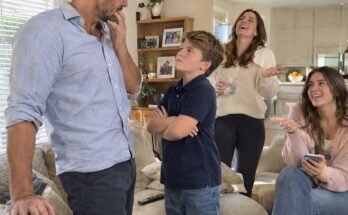
I should have walked away. Instead I stepped into the courtyard, and both of them turned.
David stood beside a lemon tree strung with small white lights. Next to him was a woman in her forties with silver-streaked dark hair and his exact eyes. She straightened when she saw me, and her hand flew to her chest.
“Margaret,” David said. His face went through three expressions and settled on none. “I was going to tell you.”
“Tell me what?” My voice came out steadier than I felt. “That you’ve been here before?”
“Yes. That, and more.”
“Let me say it for him,” the woman said quickly, and then, more gently, to me: “I’m Claire Bennett. I’m his daughter. I run this restaurant.”
I looked from one to the other. “You own it?”
“We do. My late mother and father opened it thirty-one years ago.” She glanced at David. “It’s the reason he wasn’t entirely honest with you.”
We sat on a stone bench under the lemon tree while the sounds of the restaurant drifted through the doorway: clinking glasses, a violin somewhere, laughter. David turned his hat in his hands.
“I told you I’d never been to Malta,” he said. “That was a lie. I’ve lived here for nineteen years. My wife, Rosalind, was Maltese. We moved back when I retired. She died four years ago in the house above the harbor.”
“You said you were a widower,” I said. “That part was true.”
“All of it was true except where I live.” He looked at me, miserable. “Margaret, the day I met you, I was walking to this restaurant. I do it every Tuesday. Rosalind and I ate here every Tuesday for thirty years, and after she died, I kept going. I didn’t know what else to do with the day. And I saw you with your map upside down, looking so lost and so determined at the same time…”
“And you said, ‘First time in Malta?'”
“And I said that, God help me, because I wanted to hear you talk. I didn’t plan to deceive you. I only meant to point you toward a good café.” He rubbed his face. “Then you laughed. And I hadn’t heard anyone laugh like that in so long that I couldn’t make myself correct it.”
“But you could have told me any time in six days.”
“I could have. Every morning I said I would.” He shook his head. “I was afraid that if you knew I lived here, you’d think I was just a local looking for a tourist. That I’d make it small.”
“And the phone call?”
Claire answered. “I texted him. I’ve watched him come home glowing for a week. He hasn’t done that since Mama died. I told him that if he didn’t tell you tonight, I would.” She smiled ruefully. “I’m not very patient.”
I should have been angry. Part of me was. A week earlier I would have gone straight back to my hotel and locked the door and been quietly, safely hurt, the way I’d been quietly, safely everything for sixty-seven years.
But I thought about my vow.
Yes to unusual foods. Yes to strangers. Yes to embracing life.
And I thought, with sudden clarity, about how David had not told me a lie that mattered. He had not borrowed money. He had not claimed to be someone he wasn’t. He had not pretended to feel something he didn’t. He had only been so afraid of losing six good days that he’d held on to a small false one.
I knew that kind of fear very well.
“David,” I said. “May I tell you something?”
He nodded.
“I haven’t lived anywhere but the same town in sixty-seven years. When Walter died, I stopped going to most places, because I couldn’t stand being the woman everyone looked at with that careful face. My daughter asked me when I’d last done something just because it made me happy. I couldn’t remember.” I took a breath. “This week, I remembered. You were part of it. It was real, even if one detail wasn’t.”
His eyes shone.
“But I’m not going to pretend I’m not hurt,” I went on. “I would rather you had told me on day one, ‘I live here, and I’d like to show you my favorite places.’ I would have said yes to that. I’d have said yes to that faster than to anything.”
“You would?”
“I’m sixty-seven, David. I don’t have time to be coy.”
Claire made a small sound and covered her mouth, and I realized she was trying not to laugh. Then David laughed too, helplessly, and wiped his eyes, and the three of us sat in that lemon-scented courtyard in a ridiculous tangle of relief.
“I’m so sorry,” he said. “I don’t expect you to forgive me tonight.”
“I’m not going to forgive you tonight,” I said. “I’m going to eat the dinner you ordered, because it smells wonderful. And tomorrow I’m going to get on a plane.”
His face fell.
“And then,” I said, “I’m going to do what I do with things I want to hold on to. I’m going to write to you. Properly. On paper.”
Dinner was grilled sea bream and a sweet, bitter salad of oranges and fennel. Claire joined us after a moment’s hesitation and told me stories about her mother, who had hated the fish and loved the lemon cake, and about her father’s disastrous attempt to learn the cello at sixty-two. David turned scarlet at that one.
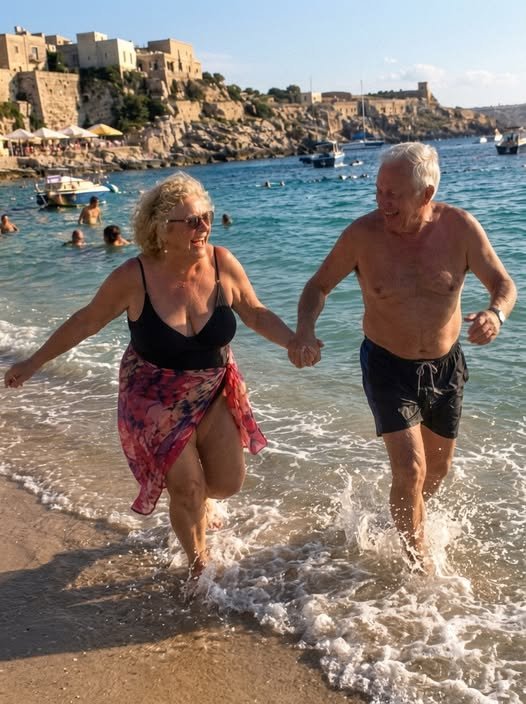
At the end of the night, he walked me to my hotel along the harbor, past the water moving black and slow under the stars. At the door, he took my hands.
“I’ll say it plainly this time,” he said. “I live at 14 Strada Marina. I have a terrible cello and a kitchen with one good pan. I’m seventy, and I’m still a little afraid of everything. And I would very much like to know you.”
“Yes,” I said.
He blinked. “Yes?”
“I made a vow, David. Seven days of yes.” I smiled. “I’m not stopping on the eighth.”
The letters began before my plane landed.
He wrote on thin blue paper, in handwriting that slanted like a tired fence. He told me about his mornings, the neighbor’s cat that kept stealing his sardines, the cello, which he’d taken up again out of sheer stubbornness. I wrote back about my garden, my daughter, and the first morning in forty years that I’d walked to the post office and not felt like I was apologizing for existing.
In October, he flew to me. He stood in my doorway in an overcoat too thin for an American autumn, carrying a lemon tree in a pot because he had heard I liked them. My daughter opened the door first. She looked at him, then at me, and said, “Mom, he’s exactly what you described.”
By spring, I returned to Malta. This time I stayed three months. Claire gave me a standing Tuesday table, the one by the lemon tree. I learned to say grazzi without sounding like a tourist, and to cook the fish Rosalind hated and the lemon cake she loved. David and I walked the harbor every evening. We argued about the best route. I always won.
On our second anniversary of that dinner, he took me to the same table. The waiter, Mateo, who had been calling me “Signora Margaret” for two years, set down two glasses of wine and, with great ceremony, one small dessert plate.
On it was a single lemon cake slice, and beside it, a tiny gold ring.
“I’ve been practicing this speech for six months,” David said. “I’m going to forget it. The short version is this. I’d like to be the person you say yes to for the rest of your life.”
I looked at him. This kind, nervous man in the string lights. And I thought of the woman who had boarded that first plane with a backward map and a trembling vow.
“Ask me again in one sentence,” I said, grinning, “so I can say it properly.”
He swallowed. “Margaret. Yes?”
“Yes,” I said, and I laughed, and so did he.
Behind us, in the doorway, Claire and Mateo and half the kitchen staff were crying openly into their aprons.
At sixty-seven, I had stepped outside my country for the first time, and I had been afraid of nearly everything. At sixty-nine, I understood that the vow had never really been about Malta.
It was about walking toward the doorway where someone’s voice was coming from, and stepping a little closer.