The knock was soft, almost shy.
Eleanor opened the door, and the cold came in, smelling of pine and snow. The tall man stood on her porch with a cardboard box in his arms and snowflakes in his hair.
“Mrs. Brooks,” he said. His voice broke on the second word. “Do you remember me?”
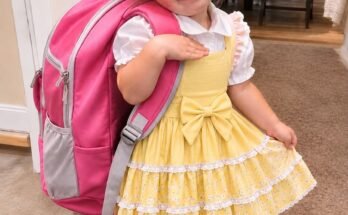
She studied his face, and the years peeled away. The missing tooth. The frayed backpack. The boy who had hidden under the reading table on the first day and refused to come out.
“Marcus Reyes,” she whispered. “Room 12. You hated the letter B.”
He laughed and wiped his eyes at the same time. “I still do. It looks like two fat bellies.”
“It does,” she said, and then they were both crying, and he stepped forward and hugged her carefully, the way you hug someone you are afraid to break.
They came in by the dozen.
She hadn’t known her small front room could hold so many. Former students filled the hallway, the staircase, the kitchen. Some she recognized at once: Tanya Gill, who’d bitten her nails to the quick, was now a pediatric nurse. Devon Okafor, who’d stuttered, now spoke at a full-throated boom. Others she had to look at twice, matching adult faces to small ones. Jenny. Ray. The twins, Abby and Cole. Each of them carried something: a covered dish, a poinsettia, a bag of presents wrapped in mismatched paper, a tray of cookies, a folding chair.
“We’re sorry we’re late,” said a woman near the back. “Thirty years late.”
Eleanor couldn’t speak. She stood in her own front hall with her hand over her mouth, while strangers who weren’t strangers filled her house with noise and warmth and the smell of cinnamon.
“Mrs. Brooks,” Tanya said, “we never forgot you. We just never knew how to say it. You don’t thank someone like you with a card.”
“How did you all find each other?” Eleanor managed.
Marcus held up his hand. The room quieted, and he set down his box on the kitchen table.
“That’s the secret,” he said. “That’s the part I need to tell you.”
He took a breath.
“Eight years ago, when Mr. Brooks passed, I saw the obituary online. I was living in Chicago. I’d just started a company. Software. I told myself I’d write to you.” He swallowed. “I didn’t. I was ashamed. I’d done well, and I hadn’t once called the woman who taught me to read.”
“Marcus,” she began.
“Let me finish, please.” His eyes shone. “Two years ago, I went back to Maple Hollow for a funeral. I drove past the school, and I stopped in the parking lot and just sat there. I thought, How many of us are there? How many kids did she teach, and what happened to them? So I did something about it. I hired a researcher. We found the old class rosters, one by one.”
He lifted the lid on his box.
Inside, bound in green cloth, were seven thick volumes. Each one was labeled with a decade. 1980s. 1990s.
“We found nine hundred and forty-three of your students,” Marcus said. “Three hundred and twelve wrote back. And every one of them told us the same thing.”
He opened the first book. Page after page held photographs, letters, and handwritten notes.
I’m a doctor now because Mrs. Brooks told me I could be.
I read to my kids every night because she read to us every afternoon.
She bought me a coat. I never told anyone. I bought one for a boy last winter.
Eleanor sat down hard in her kitchen chair.
“There’s more,” Marcus said, and the room, which had been murmuring, fell silent.
He took an envelope from his coat and placed it in her hands.
“After the letters came in, a lot of us wanted to do something. We started small. Then it grew.” He glanced around at the faces. “We formed a foundation. The Brooks Reading Fund. Over two years, we’ve raised nearly two million dollars.”
Her hands trembled around the envelope.
“It pays for reading specialists in schools like Maple Hollow. Free books for every first-grader. Winter coats for every child who needs one, no questions asked, and no one ever has to know who paid.” His voice cracked. “That’s your secret from all those years, Mrs. Brooks. Now it’s everyone’s.”
She opened the envelope. Inside was a deed to a small brick building on Main Street, newly renovated, with a sign already painted on the window: The Eleanor Brooks Reading Center.
“We’d like you to run it,” Marcus said, “if you’d like. Or just walk in and be there. Whatever you want. It’s yours.”
Nobody had expected the quiet that followed.
It was the kind of silence that holds a whole room’s breath. Eleanor looked at the volumes on the table, the faces in her kitchen, the snow falling soft against the window, and she felt something loosen inside her chest that had been tight for eight years.
“I thought,” she said, and had to stop. She tried again. “I thought nobody remembered. I thought a teacher was just a chapter.”
“A teacher,” Tanya said, taking her hand, “is the one who writes the first line of everyone else’s story.”
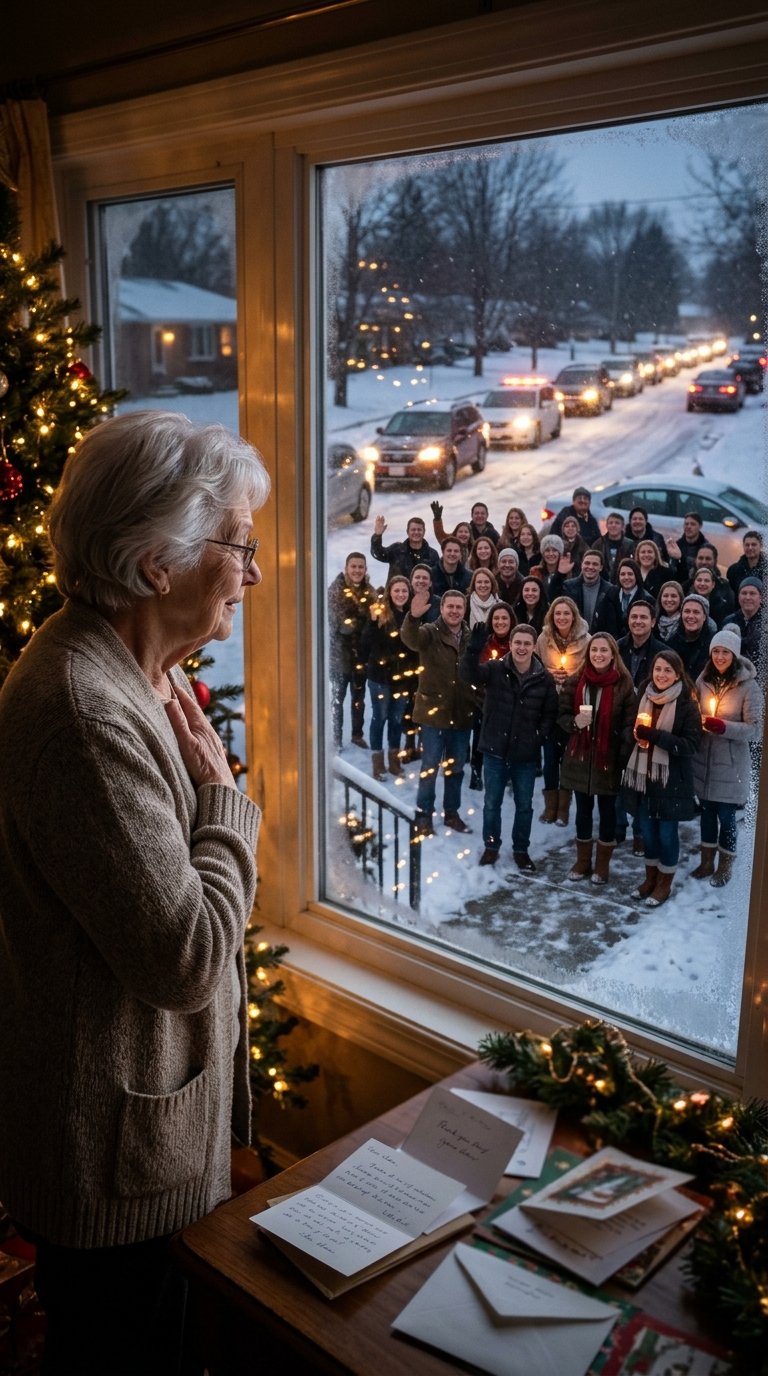
Somebody began to hum. A second voice joined, then a third, until the whole house was singing, a ragged, loving, out-of-tune carol that rolled out the open door and into the snow. The neighbors came to their porches. Somebody turned on the lights in her front yard that hadn’t been lit in years.
Eleanor sat in the middle of it, weeping and laughing, with a grown man’s hand on one shoulder and a child’s on the other. Marcus knelt beside her.
“Merry Christmas, Mrs. Brooks,” he said. “Thank you for the B.”
“Thank you for coming,” she whispered.
They stayed until midnight.
When the last car pulled away, Eleanor stood alone in the kitchen. The table was covered with gifts, books, flowers, and half-eaten pie. On the windowsill sat the shoebox of old letters, still tied with red yarn. She picked it up and held it against her chest.
Then she crossed the room to Walter’s photograph.
“Well, dear,” she said softly, her voice thick. “It wasn’t a quiet one after all.”
The snow kept falling outside. Every window on Larkin Street glowed, and one of them, the one at the end, glowed brightest.
In January, the Eleanor Brooks Reading Center opened its doors. On the first Monday, a seven-year-old boy with a missing front tooth walked in, clutching a book he couldn’t read.
Eleanor knelt beside him. “Hello,” she said. “I’m Mrs. Brooks. What do you say we start with the letter B?”