The funeral was held in Millbrook, in the small white church Henry had attended for fifty-six years.
Carol had expected a few cousins and neighbors. Instead, the pews filled and then overflowed. Farmers in clean overalls stood along the back wall. A woman whose barn Henry had helped rebuild after a fire. Two men who had worked his fields as boys, now gray and broad-shouldered, weeping openly. A teacher whose classroom he had stocked with garden seeds for decades.
Each one had a story. Each story ended the same way: He never let anyone leave empty-handed.
Brittany sat in the second pew, staring around in disbelief. “I didn’t know,” she whispered to Tyler. “I thought he was just… an old man.”
“So did I,” Tyler said, and his voice cracked.
Noah delivered the eulogy. He had written it on the back of a seed packet and abandoned it halfway.
“My grandfather taught me that dirt is alive,” he said. “He taught me that a family is like a garden. You can’t just plant it and walk away. You have to show up every morning and kneel down and get your hands dirty. I think most of us forgot that. I think he knew it and forgave us anyway.”
Nobody in the church was dry-eyed.
Three days later, the family gathered in the living room of Carol’s house. A lawyer named Mr. Dennison, a courteous man with silver hair and a worn leather briefcase, had driven up from Millbrook to read the will.
Greg checked his watch. Brittany scrolled her phone. Tyler slouched in the armchair. Carol sat on the edge of the couch twisting a tissue.
Noah sat in the corner, quiet.
“Mr. Henry Alder’s will is straightforward,” Mr. Dennison began. “He was very clear about his wishes. I’ll read them as written.”
He unfolded a single page.
“To my daughter Carol, I leave the contents of my savings account, in the amount of forty-two thousand dollars, with my love and my apology for being a stubborn father.”
Carol pressed the tissue to her mouth.
“To my son-in-law Greg, I leave my good toolbox, and I hope he finds time to use it.”
Greg looked startled, and then, unexpectedly, moved.
“To my granddaughter Brittany, I leave my late wife’s recipe box, and I hope she finds her way to the kitchen. Her grandmother would have loved to teach her.” Brittany’s face crumpled.
“To my grandson Tyler, I leave my father’s pocket watch, because he asked me what time it was a hundred times and I never got to tell him it’s always a good time to call your grandfather.”
Tyler let out a wet laugh and covered his eyes.
“And finally,” Mr. Dennison said, and paused, “to my grandson Noah Bennett, I leave my farmland. All two hundred acres, the house, the barn, and the north hill, which is worth more to me than all of it combined.”
The room went utterly still.
“Two hundred acres?” Greg said slowly. “In Iowa? That’s… Mr. Dennison, that land has to be worth over a million dollars.”
“Closer to one point four,” Mr. Dennison said. “There were developers who approached Mr. Alder repeatedly. He refused every offer.”
Brittany’s jaw dropped. Tyler stared at his younger brother as though he had never seen him before.
“There is a condition,” Mr. Dennison added. “Mr. Alder’s letter states it plainly. I’ll read it.”
The land is yours, Noah, not to sell, not to develop, but to keep. I have asked one thing of you, and you promised it, and I trust a promise from a boy who knelt in the dirt beside an old man when nobody else would. Keep the farm as a place where this whole family can always come home. Your mother. Your brother and sister. Their children someday. Let them forget who they are in the city. Let them remember it here.
To the rest of you, I hold no bitterness. I was an old man in a house where I did not quite fit, and you were busy and young. I understand it. But I want you to know I loved every one of you, even when you rolled your eyes at my stories. And I hope the farm will teach you what I tried to say at supper.
Land is only worth something if somebody loves it. So is a person.
Nobody spoke for a long time.
Brittany was crying quietly. “We called him useless,” she whispered. “I said it right in front of him.”
“He heard,” Carol said, her voice shaking. “He heard all of it. And he left us this anyway.”
Tyler wiped his face with his sleeve. “Noah. Man. I’m sorry. I’m so sorry.”
“It’s okay,” Noah said softly.
“It’s not. It isn’t.” Tyler’s voice broke. “I could’ve sat with him. I could’ve asked him one question.”
“He knew,” Noah said. “He told me once. He said you can’t resent someone for being busy. You can only invite them back.”
They drove to Millbrook together that Saturday, all five of them in two cars, and for the first time in years nobody was looking at a phone.
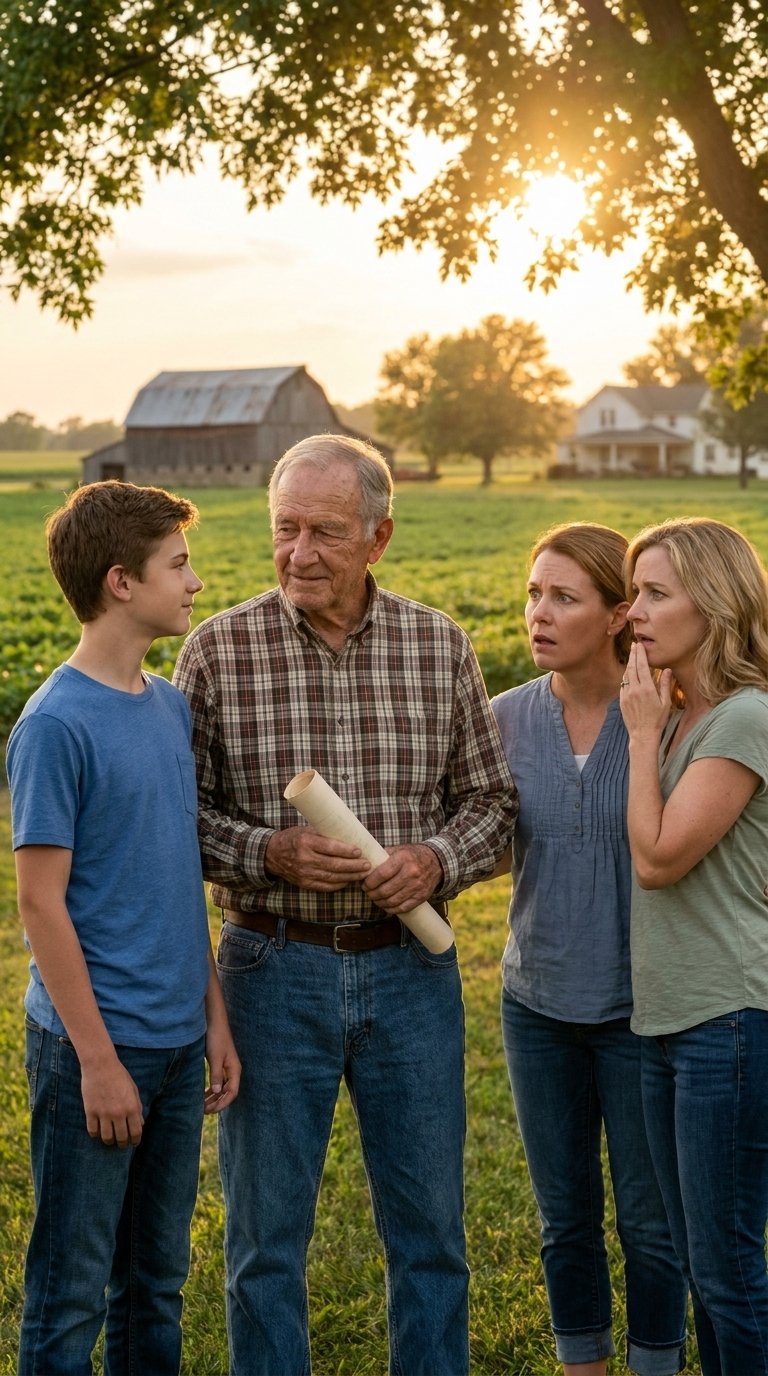
The farmhouse stood at the end of a gravel lane, white paint peeling, a porch swing hanging crooked from one chain. Fall had turned the fields golden. Behind the barn, the land rose gently toward a hill crowned with a single oak.
Noah led them up. The grass was dry and whispery under their feet. At the top, the whole valley opened below them, fields stitched together in gold and brown to the horizon, a creek winding silver through the middle.
“Grandpa said it looks like the ocean when the corn’s high,” Noah said.
Nobody answered. Carol had her hand over her heart. Greg, who had never said a sentimental word in his life, stood very still with his hat in his hands.
“I haven’t been up here since I was nineteen,” Carol said finally. “Mom and I used to bring picnics.”
“I know,” Noah said. “That’s why I’m not selling it.”
He took the coffee can from his backpack, the one Henry had carried in on the first day, and pried off the lid.
“There are enough seeds in here for next spring,” he said. “I don’t know how to farm two hundred acres. I’m going to learn. I’m going to rent most of it to the Hendersons next door, and keep the garden and the house. And I’m going to fix the porch swing.”
“We’ll help,” Brittany said instantly. “I mean it, Noah. Let us help.”
“I was hoping you’d say that.”
The next spring, they planted the first rows together. Brittany moved into the farmhouse for the summer and learned her grandmother’s recipes from the stained cards in the box, burning half of them. Tyler fixed the barn roof with Greg, who finally used the good toolbox. Carol cleaned out the kitchen and cried over every drawer. Noah rose at four every morning, made coffee, and stood at the window as the sun came up over the fields.
On the Fourth of July, the whole family came home. Cousins, aunts, neighbors, and a long table set beneath the oak at the top of the hill. Somebody played a guitar. Somebody burned the corn. Children chased each other through the rows.
Noah stood at the edge of it all, watching, the dirt still under his fingernails.
Everybody came home to that farm, Henry had said. Nobody had to be anything. They just had to show up.
He looked toward the north hill, where the grass swayed gently in the wind, and in the golden evening light he could almost see an old man in a straw hat kneeling in the soil, smiling.
“We showed up, Grandpa,” Noah whispered. “All of us.”
The wind moved through the oak, and the marigolds along the fence nodded their orange heads, and the valley below glowed like the ocean.