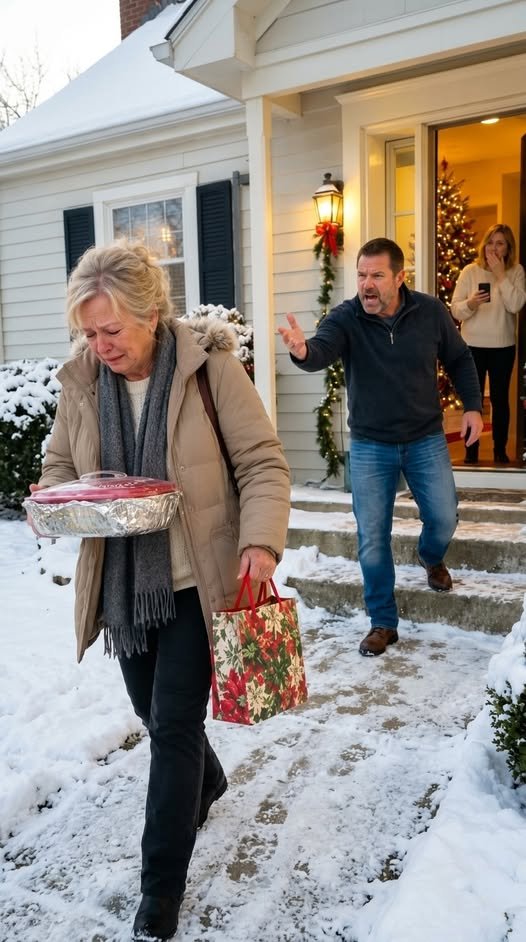
I let the phone ring a fourth time that morning before I answered. The coffee had gone lukewarm in my hands, and the kitchen was bright with winter sun, the kind of light that makes everything look forgiving. I did not feel forgiving. I felt calm, which was stranger.
“Mom.” Daniel’s voice was ragged. “Thank God. What did you do?”
“Merry Christmas, Daniel.”
“Don’t. Don’t do that. The mortgage payment bounced. The tuition draft failed. The business account is overdrawn, and Claire’s parents are sitting here…”
“I know. I read your voicemail.”
“Then fix it! Whatever this is, undo it. You can’t just turn it off on Christmas.”
“I can,” I said. “I did it on Christmas Eve, after you told your wife I was trying to buy a seat at your table.”
Silence. I could hear the house behind him: a child asking something, a woman’s sharp whisper, a door closing.
“I was drunk,” he said finally. “I didn’t mean it.”
“You meant ‘wrong house,’ and you were sober when you said that.”
He did not answer.
“I’m going to hang up now,” I said. “If you want to talk, come to my house. Not to the door. To the table. I’ll make coffee.”
I ended the call and sat very still. My hands were shaking, and I let them.
He did not come that day. He did not come the next, either. But on the twenty-seventh, a small knock sounded at my front door, and when I opened it, my granddaughter Emma stood on the porch in her puffy purple coat, nine years old, holding something wrapped in a dish towel.
Behind her, at the curb, a car idled. Claire’s mother sat at the wheel, looking at her hands.
“Grandma,” Emma said. “Can I come in?”
“Of course, sweetheart.” I knelt and hugged her. She smelled like cold air and cinnamon. “Does your mother know you’re here?”
“Grandma Joan drove me. She said I should bring you this.” She held out the bundle. Inside the towel was a slice of pie, slightly crushed. “Mommy made two. She said you weren’t coming, so we didn’t need the second one.”
I laughed and then, unexpectedly, my eyes stung.
“Grandma,” Emma whispered, “who was at the door on Christmas Eve? Daddy said nobody. But I looked out the window. I saw your car.”
I had spent three days preparing for every conversation except this one.
“It was me, sweetheart,” I said.
Her face crumpled. “Why didn’t he let you in?”
I looked at this small, serious child, and I made a decision. I would not poison her against her father. But I would not lie to her either.
“Because your daddy made a mistake,” I said. “A big one. He’s an adult, and sometimes adults are unkind when they’re afraid or ashamed. It wasn’t about you, and it isn’t your fault.”
“Are you still going to come on Sundays?”
“I would love to. But not until your daddy and I talk.”
She nodded slowly, with a gravity far beyond her years. Then she took my hand and said, “I’ll tell him that.”
It was Claire’s mother, Joan, who came back alone the next afternoon.
She sat at my kitchen table, a tidy woman in her sixties with a wool coat and a face that looked as if it had not slept. She declined coffee and then accepted it.
“Margaret, I owe you an apology. I didn’t know what Daniel did until Emma told me in the car. I would have come out myself.” She wrapped both hands around the mug. “I thought you were ill. They told us you’d decided not to come. Claire said you’d had a falling-out with Daniel and didn’t want to be around the family.”
“They said that?”
“They did.” Joan’s mouth tightened. “I’ve been sitting on the couch for three days listening to my daughter and son-in-law argue about money. Do you know what I heard? Not once did either of them say, ‘We should call her and say sorry.’ It was always, ‘How do we get her to turn it back on?'”
I stared into my coffee.
“I raised Claire better than that,” Joan said quietly. “Or I thought I did. I’m ashamed. I wanted you to know that I’m not like them. And that Emma and Lucas are the only reason I’m here.”
“Thank you, Joan.”
“There’s something else.” She hesitated. “Daniel took out a second loan against the house last year. Claire’s father found the paperwork. They’ve been using your money to cover the interest.”
My cup stopped halfway to my lips.
“I thought the automatic payments were going toward the mortgage,” I said slowly. “The principal.”
“Part of them were. The rest were… elsewhere. A boat, I think. And a trip to Cabo that Claire’s father believed was a work conference.”
I set the cup down very carefully.
For fourteen years, I had never asked for a ledger. It had never crossed my mind that I should.
I opened my laptop that evening and did what I should have done years ago. I read every statement. It took four hours and two pots of coffee.
When I finished, I did not feel rage. I felt something closer to grief, as though I had been mourning the wrong person for a very long time.
I called my attorney, Mr. Feldman, the next morning. He listened without interrupting, the way good lawyers do.
“Margaret,” he said finally, “you’ve been extremely generous, and none of it was a loan, so you have no legal claim to recover it. But nothing says you must keep giving.”
“I know.”
“What do you want?”
I thought about it for a long moment. “I want my grandchildren to be safe. I want my son to understand what he did. And I want to stop being an account.”
“Then let’s put it in writing,” Mr. Feldman said.
Daniel came on New Year’s Day.
He stood on my porch in a rumpled coat, unshaven, his eyes red. He did not carry a gift. He did not ask to come in. He just stood there with his hands at his sides, the way he used to as a boy when he had broken something and was waiting to be found out.
“Mom,” he said. “I’m sorry.”
“For what, exactly?”
He swallowed. “For Christmas Eve. For saying it was the wrong house. For what I said on the phone. For…” His voice cracked. “For all of it. For the boat. For the loan. Joan told me she told you.”
“Come in, Daniel.”
We sat at the kitchen table, the same table where he had done homework, spilled juice, announced his engagement. I slid a folder across to him.
“This is what’s going to happen,” I said. “I will not restart the automatic payments. I will pay Emma’s and Lucas’s school tuition directly to the school, every term, as long as they attend. I will not pay your mortgage, your business, or your insurance. If a real emergency comes, you may ask me, and I will decide, and you will tell me the truth about where the money goes.”
He stared at the folder. “Mom, we can’t afford…”
“You can afford a boat, Daniel.”
He flinched.
“I’m not punishing you,” I said, more gently. “I’m finished enabling you. There is a difference, and I hope you’ll learn it.”
He covered his face with both hands, and his shoulders shook. I had not seen my son cry since he was eleven.
“I treated you like a wallet,” he whispered. “And I told myself you didn’t mind. That you wanted to. Because it was easier than admitting I was ashamed of needing you.”
“You never had to be ashamed of needing me,” I said. “You only had to be kind.”
“I know. I know that now.” He lifted his head. “Can I ask you something?”
“Yes.”
“Why didn’t you just yell? On Christmas Eve? On the porch?”
I thought about it honestly. “Because I wanted to be sure you meant it. If I had screamed, you could have told yourself I was the problem. I wanted you to hear the quiet.”
He nodded slowly, as if that were the truest thing anyone had ever told him.
It did not heal overnight. Healing seldom does.
Daniel sold the boat in February. He and Claire went to a financial counselor, and then, to my surprise, to a marriage counselor. Claire called me in March. She did not apologize well, but she did say, “I laughed, and I shouldn’t have,” which was more than I expected. I accepted it as a beginning.
By spring, they had moved into a smaller house. Daniel took a second job on weekends. He called me every Sunday, and the conversations were awkward at first, then less so. He asked about my garden. He asked what I was reading. He never once asked for money.
On the following Christmas Eve, I stood on his porch again with a turkey dish in my hands and a bag of gifts.
This time, the door opened before I could ring the bell.
Daniel stood there in a sweater and socks, smiling, the whole house glowing behind him. “Mom,” he said. “You’re late. We’ve been holding dinner.”
“Was I invited?” I asked.
“You always were,” he said, and his voice broke. “I just forgot how to say it.”
Emma came barreling down the hallway and flung her arms around my waist. “Grandma! I saved you the seat by the window!”
I stepped inside. The tree was lit, the table was set, and at the head of it was an empty chair with a little paper card on the plate. Emma had drawn it herself, in crooked red crayon: Grandma. Reserved.
I sat down, and my son poured me a glass of wine, and for the first time in a long while, nobody was counting anything at all.