“You don’t understand what you’ve done,” Julian said again through the door.
“I understand perfectly,” I said. My voice shook, but it carried. “Step away from the door, Julian.”
“Mom, please. Let me explain.”
“You can explain to the police.”
For ten seconds I heard only his breathing. Then Victoria’s voice came from the hallway, sharp and fast. “Julian, the car. Now.”
Their footsteps pounded toward the front door. An engine started. Chloe flinched against my shoulder, and I rocked her the way I had rocked her father forty years ago.
“They’re leaving, baby. They can’t hurt you.”
The sirens arrived within minutes. By the time the paramedics reached the laundry room, the driveway was flooded with red and blue light. One of them, a woman named Dana, took Chloe from my arms with careful hands and murmured, “Hi, sweet girl. We’ve got you.”
Chloe looked back at me over her shoulder. “Grandma, don’t go.”
“I’m riding with you,” I said. “Every second.”
At Lurie Children’s Hospital, the doctors worked through the night. Her fever was 104.2. Her blood showed a heavy dose of sedatives, a combination no child should ever have in her system, and she was badly dehydrated.
Detective Rosa Alvarez sat with me in the corridor at dawn. She was calm and precise, and she wrote everything down.
“Mrs. Hale, the officers found a Lincoln registered to your son abandoned near O’Hare. They were trying to reach a flight. Both were arrested at the gate an hour ago.”
I stared at my hands. “Why? Why would they do this to their own child?”
“That’s what we’ve been piecing together,” she said. “And I’m afraid it’s worse than a single night.”
It came out over the following days, in fragments, then in a flood.
Julian had lost his job at a financial firm two years earlier. He hadn’t told me. He had been gambling, first small, then desperately, and eventually he had borrowed from people who did not send polite letters. By last spring he owed nearly four hundred thousand dollars.
Victoria had found a solution.
Chloe’s life insurance policy, taken out when she was born, had been increased twice in the past year. Two and a half million dollars. In addition, my late husband had left a trust for his only grandchild, which would pass to her parents if she died before she turned eighteen.
“They didn’t plan to kill her at first,” Detective Alvarez told me carefully, a week later. “They planned to fake it. They had help.”
The help was a physician named Dr. Gordon Pruitt, a former pediatrician who had lost his license six years earlier. Julian had known him from the gambling circles. Pruitt owed money too. For a share of the payout, he forged a death certificate and arranged with a funeral home employee, also in debt, to move Chloe’s “body” into the casket and keep the viewing closed to everyone except family.
“The plan was to let the funeral happen,” Alvarez said. “Cremation wasn’t scheduled until after the service. They intended to retrieve her afterward and leave the country with her.”
“Retrieve her,” I repeated. “From a casket.”
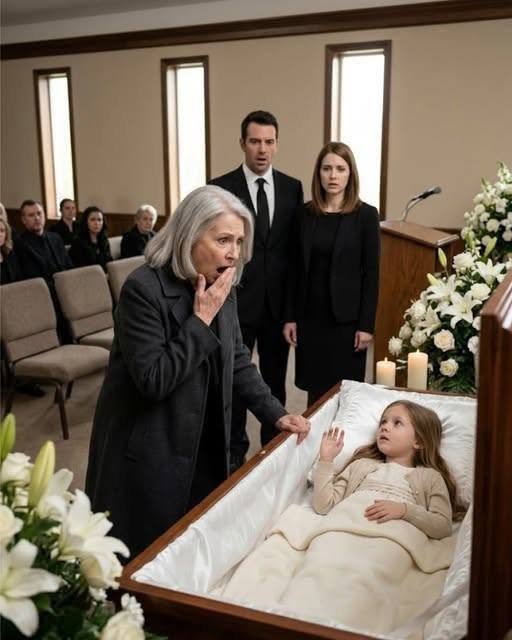
“They’d been sedating her for weeks to prepare. That’s what the fever was. Her body was fighting an infection while they kept her drugged. Mrs. Hale, if you hadn’t opened that lid, she would have been sealed into a crematory chamber.”
I put my hand over my mouth. For a long moment I couldn’t hear anything.
“And what Chloe said,” I managed. “That Daddy told her if she woke up she’d ruin everything.”
Alvarez’s face softened. “That was Julian’s script. He told her to be quiet and still, that it was a game, and that if she woke too soon, Mommy and Daddy would lose their home. A six-year-old heard that and tried to protect them.”
I cried then, the way I hadn’t at any point that night. Not because I had saved her, but because she had tried so hard to save them.
Chloe woke fully on the fourth day.
I was sitting beside her bed when her eyelashes fluttered. She looked around the room, at the monitors, the stuffed rabbit a nurse had given her, and then at me.
“Grandma,” she said. “Am I in trouble?”
My heart cracked straight down the middle.
“No, my darling. You are the bravest girl I’ve ever met. You did everything right.”
“I stayed quiet.”
“You did. And then you spoke up, and that’s the reason you’re here.”
She considered this with the solemn expression she’d had since she was a toddler. “Are Mommy and Daddy mad at me?”
I took a long breath. “They can’t be mad at you. They’re not coming to see you for a very long time. And when they do, it’ll be because you want them to.”
“Okay.” She picked at the blanket. “Can I stay at your house?”
“Forever, if you like.”
Julian pleaded guilty to conspiracy, child endangerment, and insurance fraud. He received twenty-two years. Victoria, who had administered most of the sedatives, received twenty-eight. Pruitt and the funeral home employee were each sentenced to more than a decade.
Julian wrote me a letter from prison. I read it once, standing in my kitchen, and then I put it in a drawer. He wrote that he had been drowning and that it had all spun out of control. He wrote that he loved his daughter. I believed him, and it made no difference. Loving someone is not the same as protecting them.
I did not forgive him that year. I’m not sure I ever will.
Chloe was in therapy for two years. She slept with the light on. She flinched at closed doors. For months she wouldn’t let me leave a room without telling her where I was going and when I’d return.
But children are astonishing things. In the spring, she planted tulips with me in the front yard. By summer she was riding a bicycle, and by fall she had traded the stuffed rabbit for a battered library copy of Charlotte’s Web, which she read aloud to me every night.
On the first anniversary of that terrible night, I found her in the garden at dusk, kneeling by the tulip bed.
“I used to think being good meant being quiet,” she said without turning around.
“And now?”
She looked up, her face lit gold by the fading sun.
“Now I think being good means telling the truth, even when you’re scared.”
I sat down on the grass beside her and pulled her into my lap, taller and heavier than she’d been a year before, and alive in every bone.
“That’s exactly right,” I said.
She leaned her head against my shoulder.
“Grandma?”
“Yes?”
“I’m glad you opened the lid.”
I held her tighter and watched the first stars come out over our small quiet yard.
“So am I, my love,” I whispered. “So am I.”