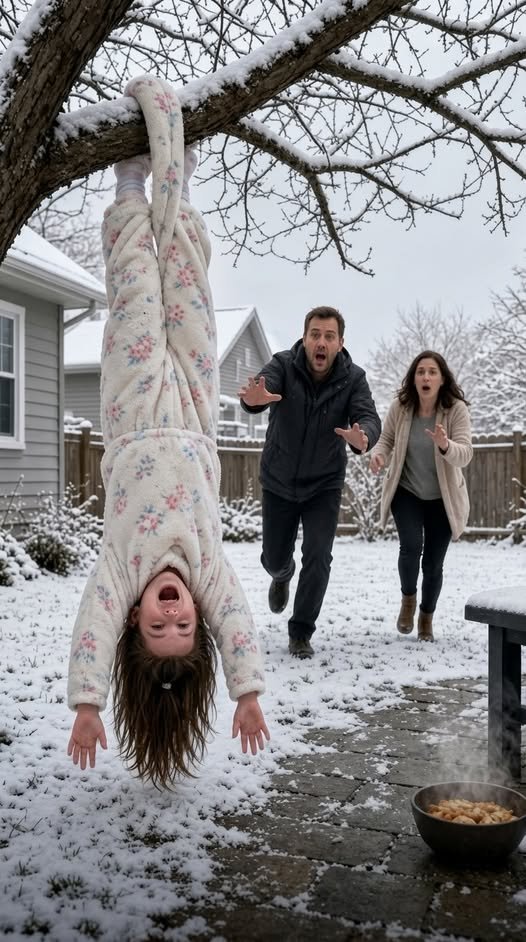
The officer’s name was Daniel Reyes. He set his phone on the rolling table beside the bed, turned the volume low so it wouldn’t wake her, and said, “You should see this before anyone tells you what it means.”
The timestamp read 4:12 p.m., more than an hour before I got home.
The camera belonged to our neighbor, Mrs. Okafor, and it looked straight across the fence into our backyard. The picture was grainy but clear enough. Our daughter stood on the patio in her pajamas and one sock, swaying slightly. Even on a tiny screen I could see the flush of fever in her face.
My wife stood over her, pointing at the ground. There was no sound, but I didn’t need any. I watched my daughter’s shoulders shake as she tried to say sorry.
At 4:19, my wife grabbed her by the ankles and lifted.
I stopped breathing.
She held our daughter upside down, the way you might hold a rag over a sink, and our daughter’s hair hung toward the concrete. My wife checked her phone with her free hand. She actually checked her phone. Then she spoke to our daughter again, bending close, and when our daughter reached up and clawed at her arm, my wife dropped her.
It wasn’t a fall. She let go, and our daughter hit the edge of the stone planter on her left side and crumpled. The sound she made didn’t need audio.
“That’s when the ribs went,” Reyes said quietly. “Not before. Not a tumble. The video is time-stamped, and it’s the only fall that happened today.”
I pressed my fist against my mouth.
On the screen, my wife stood there for a few seconds. Then she did something that made my stomach turn. She looked over the fence. She scanned the neighboring windows, checking whether anyone had seen. Satisfied, she picked our daughter up by the ankles again and hung her there, crying and gasping, for what the timestamp said was eleven more minutes.
Mrs. Okafor’s camera captured everything until my car pulled into the driveway. My wife heard it too. Her head snapped toward the sound, and she tried to set our daughter down gently, almost tenderly, as if she could erase the last half hour. But our daughter was too hurt to stand. That was why she was still outside when I opened the back door.
“There’s more,” Reyes said. “Mrs. Okafor also sent us clips from the past two months. She said she didn’t know what she was looking at until today.”
He didn’t play them for me. He didn’t have to. He told me there were four: a child kept outside in the cold in a thin shirt, a child dragged by the arm across the grass, a child made to kneel on the patio for an hour. There were dates and times. Every one of them was a day I had been at work.
I sat down hard in the plastic chair. Every time I’d told myself it was only a temper, every time I’d said she’s stressed, she’s tired, it’ll pass, I had been a man standing in the doorway of a room he refused to enter.
“This isn’t your fault,” Reyes said, as if he’d read my face.
“I should have seen it.”
“She worked hard to make sure you wouldn’t.” He paused. “But you saw it today. That’s what matters to the court, and it’s what matters to her.”
He nodded toward the bed.
My wife was arrested that evening at our house, where she had been telling anyone who’d listen that I was a liar who had ruined her life. When they played her the video, the officers told me, she said nothing at all. She just stopped talking.
She was charged with felony child abuse and aggravated assault on a minor. The prosecutor later told me the video, the medical report, and my 911 call formed a case that barely needed a trial. Her lawyer advised a plea. She took it eight months later and received a prison sentence, followed by years of supervised probation, with a permanent protective order barring contact with our daughter unless a court decided otherwise, and no court was ever likely to.
The divorce I had signed earlier that day was finalized in under three months. I received full custody.
Our daughter spent four days in the hospital. The fever broke on the second night. The ribs would take six weeks to heal. The rest would take longer.
For a while she wouldn’t let me close the back door. She’d flinch if I raised my voice at a driver on the road. She slept with my coat over her blanket, the same coat I’d wrapped around her that night, and when I tried to wash it, she cried until I handed it back.
We saw a child therapist named Ms. Lindqvist, who used drawings and stuffed animals and never once rushed my daughter. In the fourth month, my daughter drew our house with no one standing outside it. Ms. Lindqvist smiled at me across the room, and I had to leave to collect myself in the hallway.
Mrs. Okafor came to the door one afternoon with a plate of cookies and red eyes. “I should have called sooner,” she said. I told her what Officer Reyes had told me: that she was the reason my daughter was safe. She cried, and so did I, and my daughter watched us from the stairs and then came down and hugged her, carefully, on her healed side.
Last winter, it snowed for the first time in years. I found my daughter at the window, still, and I knelt beside her, ready to say whatever she needed.
“Daddy,” she said, “can we go outside?”
I hesitated. “Are you sure?”
She nodded and took my hand. We stepped onto the back patio together, and I held the door open behind us so she would always know she could go back in. The flakes landed on her eyelashes. She stuck out her tongue, giggled, and for one perfect moment the cold was just cold.
“It’s okay now,” she whispered, mostly to herself.
I pulled her close, wrapped my coat around her shoulders, and said what I should have said every day before that one.
“I’ve got you. I’m never letting go.”