The officer’s hand stayed between Miranda and me.
“Ma’am, step back,” he said. “I’ll let the girl speak first.”
Miranda’s smile flickered. “Officer, she’s been coached. My father-in-law has hated me since the wedding.”
“Ma’am. Back.”
The second officer, a woman whose name tag read Hollis, crouched to my level on the porch. She didn’t ask whether I was lying. She asked, “Nora, can you tell me why you’re wearing long sleeves in June?”
My throat closed. Behind me, Grandpa didn’t touch me or push me. He just stood there, the way he used to stand at the end of a rail yard platform, solid enough for a whole train to pass around.
So I told her. The grabbing in the hallway where Dad’s camera didn’t reach. The hairbrush. The nights she locked my door from the outside. The way she pressed her thumb into my ribs where a shirt would cover it and whispered, Nurses know where it doesn’t show.
When I finished, Miranda said, “None of that can be proven.”
“That’s the thing about my rules,” Grandpa said, almost gently. He took his phone from his pocket. “Last night, when I walked upstairs, I started a recording. I kept it running through the entire conversation on that landing.”
Miranda went still.
He pressed play. Her voice filled the porch, clear and cold: “She bruises easily. If she tells Daniel, I’ll say she’s lying for attention.” Then, lower, in the voice I knew from inside my bedroom: “You’re making a mistake.”
Officer Hollis looked up at Miranda. “That’s a threat toward a child, and an admission that you knew about the marks.”
“That’s out of context,” Miranda said, but her voice had thinned.
“There’s more,” Grandpa said. “I spent last night on the phone. Daniel is on his way home from his shift, and I told him everything. Then I called the pediatric center at Dayton Children’s. They said to bring her straight in.”
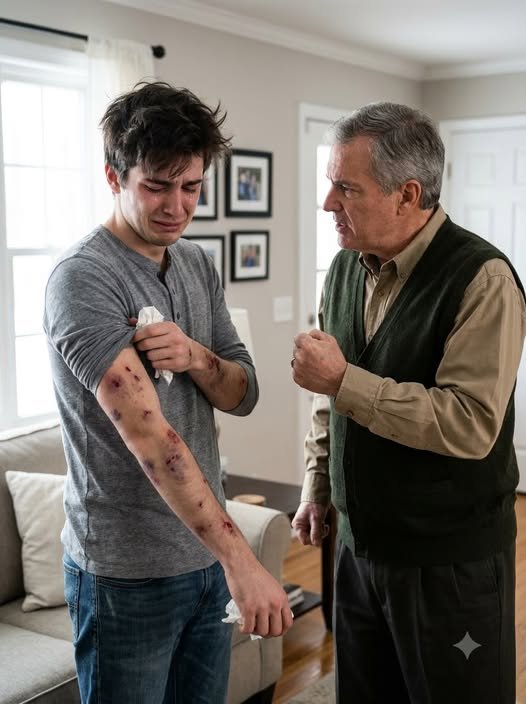
The forensic exam took three hours. A doctor named Dr. Patel and a kind social worker named Ms. Brandt documented everything with photographs, measurements, and a body map. Dr. Patel explained, in a voice I could tell she’d practiced for scared kids, that bruises from a bike fall land on elbows and knees, not in clusters along the ribs and upper arms. Some were different ages, healing at different stages. Two, she said, matched the shape of fingertips.
Dad arrived halfway through, still in his work scrubs, his face gray. He dropped to his knees in front of my chair and said, “I’m so sorry. I’m so sorry I didn’t see.” I’d spent weeks rehearsing how to tell him. I’d forgotten that he might cry.
“She told me you wouldn’t believe me,” I whispered.
“I believe you,” he said. “I will always believe you. Always.”
That afternoon, Ms. Brandt asked Dad one more question: whether any cameras in the house might help. He went pale. Then he remembered. Months earlier, after a break-in down the street, he had installed a small security system with an indoor camera in the upstairs hall, and he’d never told Miranda because he’d forgotten it recorded to a cloud account. He’d never looked at the footage once.
Hollis and a detective reviewed it that evening. Seven weeks of it. The hallway, the landing, the door to my room. The audio was faint but usable. Miranda grabbing my arm. Miranda dragging me back inside. Miranda standing at my bedroom door, locking it, and walking away.
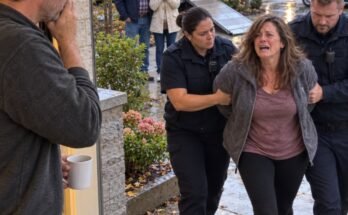
She was arrested that night at the house, in the same blue robe, still insisting she was the victim. The detective also contacted Miranda’s former employer, a hospital in Columbus. A quiet complaint had been filed three years earlier by a coworker who’d seen Miranda being rough with a patient’s child. It had been dismissed for lack of evidence. This time there was evidence. The state nursing board suspended her license within the month.
She was charged with felony child endangerment, domestic violence, and unlawful restraint. Her attorney tried to argue the recordings were illegally obtained. They weren’t. Ohio allows a recording if one party consents, and Grandpa, who was in the conversation, had. After eight months of hearings, she accepted a plea. She received a prison sentence, followed by probation, with a permanent no-contact order and a loss of any parental rights.
Dad filed for divorce the same week. He also cut his hours. The night shifts ended, and he took a job at a clinic near home so he’d be there when I woke up and when I went to sleep.
I lived with Grandpa for four months while the house was cleaned out, repainted, and stripped of everything that had been hers. I slept on the couch under the cedar quilt, even though he’d made up a real bed. He never mentioned it.
My therapist, Ms. Carter, taught me that fear isn’t weakness. It’s just the body remembering something the mind has already decided to survive. I learned to say no, to say stop, to say that hurts, and to be believed each time.
The bruises faded within weeks. The rest took longer, and I’m told it’s still taking its time.
This past fall, Dad and I moved back into our house. My room has a new door, and the lock works from the inside only. Grandpa installed it himself, grumbling about the cost of decent hardware, and then he stood in the doorway for a long minute.
“Rules,” he said. “House rules. Number one. Anyone who lives here keeps the lights on for the ones who are scared.”
“Number two?” I asked.
“Nobody gets to be quiet about hurt.” He rubbed the back of his neck. “Not you. Not me. Not your father.”
“Number three?”
He smiled, and it reached all the way to his eyes. “Pancakes on Sundays.”
That Sunday, the three of us sat in the yellow kitchen light, the same light where Grandpa had once stood, still and cold, looking at my arm. I reached for the syrup. My sleeve slid up, and there was nothing under it.
Dad reached across the table and squeezed my hand. Grandpa pushed the plate toward me. And for the first time in my life, in that house, I ate without listening for footsteps.